
🚫 Areas to avoid in Paris: an honest guide for tourists
🚫 Which areas should you avoid in Paris? It is one of the questions I get asked most often before a first trip, right after “how many steps does the Eiffel Tower have?”. And it is easy to see why: on social media you read everything and its opposite. One day Paris is a no-go city, the next day it is a flawless postcard.
The reality is much simpler and much more reassuring. Paris has no “no-go zone” for tourists. There are, however, a handful of areas, mostly around some train stations, a few of the city’s outer gates (“portes”) and very busy metro hubs, where you should keep your eyes open, especially at night. And by far the main risk is not assault: it is pickpocketing and small scams.
In this guide I go through what you really need to know, area by area: Gare du Nord, Gare de l’Est, Gare de Lyon, Montparnasse, Châtelet, Barbès, Stalingrad, Pigalle, Place des Fêtes… I tell you honestly where to be careful, at what time of day, and above all which neighbourhoods have a bad reputation they do not really deserve. The goal is not to scare you, but to help you travel with peace of mind.
🧳 My personal experience
I have lived in Paris and walked its streets for years, at all hours, and I have never been attacked. I did, however, have my phone stolen once… on a very smart café terrace, a stone’s throw from the Grands Boulevards, while it lay on the table and I was reading the menu. A young man came up holding out a sheet of paper “for a charity”, put it down on top of my phone and walked off with both. It took five seconds. My big mistake: believing that thefts only happen in “bad neighbourhoods”.
On the other hand, some places my foreign friends were wary of, like Belleville, the Goutte d’Or in the daytime or Place des Fêtes, have become some of my favourite walks: amazing markets, cheap restaurants and a real neighbourhood life. My advice: do not cross an area off your map because of its reputation. Adapt your behaviour to the time of day and the crowds instead. That is what really makes the difference.
📋 Key facts at a glance
| ⚠️ Main risk in Paris | Pickpocketing (phones, wallets) and street scams, especially in crowds |
| 🚉 Most sensitive areas | Around Gare du Nord and Gare de l’Est, Stalingrad, La Chapelle, Barbès, Porte de la Chapelle, Châtelet-Les Halles at night |
| 🌙 When to be extra careful | Late at night (after 11 pm), in empty metro corridors and on RER platforms |
| 🎭 Bad reputation but pleasant | Montparnasse, Belleville, Place des Fêtes, Goutte d’Or in the daytime, the 13th, the 19th around Buttes-Chaumont |
| ✅ Quietest areas to stay in | Le Marais, Saint-Germain-des-Prés, 7th (Invalides), 15th, 16th, Latin Quarter, Opéra |
| ☎️ Emergency numbers | 17 (police), 112 (European emergency number), 15 (ambulance), 114 (by text message) |
| 🥾 Overall risk level | ⭐⭐☆☆☆: comparable to other major European capitals |
📍 Is Paris really dangerous?
Paris is a very dense city that welcomes tens of millions of visitors every year. Wherever there are lots of tourists, suitcases and phones in hand, there are bound to be thieves. That is true of Paris just as it is of Rome, Barcelona or London. Serious violence against tourists remains rare, and it mostly happens late at night in particular situations (alcohol, fights, being alone in an empty place).
The key thing to remember is that danger in Paris depends less on the neighbourhood than on three factors: crowds (a pickpocket’s best friend), the time of day (some areas that are lively in the daytime feel less reassuring around midnight) and your behaviour (phone left on the table, open bag, looking lost in front of a map). The same pavement can be perfectly pleasant at 3 pm and a little more tense at 1 am.
For an overview, you can also read our article Is Paris dangerous?, which looks at general safety in the capital.
Tip: the “riskiest” places for a tourist are often the most beautiful ones: the Eiffel Tower, Sacré-Cœur, the Louvre, the Champs-Élysées. Not because they are dangerous, but because they attract pickpockets. Keep your good habits everywhere, not only in areas with a bad reputation.
🚉 Paris train stations: where you really need to stay alert
If you only remember one piece of advice from this guide, make it this one: vigilance matters most in and around the big train stations. Suitcases, travel fatigue, eyes glued to the departure boards: it is the perfect playground for thieves. We have a full article on Paris stations to avoid; here are the essentials.
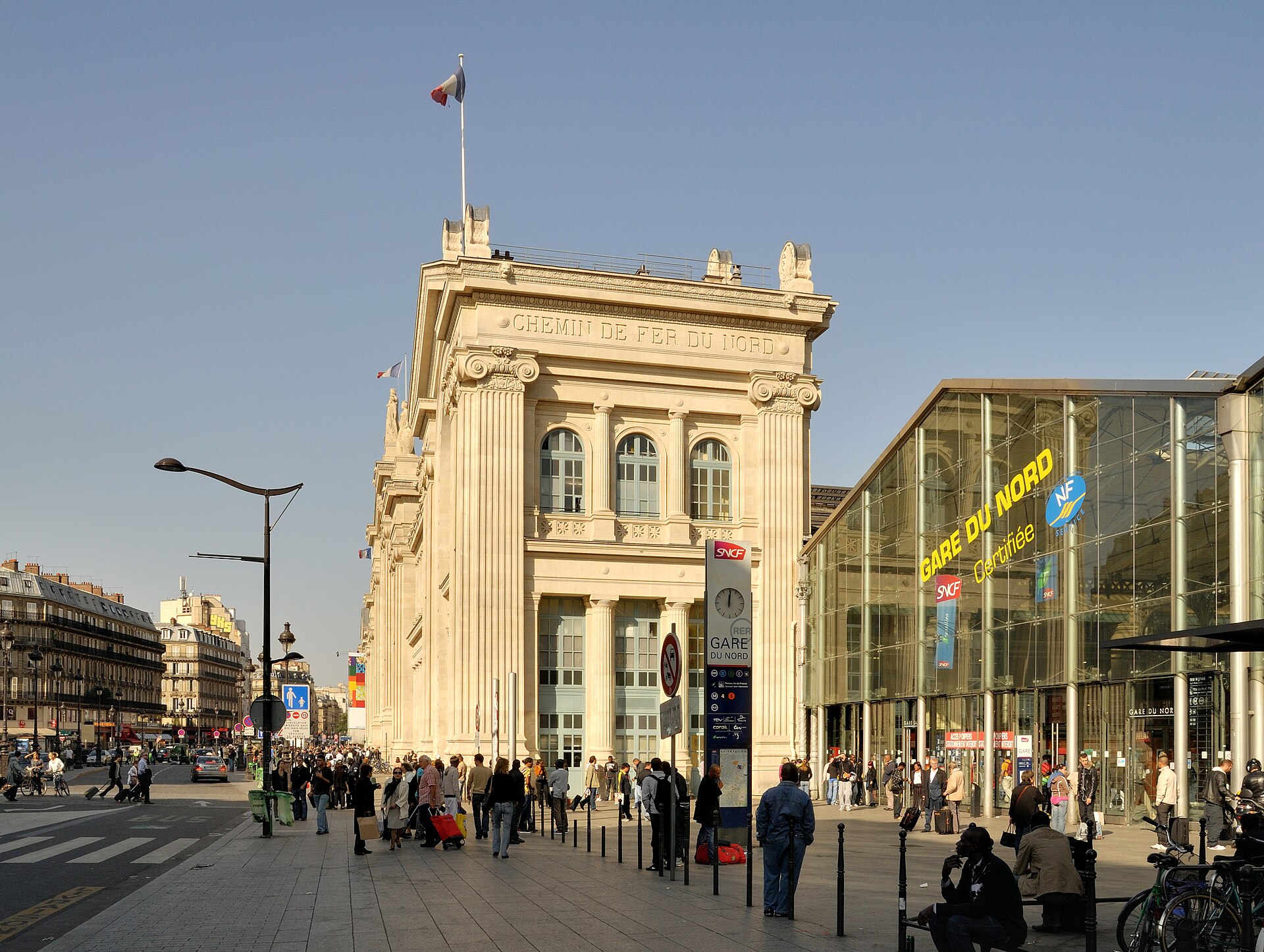
➡ Gare du Nord (10th): the most sensitive
Gare du Nord is the busiest train station in Europe: Eurostar to London, Brussels and Amsterdam, RER B to Charles-de-Gaulle airport, RER D, metro lines 4 and 5. So it is also the place where thefts and scams are most frequent. Inside, there is a strong police presence and daytime visits usually go smoothly. The surrounding streets, however, can be less pleasant: street vendors, people offering to “help” you with tickets, fake taxis, and a tenser atmosphere in the evening, especially on the boulevard de Magenta and rue de Maubeuge side.
- Never accept unsolicited help from a stranger at the ticket machines.
- Only take a taxi from the official taxi rank (Paris taxis with a “TAXI PARISIEN” roof light).
- On the RER B, keep your bag closed and in front of you, especially at stops.
➡ Gare de l’Est (10th): same caution, calmer atmosphere
Next door to Gare du Nord, Gare de l’Est is calmer and smaller. The same precautions apply in the concourse and on the forecourt, and the area between the two stations (rue d’Alsace, rue La Fayette) is best crossed with a purposeful step at night. In the daytime, it is also the gateway to the Canal Saint-Martin, one of the nicest corners of Paris.
➡ Gare de Lyon (12th): very busy but generally safe
Many readers ask us whether Gare de Lyon is dangerous. The answer is: not really. It is huge and packed, especially on Friday evenings and during school holidays, so pickpockets are around, as in any major station. But the surrounding area (12th arrondissement, avenue Daumesnil, Bercy) is residential and quiet. The station’s restaurant, Le Train Bleu, is well worth a coffee stop for its sumptuous decor.
➡ Montparnasse (14th and 15th): a largely exaggerated reputation
“Is Montparnasse dangerous?” comes up very often. Honestly: no. Montparnasse is a lively, rather family-friendly neighbourhood, with its Breton crêperies, the theatres on rue de la Gaîté, its cinemas and the Montparnasse Tower and its panoramic terrace. The only thing to watch is the station itself and the long corridors of Montparnasse-Bienvenüe metro station (with their moving walkways), where phone and bag thefts can happen at rush hour. At night, the station forecourt and place du 18-Juin-1940 can feel less reassuring, but nothing more.
➡ Saint-Lazare (8th) and Austerlitz (13th)
Saint-Lazare is a commuter station that gets very crowded at rush hour: watch your pockets, but the area (Opéra, department stores) is very safe. Austerlitz, under renovation for years, is quieter; the streets along the river nearby can feel deserted late at night.
Tip: when you arrive at a Paris station, put your phone away before getting off the train, know in advance which line to take and head straight for the metro, an official taxi or your pre-booked ride. The first two minutes, while you are looking for your way, are the most exposed.
🗺 Areas where you should be extra careful
Here are the areas where, according to locals and our readers’ feedback, it is better to stay alert, especially in the evening. Once again, thousands of Parisians live there perfectly normally: the idea is not to avoid them at all costs, but to know what to expect.
➡ Stalingrad, Jaurès and La Chapelle (10th, 18th, 19th)
This is probably the area with the most problems today. Around Stalingrad, Jaurès and La Chapelle metro stations, under the elevated section of line 2, you will see drug users (crack in particular) and severe poverty. Incidents targeting tourists remain limited, but the atmosphere can feel heavy, especially at night. In the daytime, the Bassin de la Villette and the canal right next door are very pleasant, with cinemas, bars and waterside walks.
👉 Our advice: enjoy the Bassin de la Villette during the day, but do not hang around under the elevated metro between La Chapelle and Stalingrad late at night.
➡ Porte de la Chapelle and Porte d’Aubervilliers (18th)
These city gates, squeezed between the ring road and the railway tracks, have no tourist interest. They have makeshift camps and some dealing. You have no reason to go there, except for the Adidas Arena (concert and sports venue). In that case, arrive and leave by metro or tram without wandering off on foot.
➡ Barbès, Château-Rouge and the Goutte d’Or (18th)
Barbès is one of the liveliest neighbourhoods in Paris: the Barbès market under the elevated metro (Wednesday and Saturday mornings), fabric shops, African grocery stores and the Dejean market at Château-Rouge. It is also very crowded, with illegal cigarette sellers around Barbès-Rochechouart station and possible bag snatching in the crowds. In the daytime it is a fascinating immersion. In the evening, stick to the main roads (boulevard Barbès, boulevard de la Chapelle) and avoid the small streets of the Goutte d’Or if you do not know them.
👉 To discover the rest of the arrondissement, see our guide to the 18th arrondissement.
➡ Châtelet-Les Halles (1st): mostly at night
Châtelet-Les Halles is the largest underground station in Europe and a huge shopping centre. In the daytime it is an unavoidable hub with no particular problem apart from pickpockets. In the evening, and especially late at night, the area around the Forum, the Nelson-Mandela garden and the RER corridors can become a meeting point for groups of youths, sometimes with fights. If you come back late, use the main exits (rue Rambuteau, Porte Lescot) and do not linger in the corridors.
➡ Porte de Clignancourt and the flea market (18th)
The famous Saint-Ouen flea market is really worth a visit. But between Porte de Clignancourt station and the market entrance you will walk through an unofficial street market: fake designer goods, the shell game, pushy sellers and pickpockets. Walk through without stopping, do not take out your wallet and keep your bag in front of you until you reach the Vernaison or Paul-Bert market.
➡ Major tourist sights: Eiffel Tower, Trocadéro, Sacré-Cœur
These are not dangerous areas, but they are the places where people get robbed the most. At the foot of the Eiffel Tower and at Trocadéro: the shell game, fake petitions “for deaf and mute people”, the fake gold ring “found” on the ground. On the steps of Sacré-Cœur: the famous “friendship bracelets” tied around your wrist before you are asked for money. All these traps are explained in our guide to scams in Paris.
➡ The Bois de Boulogne and Bois de Vincennes at night
These two huge green spaces are beautiful in the daytime: rowing boats, lakes, a rose garden, the Château de Vincennes. At night, though, they are very poorly lit and some paths are used for prostitution. There is no reason to be there after dark.
Tip: if a place makes you uncomfortable, trust your instinct. Walk into a café, a pharmacy or a hotel, or head to the nearest main street. In Paris, there is almost always a busy place less than two minutes away on foot.
🔴 Is there a “red light district” in Paris?
Many visitors look for Paris’s “red district”, modelled on Amsterdam. There is no district with windows in Paris: window prostitution is illegal in France. The area that comes closest in people’s minds is Pigalle, at the foot of Montmartre, with its sex shops, its neon lights and the Moulin Rouge. Rue Saint-Denis (2nd) also has a long history linked to prostitution, but today it has largely become trendy, with bars and restaurants.
Pigalle is not dangerous in itself, and the neighbouring area, South Pigalle (“SoPi”), has even become one of the trendiest in Paris. The real trap is the touts for hostess bars on boulevard de Clichy: you are offered “a cheap beer”, and the final bill runs to several hundred euros, with unfriendly bouncers to persuade you to pay. Never follow a tout. To find out more, read our article on Paris’s red light districts.
Tip: to see Pigalle and the Moulin Rouge lit up, come early in the evening, then walk up to Montmartre for dinner or down to SoPi (rue des Martyrs, rue Frochot). You will get the atmosphere without the bad surprises.
-15%BOOKING.COMExclusive offer15% off Paris hotels with Booking.com- No conditions at all
- Hotels and stays
- Booking in a few clicks
🏆 What is the “worst neighbourhood in Paris”?
There is no single answer, and be wary of rankings that claim otherwise. If we are talking about visible crime, the Stalingrad-La Chapelle area and the northern gates (Chapelle, Aubervilliers, Villette) face the most difficulties. If we are talking about thefts suffered by tourists, paradoxically it is the most beautiful and busiest areas: the 1st, the 8th (Champs-Élysées), the 7th (Eiffel Tower) and the 18th (Sacré-Cœur).
In other words, a tourist’s “worst neighbourhood” is the one where they let their guard down. And the outer north-eastern arrondissements (18th, 19th, 20th) also offer some of the most authentic walks in Paris. To make up your own mind, see our guides to the 10th, 19th and 20th arrondissement.
😌 Neighbourhoods with a bad reputation… that are worth a visit
- Place des Fêtes (19th): you often read that Place des Fêtes is dangerous. In reality it is a working-class, residential neighbourhood with a big market (Tuesday, Friday and Sunday mornings), a short walk from Buttes-Chaumont park and Belleville. As in many areas with large housing estates, there is some dealing in the evening, but no reason to avoid the area in the daytime.
- Belleville (19th and 20th): street art on rue Dénoyez, a magnificent view from the Parc de Belleville, cheap Chinese and Vietnamese restaurants. Lively and working-class, rarely a problem for tourists.
- Montparnasse (14th): as we saw above, a calm and pleasant neighbourhood, apart from the station.
- The Goutte d’Or in the daytime (18th): a unique immersion in African Paris, with its wax fabrics, grocery stores and restaurants.
- The 13th arrondissement: the Asian quarter on avenue de Choisy, the giant murals on boulevard Vincent-Auriol and the Butte-aux-Cailles. Very safe and often overlooked by tourists (see our guide to the 13th arrondissement).
- Strasbourg-Saint-Denis (10th): seedy twenty years ago, it is now one of the most festive areas in Paris, with the Passage Brady and its Indian restaurants.
Tip: neighbourhoods with a “bad reputation” are often where you eat best for the least money. Go at lunchtime or early in the evening, take the metro back from a big station, and you will get the best of Paris far from the tourist traps.
🐀 What about the rats in Paris?
Another very common search: rats. Yes, Paris has a lot of rats, like every large old city on a river. You may see some in the evening in gardens (Tuileries, Champ-de-Mars, square Saint-Jacques) or near the bins. They run away from people and pose no danger to tourists. It has nothing to do with “bad neighbourhoods”: you see them in the 1st as much as in the 19th. Find out everything in our article the rats of Paris: what you really need to know.
Tip: simply avoid picnicking at nightfall on the lawns of the Champ-de-Mars or the Tuileries; that is when they come out.
🌙 Getting around safely at night
The Paris metro closes at around 1:15 am on weeknights and around 2:15 am on Fridays and Saturdays (approximate times, check the official RATP website before you go out). After that, the Noctilien night buses take over, but they are slow and go through some stations (Gare de l’Est, Châtelet) that are not the most pleasant at 3 am.
- On the metro at night, get into a carriage with people in it, ideally near the driver (at the front of the train).
- Lines 1, 4 and 14, busy until closing time, are fairly reassuring; the elevated section of line 2 (Barbès, La Chapelle, Stalingrad) is less so late at night.
- After midnight, the simplest option is often a Paris taxi or a ride booked in an app.
To go further, read Is Paris dangerous at night? and our guide on how to get around Paris.
Tip: write your hotel’s address on a piece of paper and keep it in your pocket. If your phone is stolen or dead, you can still show it to a taxi driver.
💡 Our tips for a stress-free stay
- Never leave your phone on a café table. It is the most common theft in Paris.
- Wear your bag in front of you on the metro, the RER and in crowds, zip facing you.
- Beware of distractions: a petition, a card to sign, a map to look at, someone bumping into you. It is often the accomplice who steals.
- Never follow a tout, in Pigalle or anywhere else, and do not accept any “gift” (bracelet, flower, ring).
- Spread your money around: one bank card and a little cash on you, the rest in the hotel safe.
- Take a photo of your passport and keep it in your email.
- At night, stick to the main, well-lit streets and avoid deserted gardens and riverbanks.
- If something is stolen, call 17 or file a pre-complaint online, then go to a police station. Lost property is centralised at the Paris police lost property office, 36 rue des Morillons (15th).
All the anti-theft habits are detailed in our article how to avoid pickpockets in Paris.
💰 What budget to stay in a safe area?
Good news: staying in a quiet neighbourhood does not have to cost more. Here are rough price ranges per night for a double room (indicative prices, varying a lot with the season):
| 💶 Budget | about €100 to €150: chain hotels and small hotels in the 14th, 15th or 12th |
| 💶💶 Comfort | about €170 to €280: boutique hotels in Le Marais, the 11th, the Latin Quarter |
| 💶💶💶 Luxury | from about €400: palaces and luxury hotels in the 1st, 6th, 8th |
To choose your neighbourhood, also read where to stay in Paris: areas to avoid when booking a hotel and our article on convenient neighbourhoods to stay in Paris.
Tip: be wary of “cheap hotels near Gare du Nord”: the price is attractive, but you will spend every evening in the least pleasant area of Paris. For a few euros more, the 11th or the 15th are much quieter.
🛏 Where to stay in a safe area of Paris?
Here are five hotels in quiet, well-connected neighbourhoods that are pleasant in the evening, from the most affordable to the most luxurious.
🏨 ibis Paris Tour Eiffel Cambronne 15ème
📍 15th arrondissement · Budget · 💶 from about €110 / night
A simple, reliable hotel in a very quiet residential area, a few minutes’ walk from the Champ-de-Mars and the Eiffel Tower.
Check availability →
🏨 Hôtel Fabric
📍 11th arrondissement · Mid-range · 💶 from about €180 / night
A former textile factory turned industrial-style hotel, on a quiet street near Oberkampf, ideal for going out in the evening without going far.
Check availability →
🏨 Hôtel du Petit Moulin
📍 3rd arrondissement · Mid-range · 💶 from about €220 / night
A charming hotel in a former bakery in the upper Marais, one of the most pleasant and safest areas of Paris.
Check availability →
🏨 Hôtel Le Six
📍 6th arrondissement · Upscale · 💶 from about €280 / night
An elegant boutique hotel with a spa, between the Luxembourg Gardens and Montparnasse, on a peaceful Left Bank street.
Check availability →
🏨 Le Pavillon de la Reine
📍 3rd arrondissement · Luxury · 💶 from about €550 / night
A 5-star hotel hidden behind the arcades of the Place des Vosges, with a flower-filled courtyard and spa: quiet luxury in the heart of Le Marais.
Check availability →
Tip: before booking, look up the nearest metro station to the hotel on a map and the lines that serve it. A hotel 3 minutes from a station on lines 1, 4 or 14 will make every evening trip back much easier.
🧭 How to discover these areas differently?
🎨 A guided street art tour in Belleville
The best way to discover a little-known neighbourhood is to go with someone who lives there. Guided tours of Belleville take you through streets covered in murals, from rue Dénoyez to the Parc de Belleville, with stories about the artists and a view over the whole of Paris. Allow about 2 hours and from about €20 to €30 per person. Book a street art tour in Belleville.
📌 What to see in the areas with a “bad reputation”
- The Bassin de la Villette and the Canal de l’Ourcq (19th) · ≈ 1 km from Stalingrad
- Buttes-Chaumont park (19th) · ≈ 1 km from Place des Fêtes
- The Parc de Belleville and its viewpoint (20th) · ≈ 1.2 km from Place des Fêtes
- The Dejean market at Château-Rouge (18th) · ≈ 600 m from Barbès
- The Canal Saint-Martin (10th) · ≈ 800 m from Gare de l’Est
🗺 In our guides
- Safety in Paris: the complete guide to avoiding pitfalls
- Paris stations to avoid
- Visiting the Marais in Paris
- The 14th arrondissement: Montparnasse and around
❓ Frequently asked questions
Is the Montparnasse area dangerous?
No. Montparnasse is a calm and pleasant neighbourhood. Just keep an eye on your belongings in the station and in the long corridors of Montparnasse-Bienvenüe metro station, where pickpockets operate at rush hour.
Is Gare du Nord dangerous?
The station itself is heavily policed, but it is the place in Paris where thefts and scams are most frequent. Its surroundings are less pleasant in the evening. Arrive prepared, accept help from no one at the ticket machines and only take a taxi from the official rank.
Is Gare de Lyon dangerous?
Not particularly. It is a very busy station where you should watch your belongings, but the surrounding area in the 12th arrondissement is residential and quiet.
Is Place des Fêtes dangerous?
Not for a visitor in the daytime. It is a working-class, residential neighbourhood in the 19th with a big market. As in other areas with large housing estates, a few spots are less pleasant at night, but nothing that justifies avoiding it.
Which areas should you avoid in Paris at night?
Late at night, avoid lingering around Stalingrad, La Chapelle, Porte de la Chapelle, the streets around Gare du Nord, the corridors of Châtelet-Les Halles, and the Bois de Boulogne and Bois de Vincennes.
Is there a red light district in Paris?
Not in the Amsterdam sense: there are no windows. Pigalle, with its neon lights and the Moulin Rouge, is the best-known “red light” area. It is not dangerous, but never follow the touts for hostess bars.