



⚠️ Scams in Paris: The Ultimate Guide to Avoiding Tourist Scams
Ah, Paris! Its Eiffel Tower, its warm croissants, its romantic alleyways, and… its nimble pickpockets. Let’s be honest—the City of Light is a dream destination for people all over the world. However, like all major tourist capitals, it also attracts unscrupulous individuals who compete in ingenuity to empty the pockets of distracted travelers. That’s precisely why it’s essential to be prepared before setting foot on the streets of Paris.
I’ve been a tour guide in Paris for 5 years 🇫🇷. Suffice it to say, I know the city like the back of my hand. From the steps of Montmartre to the area around the Louvre, I’ve seen hundreds of travelers fall for the same well-rehearsed scams. But rest assured: Paris remains a magnificent and generally safe city if you know where to look. In this comprehensive article, I’ll take you behind the scenes of the most common scams, share my on-the-ground tips for avoiding them, and offer practical advice for planning your trip with complete peace of mind.
🤫 My Experience as a Tour Guide: Behind the Scenes of Parisian Tourism
When I first started working as a tour guide, I thought my role would be limited to recounting France’s grand history, sharing anecdotes about Queen Marie Antoinette, or unearthing the capital’s best hidden bistros. However, the reality on the ground quickly caught up with me. In my very first year, I witnessed a Canadian couple have all their savings stolen in less than thirty seconds, right in the heart of the Latin Quarter.
As a result, I’ve included a “safety” section at the very beginning of each of my guided tours. My goal is absolutely not to dramatize visitors’ stays, but rather to give them the tools to make themselves harder targets. After all, Parisian scammers look for easy marks. If you show that you’re alert, they’ll immediately move on to the next victim. That’s why a well-informed traveler is worth two. To get started with your travel planning, feel free to check out our guide to transportation in Paris so you can get around like a local as soon as you arrive at the train station or airport.
🚨 The 4 Most Common Scams in Paris: What to Watch Out For
To help you navigate the city without a hitch, let’s go over the classic traps you’ll inevitably encounter during your walks.
1️⃣ The “Friendship Bracelet” in Montmartre
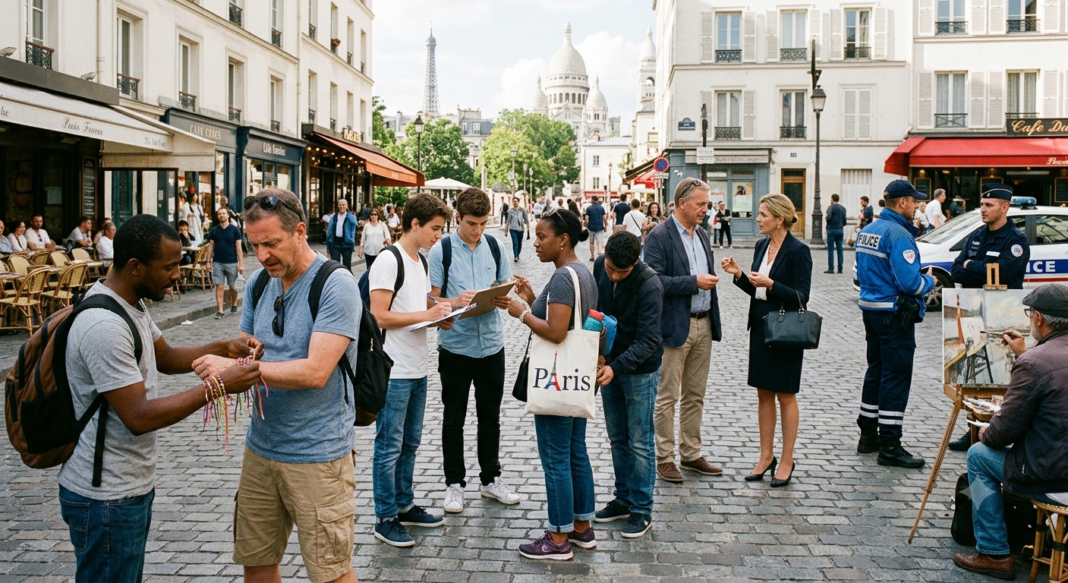
If you plan to climb up to the magnificent Sacré-Cœur Basilica, you’ll most likely take the stairs at Square Louise-Michel. This is where the bracelet scam lurks. Men—often very smiley and pushy—will approach you, holding out their hands. Before you even have a chance to react, they’ll tie a colorful string around your wrist. Once the knot is tight, the trap snaps shut: they claim it’s a handmade craft and demand an exorbitant amount of money (sometimes 20 or 30 euros). If you refuse to pay, their tone quickly changes, and several accomplices may surround you to intimidate you.
2️⃣ Fake petitions and “peace signatures”
This scam is particularly common around the Louvre Museum, on the Champ de Mars, and near major Parisian train stations (Gare du Nord, Gare de l’Est). Young women, often pretending to be deaf and mute or to be collecting funds for an international humanitarian cause, will hand you a sign with a list of signatures. It’s a two-pronged trap. On the one hand, if you sign, you’ll be aggressively asked for money. On the other hand, while your eyes are fixed on the paper and your hands are holding the pen, an accomplice will discreetly rummage through your pockets or your unattended backpack.
3️⃣ The “Found Gold Ring” Scam
You’re walking peacefully along the banks of the Seine or through the Tuileries Garden, and suddenly, someone ahead of you bends down and picks up a large gold ring. They turn toward you, looking surprised, and ask: “Excuse me, did you just lose this gold ring?” When you say no, the person insists that it’s your lucky day, that they can’t keep it for religious or personal reasons, and hands it to you. As soon as you take the ring, the scammer asks you for a little money to “reward their honesty” or to buy something to eat. The ring, of course, is just a worthless piece of copper.
4️⃣ Fake taxi drivers at airports
As soon as you step off the plane at Roissy-Charles de Gaulle or Orly, you’ll encounter people in the terminals whispering, “Taxi? Paris?” Be aware that these individuals do not have official licenses. They’ll lead you to unmarked vehicles and demand astronomical sums (sometimes over 150 euros) upon arrival, even though official Parisian taxi fares are strictly fixed between the airports and downtown.
💡 Tips for a Safe Stay
Now that you know these pickpockets’ tactics, here are the golden rules I teach my tour groups so they can enjoy the capital stress-free:
- Carry your bag in front of you: On the metro (especially on tourist lines like the 1, 2, or 4) and in lines, always keep your purse or backpack in front of your body, with your hand resting on the zipper.
- Master the “No, thank you”: Don’t be too polite with street hawkers. A firm “No, thank you,” spoken loudly with direct eye contact, is usually enough to make them back off. Keep walking without stopping.
- Never leave your phone on the table: When you’re sitting on the patio of a Parisian café, don’t leave your smartphone in plain sight on the table. Pickpockets use the “road map” or “fake document” trick—placing a map or a fake form on your phone to steal it as you get up to leave.
- Book your accommodations in advance: To avoid unpleasant last-minute surprises in unsavory neighborhoods, take the time to book a secure hotel in Paris in the heart of the central arrondissements.
ℹ️ Practical Information and Official Resources
No matter how many precautions you take, there’s no such thing as zero risk. If you’re unfortunately the victim of a theft or scam, it’s important to react quickly and appropriately. Never try to confront pickpockets directly, as they almost always operate in organized groups.
Go immediately to the nearest police station to file a report. To simplify the administrative process, the Prefecture has set up a highly efficient online pre-report system. In addition, for any questions regarding public safety, transportation, or tourism regulations, you must consult the official website of the Paris Police Prefecture.
Furthermore, to plan your visits to monuments and museums without going through fraudulent third-party resellers, always use official platforms or choose a trusted accommodation provider that can advise you. You’ll find great options for accommodating your loved ones by searching for family-friendly accommodations near Paris’s major parks.
❓ SEO FAQ: Everything You Need to Know About Safety in Paris
Is Paris a dangerous city for tourists?
No, Paris is not a dangerous city. Violent crimes against tourists are extremely rare. However, petty crime, such as pickpocketing and street scams, is quite common due to the high concentration of travelers. As long as you stay vigilant, you won’t run into any problems.
Which neighborhoods should tourists avoid in Paris?
Highly touristic areas such as Montmartre, the area around the Eiffel Tower, the Louvre, and the Châtelet district are favorite haunts for pickpockets during the day. At night, it’s advisable to be extra careful around the Barbès-Rochechouart and Porte de la Chapelle metro stations, as well as around major train stations.
What is the official fare for a taxi from Roissy-CDG Airport?
To avoid scams involving fake taxis, keep in mind that fares are fixed. The price of a ride in an official taxi between Paris-Charles de Gaulle Airport and the right bank of Paris is set by law at a regulated rate, and the same applies to the left bank. Always follow the official “Taxis” floor markings inside the airport.
What should I do if my ID is stolen in Paris?
If your passport or ID card is stolen, you must first go to a police station to file a theft report. Next, immediately contact your home country’s embassy or consulate in Paris to obtain an emergency travel document.
How can I tell if a police officer in Paris is genuine?
Genuine police officers in Paris wear standard uniforms or, if in plain clothes, must wear an orange armband marked “POLICE” and show you their official ID card, which contains an official hologram. Be wary of fake police officers in plain clothes who ask to check your wallet on the street.