






Do Parisians really have a reputation for being rude? For many foreign visitors, the answer seems obvious after just a few days in the capital. A waiter seems cold, someone doesn’t respond in English, a fellow passenger sighs on the metro, or a shopkeeper seems much less enthusiastic than expected. However, behind this impression often lies something much simpler: French social norms aren’t always the same as those tourists are used to. Behavior that’s perfectly normal in the United States, the United Kingdom, or other countries can be perceived differently in Paris.
So the problem isn’t necessarily that Parisians are unfriendly. It’s simply that visitors and locals don’t always speak the exact same “social language.” Some rules aren’t written down anywhere, but they’re so deeply ingrained in French customs that locals follow them almost unconsciously. Saying “bonjour” before asking a question, speaking a little more quietly in a restaurant, or not starting a conversation in English right away can completely change the way you’re received.
Here are the main unwritten rules you should know to better understand Parisians and avoid some very common mistakes during a stay in the capital.
🇫🇷 1. Almost always start with “Bonjour”
Probably no other tip is as important. When you walk into a bakery, a small shop, or a café—or when you approach someone to ask for directions—start by saying “Bonjour.” This may seem like a minor detail, but in France it’s a genuine social courtesy. Walking into a store and immediately asking, “Two croissants, please,” without saying hello can come across as abrupt—even if you’re smiling and your intentions are perfectly friendly.
The same principle applies when asking for help on the street. Imagine you’re lost near the Eiffel Tower. Rather than jumping right in with “Excuse me, where is the metro?”, a simple phrase like “Bonjour, excusez-moi… Do you speak English?” can make the interaction much more pleasant. You absolutely don’t need to speak French fluently. Simply showing that you know a few words and are making an effort to respect local customs is generally appreciated.
In the evening, you can of course say “Bonsoir.” And when you leave a store or restaurant, a quick “Merci, au revoir” is a natural way to wrap up the interaction. These few words may seem insignificant, but they’re part of the fundamental customs of French etiquette.
🥐 2. A croissant isn’t a weapon: eat it calmly
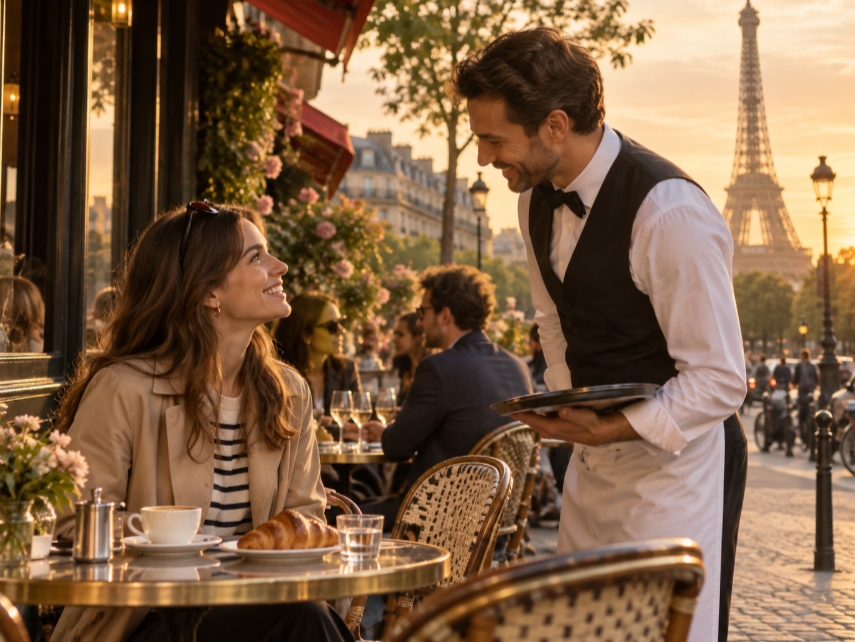
French cuisine also has its own little unwritten rules. No one will seriously expect you to follow an etiquette manual when eating a croissant in a Parisian café, but the French dining experience generally revolves more around taking your time than rushing through a meal. In many cafés, it’s perfectly normal to sit with a drink for a while. You order, chat, watch the street, and enjoy the moment.
This cultural difference may surprise some visitors accustomed to extremely fast service. A French server who doesn’t come back every two minutes to ask if everything is okay isn’t necessarily ignoring you. They may simply be giving you the space to enjoy your meal in peace. Similarly, the check doesn’t always arrive automatically the moment you finish your plate. You usually just need to ask for it: “The check, please.”
If you’d like to learn more about Parisian culinary traditions, check out our tips for dining out in Paris and discover the French specialties to try during your stay.
🗣️ 3. Don’t immediately switch to English
Paris is an international destination, and many people working in hotels, restaurants, and tourist attractions speak English. However, starting a conversation in English right away can sometimes come across as a bit abrupt. Again, just a few words in French can completely change the interaction.
You can simply say, “Bonjour, do you speak English?” Even if your pronunciation isn’t perfect, no one expects a visitor to be fluent in the language. The goal is simply to show that you’re aware you’re in France and that you don’t automatically assume the person you’re talking to speaks your language.
A few phrases are enough for almost your entire stay: “Bonjour,” “Bonsoir,” “Merci,” “Please,” “Excuse me,” and “Goodbye.” If you want to go a little further, learning how to order a coffee or ask for directions can also be fun. What matters isn’t grammatical perfection but the intention.
🔉 4. Speak a little more quietly in public places
This is probably one of the most noticeable cultural differences between some visitors and the locals. On the subway, in restaurants, or in cafés, French conversations can obviously be lively, but groups of tourists sometimes speak much louder than they realize. This is especially noticeable on public transportation or in small restaurants where tables are close together.
You obviously don’t need to whisper your entire stay. But being mindful of the noise level around you is a good rule to follow. If the entire car is quiet and your conversation can be heard from the other end of the train, you could probably lower your voice slightly.
This rule becomes even more important in certain churches and memorial sites. Notre-Dame, the Sainte-Chapelle, and other monuments may be major tourist attractions, but they are also places with religious or historical significance. Speaking softly and respecting areas set aside for quiet reflection is simply part of showing respect for the place.
⛪ 5. In a church, observe the customs before taking out your phone
Paris is home to some of the world’s most famous churches. For visitors, they are naturally landmarks to explore and photograph. For others present at the site, however, they may be places of prayer. Both uses can coexist, provided you follow a few simple rules.
Removing a cap or hat indoors remains a traditional sign of respect in many religious buildings. Also avoid making phone calls, speaking loudly, or interrupting a ceremony just to get a better photo. If an area is closed to visitors, obviously do not cross the barrier to take a picture.
Rules regarding photography may vary depending on the location and event. When a sign indicates that photography is prohibited or that flash photography is prohibited, please follow the instructions. It’s also a good way to truly enjoy a few minutes without constantly looking at Paris through your phone screen.
🔒 6. Don’t put padlocks on Paris’s bridges
The “love padlock” is probably one of the best-known tourist traditions associated with Paris. For years, couples have been attaching padlocks to certain bridges before throwing the key into the Seine as a symbol of their love. The problem is that the accumulation of thousands of padlocks places a considerable weight on the structures and also detracts from the bridges’ appearance.
Today, adding a padlock is therefore not a tradition worth continuing. Certain areas have been modified specifically to prevent their accumulation, and the padlocks may be removed. There are plenty of other ways to celebrate a romantic trip to Paris: take a photo, go for a walk along the Seine, or simply return to the same spot a few years later.
Looking for a romantic stroll? Check out our ideas for walks along the Seine and romantic spots in Paris.
🚇 7. On the metro, let people exit before you enter
The Paris metro also has its own unwritten rules. One of the main ones is simply to stand to the side of the doors and let passengers exit before boarding. It seems obvious, but during rush hour, just a few seconds can be enough to create a real traffic jam on the platform.
On escalators, another common practice is to stay on the right when you’re not walking, so as to leave the left side for people who want to go up faster. This isn’t necessarily followed everywhere or all the time, but adhering to this rule makes it much easier to move through large stations.
Also, avoid standing still right in front of the turnstiles after passing through them. Stations can get extremely crowded, and Parisians who use the metro daily often move at a fairly brisk pace. What may be interpreted as impatience is sometimes simply the behavior of someone trying to catch a connection or get to work on time.
🚶 8. Don’t completely block the sidewalk
This rule applies in almost every major city. Paris is beautiful and makes you want to stop every fifty meters to take a picture of a building facade or look at a map. But on some narrow streets, a group of four or five people can quickly block the entire path.
If you need to check your phone or decide on your next destination, simply step to the side rather than standing in the middle of the sidewalk. The same goes for exiting a metro station. Stopping right after an escalator or at the top of a flight of stairs forces everyone behind you to stop as well.
It’s often in situations like these that the famous cliché of the Parisian sighing or looking impatient arises. Yet, imagine the same situation in your own city when you’re in a hurry: you’d probably have exactly the same reaction.
👗 9. You don’t need to dress “like a Parisian”
The internet loves to tell tourists that they absolutely must ditch their sneakers, workout clothes, or certain accessories so as not to look like a foreigner. The reality is much simpler: Paris is a huge city where clothing styles are extremely varied. You’ll see suits, jeans, sneakers, athletic wear, very elegant outfits, and practically every style imaginable.
There are, however, a few situations where a slightly more polished outfit might be appropriate. Some fine-dining restaurants, upscale bars, or specific establishments may have their own dress code. In that case, simply check the information provided by the establishment before your visit.
Otherwise, prioritize comfort above all else. Paris is a city where you’ll do a lot of walking. A comfortable pair of shoes will be much more useful than trying to copy a Parisian style you saw on social media.
☕ Why do Parisians sometimes seem cold?
Another important difference concerns how politeness is expressed. In some cultures, staff at a store or restaurant may offer plenty of smiles, ask lots of questions, and engage in casual conversation. In France, professional service can be much more low-key. This doesn’t necessarily mean the person is unhappy to see you or doesn’t like you.
Similarly, the French don’t always use the same enthusiastic phrases as Americans in everyday interactions. An exchange can be polite while remaining very brief. The tone may therefore seem cold when compared to the standards of another country, even though it is considered perfectly normal locally.
Of course, there are friendly, hurried, smiling, grumpy, or extremely helpful Parisians—just like in any other big city. Reducing several million people to the idea that “Parisians are rude” is inevitably an oversimplification.
❤️ The real rule: observe before judging
Ultimately, the best way to enjoy Paris is probably to observe local customs for a few minutes. Watch how people enter a bakery, how they use the metro, or how they speak to waitstaff. You’ll quickly grasp the main social cues without needing a manual.
And above all, don’t worry about making a small mistake. No one expects a foreign visitor to know all the nuances of French culture. A smile, a “Bonjour,” a “Merci,” and a little respect are enough in the vast majority of situations.
Paris can sometimes seem fast-paced, direct, and a little intimidating at first. However, once you understand some of its unwritten rules, interactions often become much easier. What some tourists interpret as rudeness is sometimes simply a different way of communicating.
So before you jump to the conclusion that Parisians are unfriendly, try something very simple: walk into the next bakery, look at the person behind the counter, and say “Bonjour.” You might be surprised by the difference.