
🎨 Exploring Paris’s 11th Arrondissement: Must-See Attractions
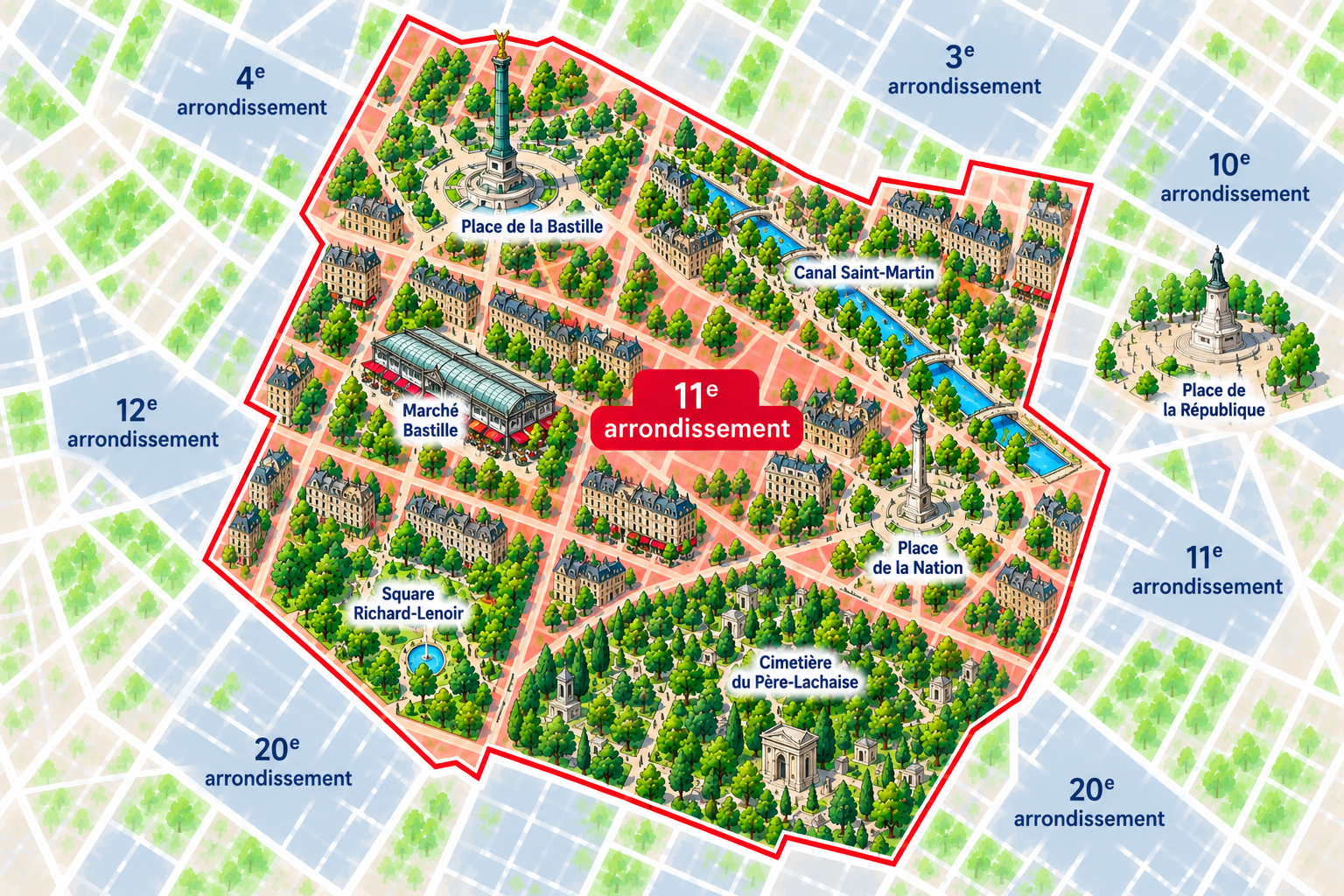
Paris’s 11th arrondissement is one of the most dynamic neighborhoods in the capital. Between Place de la Bastille, the craftsmen’s courtyards of Faubourg Saint-Antoine, the bars of Rue Oberkampf, the Atelier des Lumières and the Cirque d’Hiver, it offers a successful blend of history, creativity and nightlife.
Located on the Right Bank, between Place de la République and Place de la Nation, the 11th arrondissement is a lively residential area, popular for its markets, restaurants, designer boutiques and village atmosphere. Here are the places to discover and our tips for planning your visit.
🗽 Place de la Bastille, a place steeped in history
Place de la Bastille, where the 4th, 11th and 12th arrondissements meet, is one of the symbols of French history. This is where the fortress stormed by revolutionaries on July 14, 1789 once stood. Today, the July Column, topped by the gilded Spirit of Freedom, honors those who fought in the 1830 revolution.
The square is a busy crossroads surrounded by cafés and terraces. It is an ideal starting point for exploring Faubourg Saint-Antoine and the shopping streets of the 11th arrondissement.
🪚 Faubourg Saint-Antoine and its craftsmen’s courtyards
For centuries, Faubourg Saint-Antoine has been the district of cabinetmakers and furniture craftsmen. Behind the façades of Rue du Faubourg-Saint-Antoine lie many cobbled courtyards and passages, such as Cour Damoye, Cour de l’Étoile-d’Or and Passage du Chantier, which have kept their old-world charm.
Wandering through these courtyards reveals a more secret Paris, where workshops, decoration shops and small houses stand side by side. It is an ideal walk for heritage and photography lovers.
✨ The Atelier des Lumières, an immersive experience
Housed in a former 19th-century foundry, the Atelier des Lumières was Paris’s first digital art center. Works by great artists such as Van Gogh, Klimt, Monet and Dalí are projected onto the walls and floor, set to music, for a fully immersive experience.
Exhibitions change regularly. It is best to book your time slot in advance, especially on weekends and during school holidays.
🎪 The Cirque d’Hiver, a landmark of entertainment
Opened in 1852, the Cirque d’Hiver Bouglione is one of the oldest circuses in the world still in operation. Its polygonal façade, decorated with friezes and equestrian statues, makes it a remarkable building even from the outside.
Every year, usually from autumn to spring, it hosts traditional circus shows that delight young and old alike. An ideal family outing during a stay in Paris.
🍸 Rue Oberkampf and Rue de Lappe, the heart of the nightlife
Rue Oberkampf and Rue Jean-Pierre-Timbaud are among the most famous spots for a night out in Paris. Bars, music cafés, wine bars and restaurants follow one another in a relaxed, down-to-earth atmosphere.
Near the Bastille, Rue de Lappe, once the street of accordion dance halls, is still a hotspot of Parisian nightlife. The area also has several concert venues, including the Bataclan, an iconic venue of the Paris music scene.
🧺 The Bastille market and neighborhood markets
The Bastille market, held along Boulevard Richard-Lenoir on Thursday and Sunday mornings, is one of the largest open-air markets in Paris. Fruit, vegetables, cheeses, fish, flowers and specialties from all over the world attract large crowds.
The smaller Popincourt market completes the neighborhood’s offer. To make the most of these markets, check the weather in Paris before heading out.
🛍️ Rue de Charonne and designer boutiques
Rue de Charonne and Rue Keller are known for their independent fashion boutiques, concept stores, galleries and cafés. It is the ideal place to find original pieces and discover Parisian design.
The area around Rue Paul-Bert and Rue de la Roquette is also home to bookshops, record stores and delicatessens that give the neighborhood its charm.
-15%BOOKING.COMExclusive offer15% off Paris hotels with Booking.com- No conditions at all
- Hotels and stays
- Booking in a few clicks
🍽️ Where to eat in Paris’s 11th arrondissement?
The 11th arrondissement is one of the most sought-after food neighborhoods in Paris. You will find many modern bistros, traditional bistros like those on Rue Paul-Bert, chef-led restaurants, natural wine bars and cuisines from all over the world at a range of prices.
The Belleville area, on the edge of the 11th, also offers excellent Asian restaurants. Remember to book the most popular places, which are often full in the evening.
🏨 Where to stay in the 11th arrondissement?
The 11th arrondissement offers many charming hotels and reasonably priced accommodation. Well connected, it gives easy access to the Marais, central Paris and the main tourist sights while letting you enjoy a neighborhood atmosphere.
- Les Jardins du Marais: large four-star hotel set around an inner garden, between the Marais and the Bastille.
- Hôtel Fabric: former textile factory turned design hotel, with a spa and hammam, steps from Oberkampf.
- Le Général Hôtel: colorful contemporary hotel with a gym and sauna, a few minutes from Place de la République.
- Hôtel Le Mareuil: cozy, quiet boutique hotel, perfect for a romantic stay between Bastille and République.
🚇 How to get around the 11th arrondissement?
The 11th arrondissement is served by many metro lines, including at Bastille, République, Oberkampf, Voltaire, Charonne, Parmentier and Nation stations. The area is very pleasant to explore on foot, and many bike lanes cross it.
🗺️ Suggested itinerary for a day in the 11th arrondissement
Start the morning at Place de la Bastille and, if it is a Thursday or Sunday, browse the Bastille market. Then walk up Faubourg Saint-Antoine to explore its craftsmen’s courtyards before heading to Rue de Charonne for some shopping.
After lunch, visit the Atelier des Lumières, then pass by the Cirque d’Hiver. End the day in a bistro on Rue Paul-Bert or in one of the lively bars on Rue Oberkampf.
❓ FAQ: visiting Paris’s 11th arrondissement
What are the must-see sights in the 11th arrondissement?
Place de la Bastille, the courtyards of Faubourg Saint-Antoine, the Atelier des Lumières, the Cirque d’Hiver, Rue Oberkampf, the Bastille market and Rue de Charonne are the places not to miss.
How much time do you need to visit the 11th arrondissement?
One day lets you see the main sights, wander through the craftsmen’s courtyards and enjoy the neighborhood’s restaurants.
What can you do for free in the 11th arrondissement?
You can admire Place de la Bastille, explore the cobbled courtyards of Faubourg Saint-Antoine, browse the Bastille market and discover the boutiques on Rue de Charonne.
Is the 11th arrondissement family-friendly?
Yes. The Cirque d’Hiver, the Atelier des Lumières and the neighborhood’s small parks are very popular with children.
Where to go out at night in the 11th arrondissement?
Rue Oberkampf, Rue Jean-Pierre-Timbaud and Rue de Lappe are home to most of the bars and concert venues.
How do you get to the 11th arrondissement?
Bastille, République, Voltaire and Nation stations are the main access points, served by several metro lines.
✨ Why visit Paris’s 11th arrondissement?
The 11th arrondissement embodies a lively, creative Paris. Its revolutionary history, craftsmen’s courtyards, innovative cultural venues, markets and renowned nightlife make it an essential stop for seeing the capital differently.
Take time to wander its streets, sit on a terrace and step into its shops. To continue exploring the capital, find our other guides to Paris’s neighborhoods and monuments on City-Paris.fr.