
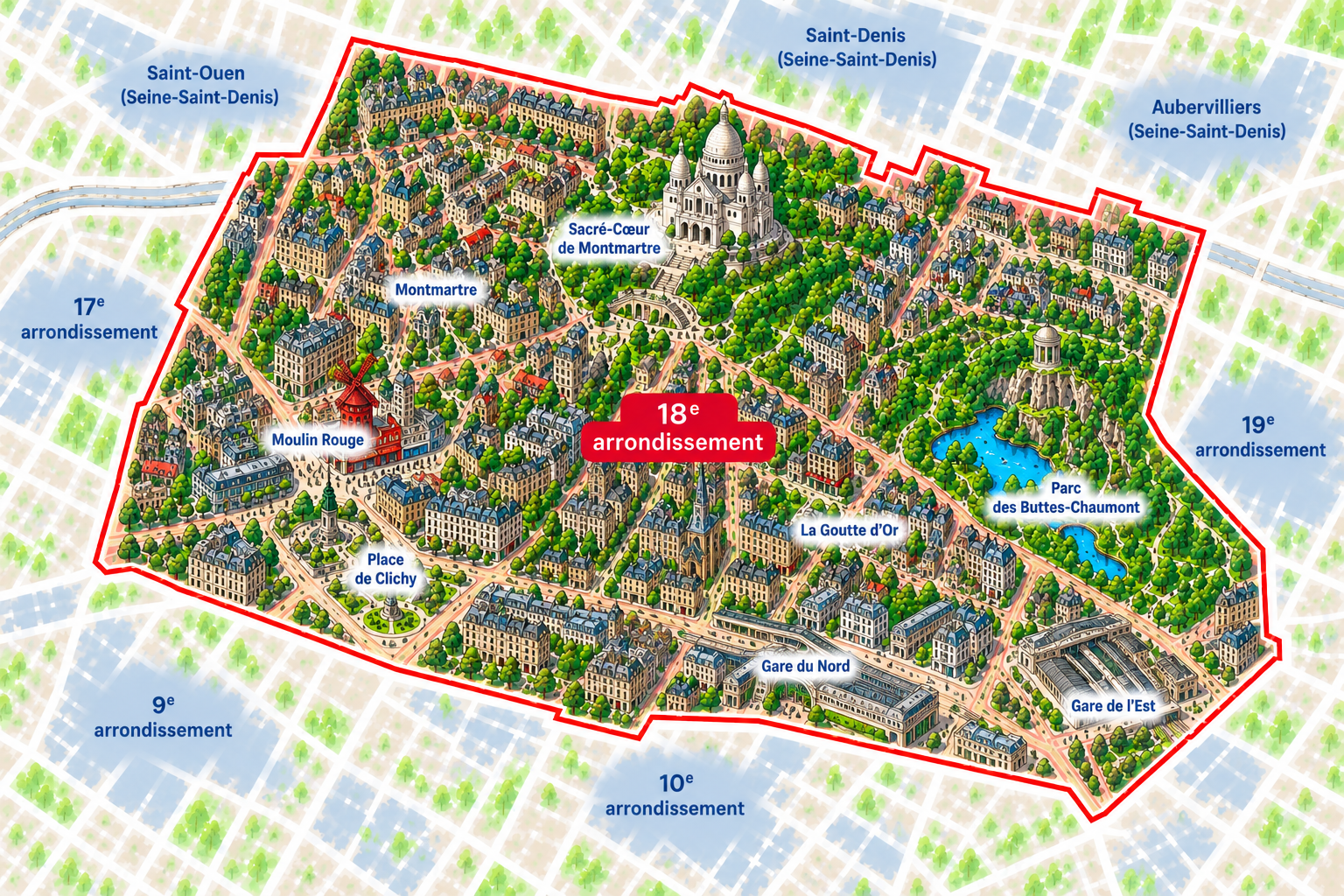
🎨 Exploring Paris’s 18th Arrondissement: Must-See Attractions
Paris’s 18th arrondissement is one of the most famous neighborhoods in the world thanks to Montmartre. Between the Sacré-Cœur Basilica, Place du Tertre and its painters, the Moulin Rouge, the Montmartre vineyard, the cobbled lanes and the lively Goutte-d’Or district, it embodies romantic and bohemian Paris.
Located on the Right Bank in northern Paris, the 18th arrondissement stretches from Boulevard de Clichy to the ring road. It appeals to lovers of art, views, cabarets and leisurely strolls. Here are the must-see sights and our tips for planning your visit.
⛪ The Sacré-Cœur Basilica, at the top of Paris
Perched at the top of the Montmartre hill, the Sacré-Cœur Basilica is one of the most visited monuments in Paris. Built at the end of the 19th century in a Romano-Byzantine style, it stands out for its white stone and domes. Inside, the huge mosaic in the choir is one of the largest in the world.
The view over Paris from its forecourt is spectacular. For an even wider panorama, you can climb to the top of the dome. You can reach the basilica via the steps of Square Louise-Michel or by the Montmartre funicular.
🖌️ Place du Tertre and its artists
A few steps from the Sacré-Cœur, Place du Tertre is the historic heart of Montmartre. Painters and portrait artists set up their easels here, carrying on the neighborhood’s artistic tradition. The surrounding café and restaurant terraces are very lively.
Right next door, the Saint-Pierre de Montmartre church, one of the oldest in Paris, is worth a visit. Dalí Paris, dedicated to the master of Surrealism, is also nearby.
🍇 The Musée de Montmartre and the vineyard
Housed in the oldest house on the hill, the Musée de Montmartre traces the artistic history of the neighborhood. Renoir, Suzanne Valadon and Maurice Utrillo lived and worked here. Its gardens, known as the Renoir gardens, overlook the Clos-Montmartre vineyard.
Every autumn, the Montmartre Grape Harvest Festival celebrates the vineyard with parades, concerts and tastings. Nearby, the pink house and the Au Lapin Agile cabaret are among the most iconic images of Montmartre.
💃 The Moulin Rouge and Pigalle
At the foot of the hill, on Boulevard de Clichy, the Moulin Rouge is the most famous cabaret in the world. Since 1889, it has been associated with the French cancan, immortalized by Toulouse-Lautrec. Its revue show, with feathered and rhinestone costumes, attracts visitors from around the world every night.
The Pigalle area, long known for its nightlife, is now buzzing with bars, concert venues and trendy restaurants.
🏡 The secret lanes of Montmartre
Beyond the busiest spots, Montmartre is best discovered by getting lost in its lanes. Rue de l’Abreuvoir, Allée des Brouillards, Place Dalida, the Wall of Love in Square Jehan-Rictus and Place Émile-Goudeau, home to Picasso’s Bateau-Lavoir, reveal a charming neighborhood.
The Moulin de la Galette windmills and the Passe-Muraille, a sculpture inspired by Marcel Aymé’s short story, complete the walk. Before setting off, check the weather in Paris, as the slopes and steps are more pleasant in dry weather.
🌍 La Goutte-d’Or and the Marché Saint-Pierre
East of Montmartre, the Goutte-d’Or district is one of the most multicultural in Paris. Its African fabric shops, grocery stores, restaurants and the Dejean market offer a lively and exotic atmosphere.
At the foot of the Sacré-Cœur, the Marché Saint-Pierre is a must for sewing and decoration lovers, with several floors of fabrics at attractive prices.
🪦 The Montmartre cemetery
A peaceful and romantic place, the Montmartre cemetery holds the graves of many famous figures: Dalida, Edgar Degas, Émile Zola (cenotaph), Stendhal, Vaslav Nijinsky, François Truffaut and Hector Berlioz. Its shady paths invite a timeless stroll.
-15%BOOKING.COMExclusive offer15% off Paris hotels with Booking.com- No conditions at all
- Hotels and stays
- Booking in a few clicks
🍽️ Where to eat in Paris’s 18th arrondissement?
The 18th arrondissement offers a wide choice of restaurants. Around Place du Tertre, places are often touristy; head instead to Rue des Abbesses, Rue Lepic, Rue des Martyrs or Rue Caulaincourt to find bistros, crêperies and renowned bakeries. La Goutte-d’Or offers excellent African and North African cuisine.
🏨 Where to stay in the 18th arrondissement?
Staying in Montmartre lets you enjoy the neighborhood’s atmosphere early in the morning and in the evening, once the day visitors have left. The 18th arrondissement offers boutique hotels, some with views over Paris, as well as more affordable options around Pigalle and Abbesses.
- Hôtel Particulier Montmartre: secret mansion surrounded by a garden, for an intimate stay in the heart of Montmartre.
- Terrass” Hôtel: hotel with a rooftop and panoramic views of Paris, ideal for a sunset drink.
- Regyn’s Montmartre: welcoming hotel on Place des Abbesses, right in the atmosphere of the hill.
- Timhotel Montmartre: well-located hotel on Place Émile-Goudeau, a few minutes from the Sacré-Cœur.
🚇 How to get around the 18th arrondissement?
The arrondissement is served by Abbesses, Anvers, Blanche, Pigalle, Lamarck-Caulaincourt, Barbès-Rochechouart, Château-Rouge and Jules Joffrin stations. The Montmartre funicular lets you avoid the steps up to the Sacré-Cœur. Wear comfortable shoes: the hill is best explored on foot.
🗺️ Suggested itinerary for a day in the 18th arrondissement
Start early in the morning at the Sacré-Cœur to enjoy the view before the crowds, then head to Place du Tertre. Visit the Musée de Montmartre and its gardens, then walk down Rue de l’Abreuvoir to the Lapin Agile and the vineyard.
After lunch, stroll along Rue Lepic, pass the Moulin de la Galette and the Wall of Love in Abbesses. End the day with a show at the Moulin Rouge or dinner in a Montmartre bistro.
❓ FAQ: visiting Paris’s 18th arrondissement
What are the must-see sights in the 18th arrondissement?
The Sacré-Cœur, Place du Tertre, the Musée de Montmartre, the vineyard, the Moulin Rouge, the Wall of Love, Rue de l’Abreuvoir and the Montmartre cemetery are among the places not to miss.
Is entry to the Sacré-Cœur free?
Yes, entry to the basilica is free. Climbing the dome requires a ticket.
What can you do for free in the 18th arrondissement?
The Sacré-Cœur Basilica, the view from its forecourt, Place du Tertre, the Wall of Love, the lanes of Montmartre and the Montmartre cemetery are all free.
Is the 18th arrondissement family-friendly?
Yes. The funicular, the little Montmartre tourist train, the carousel at the foot of the Sacré-Cœur and the artists of Place du Tertre are popular with children.
Is Montmartre safe?
Yes, but stay alert to pickpockets and pushy street sellers around the Sacré-Cœur and Anvers and Barbès stations.
How do you get to the 18th arrondissement?
Abbesses, Anvers and Lamarck-Caulaincourt stations are the most convenient for Montmartre, served by metro lines 2 and 12.
✨ Why visit Paris’s 18th arrondissement?
The 18th arrondissement holds much of the magic of Paris. The views from the Sacré-Cœur, Montmartre’s artistic heritage, the spirit of its cabarets and the diversity of the Goutte-d’Or make it an essential stop on any trip to Paris.
Take time to get lost in its lanes and savor its viewpoints. To continue exploring the capital, find our other guides to Paris’s neighborhoods and monuments on City-Paris.fr.