



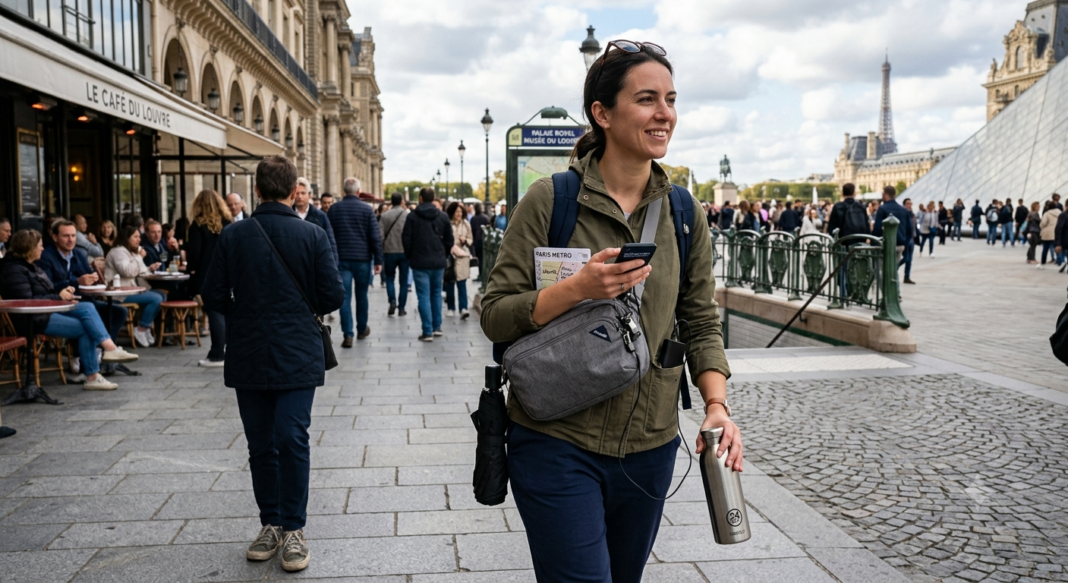

Ah, Paris! The City of Light, with its lively café terraces, the majesty of the Eiffel Tower, and the timeless charm of the banks of the Seine. Traveling to the French capital is an absolutely magical experience. However, to ensure this dream trip doesn’t turn into a real obstacle course, carefully packing your backpack is essential. Indeed, the city has its own unique quirks, little pitfalls, and very specific logistical requirements. Having walked the cobblestone streets of Paris dozens of times myself, I’ve learned the hard way what you absolutely must have with you and what you can leave at home.
First, you should know that Paris is best experienced intensely and primarily outdoors. Whether you spend your days in museums or strolling through parks, your daily essentials will be your best ally. That’s why, in this comprehensive article, we’ll explore in detail the eleven must-have items to pack before setting out to conquer the capital. Thanks to this practical guide, peppered with my own adventures, mishaps, and hard-won tips, you’ll be able to travel with peace of mind and in complete safety. Follow the guide!
🔥 1. A theft-proof backpack or crossbody bag‼️
Let’s start with the most crucial factor for your peace of mind: the safety of your personal belongings. Unfortunately, Paris is notorious for its particularly nimble pickpockets. They operate mainly in crowded metro cars, near iconic landmarks like the Sacré-Cœur or the Louvre, and inside department stores. As a result, using the right bag can completely transform your travel experience.
My personal experience: During my very first long weekend in Paris, excited at the thought of seeing the Eiffel Tower, I made the classic mistake of carrying a standard canvas backpack. As I stepped out of the packed Châtelement metro station, I suddenly felt an unusual draft behind me. When I touched my back, I was horrified to discover that the large zipper was wide open. Miraculously, my wallet had gotten stuck under a thick sweater, but my pack of tissues and a paper guidebook were gone. That huge scare taught me a lesson I’ll never forget. Ever since that fateful day, I’ve traveled exclusively with a bag that has hidden openings against my back or a crossbody bag worn diagonally across my chest.
📌 2. Keep copies of your ID documents in the cloud‼️
Besides, what happens if, despite all your precautions, you lose your wallet or bag? To prepare for this catastrophic scenario, it’s essential to save copies of your important documents (passport, ID card, visas, train tickets) on an online storage platform like Google Drive or Dropbox, or simply email them to yourself.
My personal experience: This tip saved the day during a trip when I foolishly left my travel pouch on the train from Lyon. Fortunately, I’d gotten into the habit of scanning everything to my iCloud account. When I had to go to the front desk to pick up my room keys, the manager initially refused to check me in without a physical ID. When I showed her the perfectly clear copy on my smartphone, she agreed to make an exception for my first night while I sorted out the issue at the police station. Without that, I would have found myself out on the street in the middle of Paris at 10 p.m.
📌 3. Your accommodation address and emergency numbers‼️
Next, even though we live in a fully digital age, technology can sometimes fail at the worst possible moment. A dead battery, a sudden loss of 4G/5G signal in the deep basements of the metro, or a glitch in your navigation app can happen without warning. That’s why I strongly recommend always writing down the exact address of your hotel or apartment in a paper notebook.
My personal experience: One winter evening, after a wonderful dinner near Bastille, my smartphone literally shut down due to the intense cold, dropping from 30% to 0% in two minutes. Unable to remember the exact name of the small street where my Airbnb was located in the Marais, I wandered around for an hour in the cold before having to beg a café waiter to let me plug my cable into the outlet at the counter. Ever since that miserable night, I’ve made it a habit to write down the full address on a piece of paper that I slip into my pocket.
So before you set out to explore a new neighborhood, make sure you’ve chosen the right location for your accommodation. If you’re still looking for that hidden gem for your stay, don’t hesitate to find the perfect place to stay in central Paris to make getting around late at night easier. Also, memorize or write down the official emergency phone numbers in France:
- 🚔 Police Emergency: 17
- 🚑 SAMU (Ambulance): 15
- 🔥 Fire Department: 18
- ☎️ European Emergency Number: 112 (accessible free of charge even from a foreign cell phone)
📌 4. Cash and Physical Currency‼️
Admittedly, France is a highly digitized country where credit cards and contactless payments via smartphone are accepted almost everywhere, even for very small amounts. Nevertheless, there are still notable exceptions where “cash” remains absolutely essential.
My personal experience: I remember that sunny Sunday morning when I was itching to buy a traditional baguette and two warm croissants at a small artisanal bakery tucked away behind the stairs in Montmartre. When I reached the cashier, she pointed to a handwritten sign that read: “No credit cards for amounts under €10.” Since I didn’t have a single cent in my pocket, I had to give up on my order under the impatient stares of the local customers and walk ten minutes to find an ATM. My pastries ended up getting cold! Always make sure to have a 10 € bill and a few 1 or 2 € coins before heading out.
📌 5. A power plug adapter (Type E) ‼️
For international travelers coming from countries outside the European Union, you’ll need to plan ahead for power plug compatibility. In France, electrical outlets are Type E, characterized by two round prongs and a male grounding pin protruding from the socket. If your devices are from the United Kingdom, the United States, or Asia, a universal adapter is essential.
My personal experience: On a trip where I was accompanying a Canadian friend, he naively assumed that high-end Parisian hotels provided adapters on every floor. Unfortunately, the hotel was out of stock that evening. He couldn’t charge his laptop for his meeting the next morning. We had to run all over the neighborhood looking for an electronics store that was open on short notice—and ended up paying exorbitant prices. Don’t take that unnecessary risk.
📌 6. A compact umbrella or a lightweight raincoat‼️
We forget this all too often, but the Parisian weather is particularly changeable, especially in the fall and spring. A beautiful, sunny morning on a terrace can quickly give way to a torrential downpour in the early afternoon. Never let the French capital’s capricious weather catch you off guard!
My personal experience: I got caught in the middle of the Tuileries Garden on a seemingly perfect May afternoon. The sky turned black in less than five minutes, and a downpour swept over the city. With no shelter nearby, I ended up completely soaked in the blink of an eye. That’s exactly when the street vendors pop up, offering you cheap umbrellas for 15 euros that fold up and break at the first gust of wind. Ever since then, my little ultra-lightweight folding umbrella has never left the bottom of my bag, no matter what the weather forecast says.
📌 7. A high-performance power bank‼️
Similarly, between taking dozens of souvenir photos in front of the Arc de Triomphe, constantly using interactive maps to find your way around, and checking restaurant apps, your smartphone’s battery will drain at an incredible rate. In Paris, free public charging stations are extremely rare.
My personal experience: One night out, I found myself at the other end of the Canal Saint-Martin at exactly midnight, tired and disoriented. Just as I was about to open my app to order a ride-hailing service to get back to the hotel, my screen went black: 0% battery. I couldn’t find my way back from memory or call my friends and family. I had to walk for several long minutes looking for an open metro station, asking passersby for directions. Buying this 10,000 mAh power bank transformed my subsequent trips by completely eliminating that anxiety of running out of battery.
📌 8. A reusable water bottle‼️
Traveling in an eco-friendly way while staying within your budget is entirely possible in Paris. In fact, the city has an exceptional network of public drinking fountains, including the famous historic Wallace fountains and modern stations that even dispense fresh sparkling water.
My personal experience: During my first few visits, I easily spent between 6 and 8 euros a day just buying small disposable plastic water bottles at convenience stores near the monuments. One day, a local guide showed me a beautiful carved green fountain right in the heart of the Latin Quarter, explaining that the water there was excellent and completely free. Ever since I started bringing my stainless-steel water bottle, I’ve saved a lot of money over the course of a week-long trip and am helping to reduce waste in this beautiful city.
📌 9. Sunglasses and sunscreen‼️
Unlike rainy days, summer and spring days in Paris can be extremely hot and stifling. Long walks along the banks of the Seine or in the Parc des Buttes-Chaumont offer very little shade, and the glare off the Parisian concrete can be brutal at times.
My personal experience: I made the mistake of spending an entire day in July waiting in line on the stone forecourt of the Palace of Versailles without a hat or sunscreen, thinking that the climate in northern France was always mild. The result: a massive sunburn on my shoulders and the onset of heatstroke that forced me to stay cooped up in the cool of my hotel room for the next two days, ruining part of my trip. Never underestimate the strength of the Parisian sun on a terrace!
📌 10. Comfortable shoes above all else‼️
If there’s one golden piece of advice you should take away from my own firsthand experience, it’s this: Paris is best explored—and earned—on foot. It’s estimated that the average traveler walks between 15 and 20 kilometers a day without even realizing it, simply by navigating between museums and the endless corridors of the metro transfer stations.
My personal experience: Wanting to go for that “Parisian-style” elegance to impress some friends at a party, I slipped on a pair of brand-new, very stylish but stiff leather shoes to stroll through the cobblestone streets of Montmartre. Big mistake! After two hours of going up and down stairs, my heels were covered in bloody, painful blisters. I ended the evening limping and had to rush to a 24-hour pharmacy to buy bandages. Forget about strict fashion rules and go all in on your best pair of worn-in running shoes.
📌 11. A list of basic French phrases‼️
Finally, while it’s true that most tourism professionals in Paris speak decent English, making the effort to say a few words in the local language instantly opens doors and wins over the locals. Parisians really appreciate traditional politeness.
My personal experience: I’ve seen tourists way too often approach stressed-out café servers and jump right into the topic in English, without even a word of courtesy. The reception was often icy. Conversely, when I use my little ritual of starting with a big smile and a warm “Bonjour, s’il vous plaît…,” the staff’s attitude changes completely. The servers suddenly become very attentive and go out of their way to help you as much as possible. The French language is the key to great service in Paris!
To learn more about planning your trips and avoiding route mistakes, feel free to check out our guide to optimizing your transportation in Paris, which will give you all the tips on Navigo passes.
In conclusion, visiting the capital requires a bit of common sense and practical organization. By carefully packing your day bag with these essential items, you’ll avoid unpleasant surprises and make the most of every moment. Also, remember to book your hotel room in advance to get the best rates and ensure a comfortable night’s sleep after your long days of walking.
🙋♀️ FAQ: Frequently Asked Questions About Planning a Trip to Paris‼️
🤔 How can I avoid pickpockets on the Paris Metro? ‼️
To avoid pickpockets on the Paris Metro, always wear your backpack or shoulder bag in front of you. Never leave your phones or wallets in your back pants pockets, and be especially vigilant when metro cars are crowded or when the doors open.
🤔 Where can you find free water on the streets of Paris? ‼️
It’s very easy to find free water in Paris thanks to the 1,200 public fountains scattered throughout the city. You can look for the famous green cast-iron Wallace fountains or use dedicated mobile apps to locate drinking water stations and free sparkling water fountains.
🤔 When is the best time to visit Paris on foot? ‼️
The best time to visit Paris on foot is from May to September, when the days are long and sunny. However, spring and fall offer milder temperatures, ideal for walking for hours on end—as long as you have a compact umbrella in your bag.
🤔 Do you absolutely need to carry cash in Paris? ‼️
Although credit cards are accepted almost everywhere, it’s highly recommended that you always carry 10 to 20 euros in cash. You’ll need it to pay at small neighborhood bakeries that have a minimum card purchase amount or to buy items at local markets.