





🧹 Is Paris dirty? The truth about the capital’s cleanliness
It’s the question on every traveler’s mind: Is Paris dirty? The French capital fascinates the whole world with its history, its prestigious architecture, and its refined cuisine. However, the City of Lights also has a persistent reputation when it comes to cleanliness. Social media frequently shares images of overflowing trash cans or littered streets. Many tourists therefore wonder if reality matches these alarmist images. The answer requires nuance and an in-depth analysis of the situation on the ground.
In fact, cleanliness in Paris varies considerably depending on the time of day, the season, and the neighborhood. The city government devotes enormous resources to maintaining public spaces on a daily basis. Nevertheless, the extremely high population density and the constant flow of tourists create ongoing challenges for cleaning services. In this in-depth article, we analyze the actual state of urban cleaning. You’ll discover the best-maintained areas, the main causes of litter, and our practical tips for enjoying your stay in Paris without any unpleasant surprises.
🌆 Why does Paris have a reputation for being a dirty city?
First, the capital’s exceptional population density accounts for a large part of the problem. Paris is home to more than two million residents within a very limited area of 105 square kilometers. In addition, tens of millions of visitors walk the streets of Paris every year. This impressive concentration of people produces a massive amount of trash every day. As a result, public trash cans fill up at lightning speed in high-traffic areas.
Second, the gap between the romanticized myth and the reality of a major city often comes as a shock to visitors. Many foreign tourists imagine a perfectly pristine movie set. This psychological phenomenon is even known as “Paris syndrome.” When these travelers come across cigarette butts on the ground or graffiti on the walls, their disappointment grows instantly. They are then quick to label Paris a “dirty city” on travel forums and social media.
Finally, individual acts of incivility significantly degrade the urban landscape. Despite the presence of thousands of trash cans on the sidewalks, some passersby still throw their wrappers or cans on the ground. Illegal dumping of bulky items, delivery packaging, and dog waste further exacerbate this unpleasant impression. Thus, human behavior remains the primary factor contributing to the litter on Paris’s streets.
📊 Cleanliness in Paris: Facts and Figures
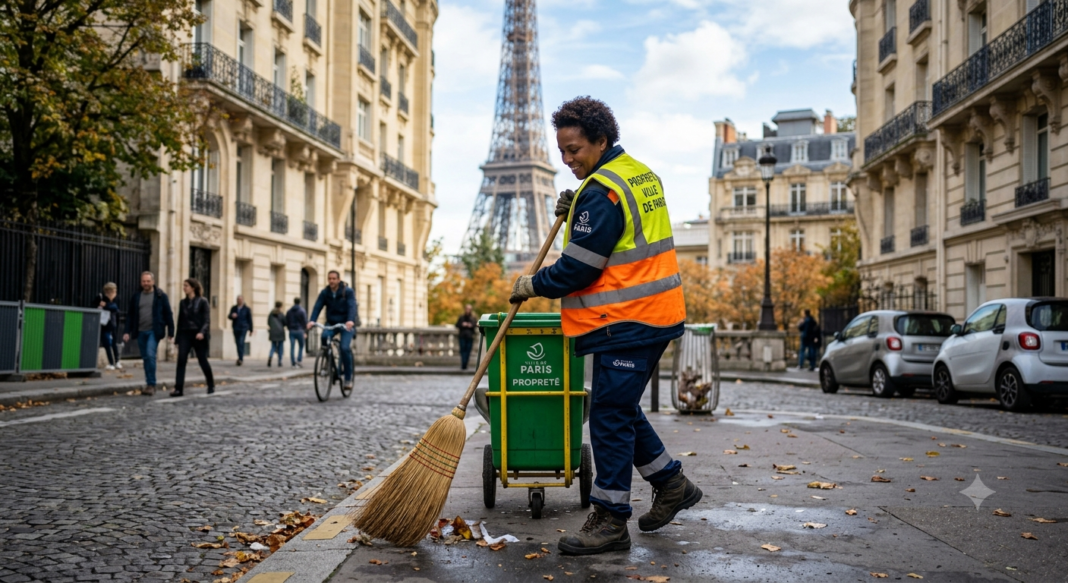
To understand the reality of waste management in Paris, it’s important to examine the city’s official figures. The city allocates a massive budget of several hundred million euros per year to sanitation and street cleaning. City workers labor tirelessly, day and night, to maintain overall cleanliness across the twenty arrondissements.
- 3,000 sanitation workers sweep and wash the sidewalks every day of the year.
- 30,000 street trash cans are installed throughout Paris’s public spaces.
- 3,000 metric tons of householdwaste are collected daily from apartment buildings.
- 100% of Parisian streets are regularly cleaned with high-pressure water jets.
Therefore, to say that the city neglects its upkeep is completely false. Paris’s cleaning services collect trash with impressive regularity. However, the volume of trash generated by the public sometimes exceeds the city’s capacity to respond during peak summer hours.
🗺️ Which arrondissements are the cleanest and which are the dirtiest?
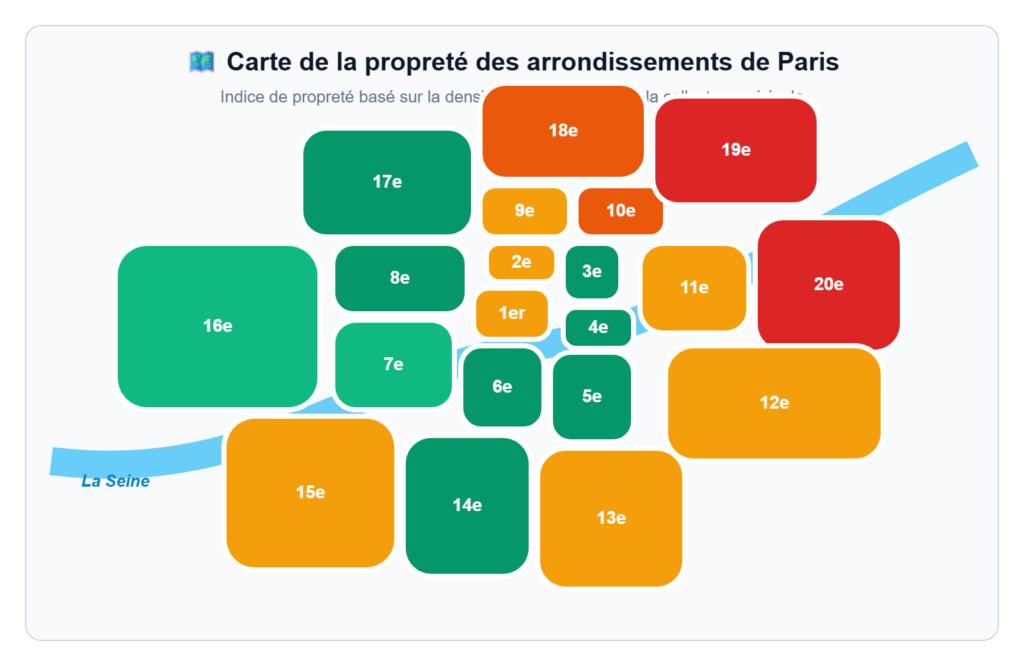
Cleanliness is not evenly distributed across Paris. Affluent residential neighborhoods are often exceptionally well-maintained. In contrast, nightlife districts, popular markets, and areas around train stations face much greater pressure.
🟢 The cleanest arrondissements
The arrondissements in the historic center and western Paris receive constant attention from city services. The 7th arrondissement, home to the majestic Eiffel Tower, benefits from enhanced cleaning efforts. Similarly, the 8th and 16th arrondissements feature very well-maintained sidewalks. Residents there strictly adhere to the schedules for putting out household trash bins.
If you’re looking for impeccable accommodations for your trip, choose hotels located in these quiet and prestigious neighborhoods. You can book your room in advance on Booking to ensure optimal comfort:
- Check availability at the sublime Hôtel Le Meurice, located in the heart of the 1st arrondissement.
- Book a night at the Novotel Paris Les Halles for a central stay with excellent transportation links.
- Discover the refined amenities of the Pullman Paris Tour Eiffel Hotel, ideally located near the Champ-de-Mars.
🔴 Areas more prone to dirt
Conversely, northeastern Paris suffers more from recurring sanitation issues. The 18th, 19th, and 20th arrondissements have a higher population density and very intense nightlife. The areas around the Gare du Nord and Gare de l’Est stations also see a constant stream of travelers in a hurry. In these areas, trash cans regularly overflow before the evening cleanup crew arrives.
Additionally, the banks of the Seine draw thousands of people after a warm summer evening. The next morning at dawn, the riverbanks are often littered with discarded glass bottles and pizza boxes. Fortunately, the garbage collectors and municipal cleaners restore the area to perfect condition before 9 a.m.
👁️ My Personal Experience on the Streets of Paris
As a keen observer of daily life in Paris, I regularly cross the capital from north to south. What I see every day strongly contradicts the doomsday narratives we sometimes hear on TV or online. If you take a walk at 6 a.m. in the city center, you’ll see an army of workers in fluorescent uniforms hosing down the pavement. At that exact moment, the city sparkles and exudes the freshness of the morning.
However, around 6 p.m., the scene naturally changes. Pedestrians have been walking the streets all day, delivery drivers have dropped off their packages, and the café patios are in full swing. It is during this specific time of day that the perception of dirtiness in Paris increases sharply. A plastic bag blowing in the wind or an overflowing trash can immediately spoils the view of a historic monument.
I’ve also noticed a clear overall improvement since the introduction of new enforcement teams. People now think twice before tossing a cigarette butt on the ground. To plan your trips effectively and avoid crowded areas, check out our essential tips for visiting Paris with peace of mind.
💡 How is the Paris City Hall tackling litter?
In response to recurring criticism from residents and tourists, the city is rolling out new technological and human-centered strategies. The main goal is to make the sanitation system more responsive, more efficient, and more environmentally friendly.
First, the city now uses 100% electric street sweepers and vacuum cleaners. These modern machines significantly reduce noise and air pollution. They clean bike paths and pedestrian areas at dawn without disturbing the sleep of nearby residents.
Second, the DansMaRue mobile app allows any citizen to report a sanitation issue in real time. All you have to do is take a photo of illegally dumped trash, bulky items, or graffiti. The system immediately geolocates the incident and forwards it to the neighborhood cleanup crews, who respond as quickly as possible.
In addition, enforcement against misbehavior on public streets is being stepped up. Littering, discarding a cigarette butt, or failing to pick up after your dog exposes the offender to a fixed fine of 135 euros. This hefty financial penalty effectively deters repeated acts of incivility.
🚶♂️ Our tips for visiting Paris without being bothered by litter
Are you planning your next trip and want to fully enjoy the wonders of Paris? Here are a few simple tips for an unforgettable experience, free from the hassles of traffic and city crowds.
- Visit major landmarks early in the morning: The Trocadéro and Louvre esplanades have just been cleaned at 8 a.m. This way, you’ll avoid the crowds and litter that accumulate throughout the day.
- Opt for enclosed parks and gardens: The Jardin du Luxembourg, the Jardin des Tuileries, and Parc Monceau benefit from daily landscaping maintenance of remarkable quality.
- Explore the city from the water: Avoid the crowds on the sidewalks by opting for a relaxing river cruise. You can book a guided cruise on the Seine directly to admire the most beautiful historic facades from their best angles.
- Choose your neighborhood wisely: Stay in the 5th, 6th, 7th, or 15th arrondissement to ensure a clean, quiet, and safe environment.
❓ Frequently Asked Questions: Everything You Need to Know About Dirt in Paris
❓ Why are there rats on the streets of Paris?
The occasional presence of rodents can be attributed to the capital’s very old and extremely extensive sewer system. In addition, the abundance of food scraps left on the ground attracts these wild animals to the surface, especially at dusk. The city regularly conducts targeted rat control campaigns to limit their proliferation in parks and green spaces.
❓ Where should you dispose of your trash when walking around Paris?
Paris has more than 30,000 transparent street trash cans, installed approximately every 100 meters. In addition, many public squares are equipped with recycling bins for glass, paper, and plastic. This makes it particularly easy to find an available trash can at any time during your walks.
❓ Is Paris dirtier than other major European capitals?
The comparison depends heavily on which international cities are being compared. Paris often appears less clean than Tokyo, Zurich, or Vienna, where the civic culture of respect for public spaces is exemplary. On the other hand, the French capital has a level of cleanliness similar to or higher than that of Rome, New York, or London in their areas with very high tourist traffic.
❓ Which arrondissement in Paris is the cleanest place to stay?
The 6th, 7th, and 16th arrondissements are among the cleanest areas in the city. Their quiet residential streets, beautiful Haussmann-style facades, and low density of fast-food restaurants ensure that the sidewalks are extremely well-maintained throughout the year.
❓ Do garbage collectors’ strikes often affect the city’s cleanliness?
Labor strikes by waste collection services remain sporadic but leave a strong impression. During a strike, trash piles up quickly on the sidewalks due to the volume of daily waste. As soon as the strike ends, City Hall deploys exceptional resources to clear the backlog in just a few days.
📝 Conclusion: Should you worry about dirt during a trip to Paris?
In short, claiming that the French capital is an open-air garbage dump is a media exaggeration. Admittedly, there are issues in certain working-class neighborhoods or during busy summer evenings. Nevertheless, the city’s sanitation services do a tremendous job of keeping the city in a generally acceptable condition.
By practicing good civic behavior, carefully choosing where you stay, and visiting major attractions at the best times of day, the question “Is Paris dirty?” will in no way spoil your enjoyment. The city’s incomparable cultural richness, fascinating architecture, and unique charm far outweigh these minor urban imperfections.