




👋 Cultural Guide to a Successful Trip to Paris: Etiquette, Secrets, and Golden Rules
Planning your first trip to the French capital always brings a mix of great excitement and slight apprehension. Travelers cross the Atlantic with images of Haussmann-style boulevards, romantic cafés, and legendary monuments in mind. However, one question keeps coming up on travel forums before the big departure: Are Parisians really cold or rude to foreign visitors? The reality is far more nuanced than a simple cliché. In fact, it all comes down to understanding a few fundamental cultural norms that are very easy to adopt. This practical guide reveals the golden rules of Parisian etiquette to turn your stay into an unforgettable experience.
❓ Why does the reputation of Parisian hospitality cause so much concern?
The reputation of the capital’s residents is a hot topic online. Many travelers fear they’ll receive a frosty welcome in their day-to-day interactions. This fear often stems from a deep cultural misunderstanding between North American customs and the French way of life. In North America, friendliness is immediately expressed through a warm, broad smile and close physical proximity. In France, politeness is based on reserve, discretion, and respect for others’ personal space.
Parisians navigate a particularly intense and fast-paced urban lifestyle. They ride crowded public transportation every morning and work in a very dense environment. Consequently, their natural reserve is not a sign of hostility toward you. It simply reflects their usual way of navigating a bustling metropolis. Once you understand how this works, you’ll approach every interaction with complete peace of mind.
To learn more about how to prepare for your trip, feel free to check out our guide on essential tips for visiting Paris stress-free. This resource will help you plan for all the logistical aspects of your trip.
🇫🇷 The Golden Rule of “Bonjour”: The Magic Key to Opening Every Door
If you had to remember just one essential rule for your entire stay, it would undoubtedly be this one. In France, the word “Bonjour” isn’t just an optional greeting. It’s a true social open door—a magic word that immediately sets the tone for the rest of your interaction. Approaching a shopkeeper, a server, or a receptionist without saying “Bonjour” is tantamount to completely ignoring their existence as a human being.
Imagine the scene in a classic Parisian café. If you order a coffee directly in English without greeting them first, the person you’re speaking to will perceive this as a blatant sign of rudeness. On the other hand, if you say “Bonjour” clearly and with a smile in your local accent, the dynamic changes instantly. The person’s face will light up, and they’ll go out of their way to help you, even if their English is limited.
Here are four simple steps to make every interaction a success:
- Make direct eye contact with the person as soon as you arrive.
- Say “Hello” clearly and loudly.
- Pause for two seconds to let the person respond.
- Then continue your sentence in French if you can, or politely ask in English if they speak your language.
After 7 p.m., naturally replace “Bonjour” with “Bonsoir.” Don’t forget to end your conversation with an equally enthusiastic “Merci, au revoir!” This simple daily verbal ritual radically transforms the quality of your interactions with the local population.
🔊 Managing Volume in Public Spaces
Noise levels are another recurring cultural point of friction for foreign visitors. In North America, talking loudly in a restaurant or on public transportation is rarely a problem. In Paris, public space belongs to everyone. Residents particularly value quiet and restraint when they’re out and about or dining at a restaurant.
On the subway, people read, listen to music with headphones, or discreetly look at their phones. A group that talks loudly or laughs out loud immediately attracts disapproving glances. This isn’t about hatred toward tourists, but rather a desire to preserve the general tranquility. To blend in perfectly with your surroundings, simply lower your voice a notch. Adjust your volume to match the person sitting directly across from you, without trying to drown out the ambient noise.
☕ The Art of Dining in Restaurants and Cafés: Rules and Customs
Meals hold a sacred place in French culture. The etiquette in restaurants differs considerably from what visitors from across the Atlantic are used to. Dining out is a leisurely experience, not a quick series of logistical steps.
💳 The bill and the sensitive issue of tipping
In France, the server will never bring you the check unless you specifically ask for it. You can stay seated at your table for two hours after finishing your meal without anyone rushing you out. Americans sometimes interpret this behavior as negligence or poor service. However, it is actually a sign of the utmost respect for your time to relax. To ask for your bill, give the server a slight wave and simply say, “The bill, please.”
As for tipping, French law requires that service charges be included directly in the price of the dishes. The phrase “Service included” on your bill guarantees that staff are paid. The mandatory 18% to 25% tip common in the United States therefore does not exist here at all. If the service is particularly pleasant, you can leave one to two euros in cash on the table for coffee or lunch. For a more upscale dinner, leaving between 5% and 10% of the total bill is a very generous gesture but entirely optional.
💧 How can you order water without spending a fortune?
Here’s a handy tip to help you avoid paying unnecessarily for expensive bottled mineral water at restaurants. If you simply ask for “water” in English, the server will automatically bring you bottled mineral or sparkling water in a glass bottle, which you’ll have to pay for. To get free, perfectly safe tap water, use the standard phrase: “A carafe of water, please.” Establishments are legally required to provide it to you free of charge.
🗺️ Avoiding Tensions on the Ground: Practical Tips and Etiquette for Visitors
Politeness isn’t limited to simple words at a café counter. It also involves respecting local customs on public transportation and planning your visits carefully. Poor logistical preparation creates stress and leads to unnecessary friction with staff and locals.
🚇 Metro and travel: etiquette rules on the transit system
Parisians use public transit daily to get to work. Blocking the flow of traffic on an escalator or in front of a turnstile immediately causes annoyance. The golden rule is to stand on the right side of escalators to keep the left side clear for people in a hurry.
As for fares, a single metro ticket costs €2.55. To avoid waiting in line at the ticket windows for every trip and risking blocking the way for residents, opt for the Navigo Weekly pass, priced at €30.75. It allows for unlimited travel throughout the Île-de-France region, including to the airports and Versailles. The metro runs from 5:30 a.m. to 1:15 a.m. on weekdays (until 2:15 a.m. on Fridays and Saturdays). Always keep your ticket until you exit to avoid fines during frequent inspections.
🏛️ At the monuments: be flexible for a warm welcome
Security guards and museum staff handle thousands of visitors every day. Arriving without a reservation or failing to follow the time rules immediately undermines the quality of your interaction. A friendly “Hello” to the security guard before opening your bag will drastically change their attitude toward you.
To plan your days with peace of mind:
- The Louvre Museum: Open from 9:00 a.m. to 6:00 p.m. (closed on Tuesdays), with late-night hours on Fridays until 9:45 p.m. Tickets cost €22, and online reservation of a time slot is required. To enjoy a relaxed experience with a passionate guide and avoid stressful lines, you can book a skip-the-line guided tour of the Louvre Museum before your trip.
- The Eiffel Tower: Open daily from 9:30 a.m. to 10:45 p.m. An adult ticket to the top costs €36.70 by elevator and €14.80 for access to the second floor via the stairs.
- The Musée d’Orsay: Open from 9:30 a.m. to 6:00 p.m. Tuesday through Sunday (closed Mondays). Admission is €16.
🏨 Where to Stay in Paris: Our Accommodation Recommendations
The neighborhood you choose to stay in greatly influences your experience of the city. Here are two exceptional properties ideally located for exploring the city’s most beautiful landmarks on foot:
- Hôtel d’Aubusson: Nestled in the heart of the prestigious Saint-Germain-des-Prés neighborhood in the 6th arrondissement, this 17th-century mansion offers a refined, upscale atmosphere. Guests love the lush patio, the indoor pool, and the cozy jazz bar. Rates start at around 450 €.
- Hôtel Le Relais Saint-Germain: Located just steps from the Luxembourg Gardens, this charming hotel offers elegant rooms with personalized decor. You’ll appreciate the warm welcome from the staff and the gourmet cuisine at the adjoining restaurant, Le Comptoir. Expect to pay around €320 per night.
✨ My personal experience: a revealing encounter at a bakery in the Marais
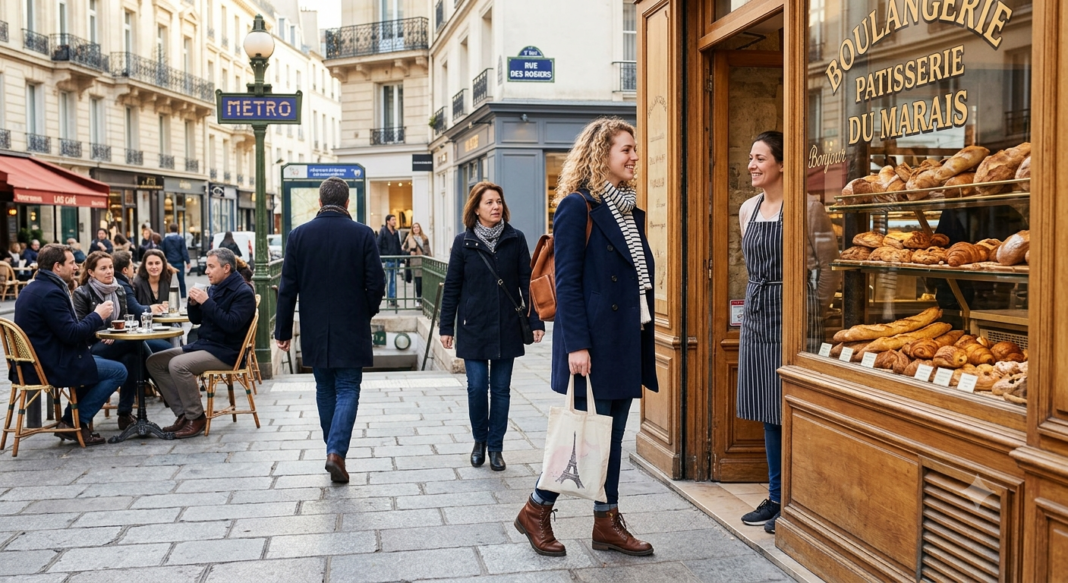
One beautiful fall morning, I found myself in a small, bustling artisanal bakery in the Marais neighborhood. The line stretched all the way out onto the sidewalk. Right in front of me stood a couple of American tourists who were clearly very excited. When it was finally their turn, the young man stepped up to the baker. He pointed directly at a pastry and asked loudly in English, “Give me two croissants, please!”
The baker’s reaction was immediate. Her face hardened; she didn’t smile and placed the two pastries into a paper bag in a very mechanical manner, without saying a single word. The couple walked away muttering that Parisians were definitely cold and unfriendly.
A few seconds later, the elderly woman behind me stepped up to the counter. She looked the shopkeeper in the eye, flashed a warm, friendly smile, and said aloud, “Good morning, ma’am! What beautiful weather we’re having this morning. Could I have a well-baked baguette, please?”
The baker’s transformation was striking. Her face immediately lit up with a huge, warm smile. She took the time to choose the best baguette from the display and exchanged a few very friendly words about the weather. This simple scene perfectly sums up the entire social dynamic of Paris. The so-called coldness vanishes instantly as soon as you show the basic respect expected by local etiquette.
❓ Frequently Asked Questions (FAQ) on Cultural Customs in Paris
🙋♂️ Is it mandatory to speak French to visit Paris?
No, it’s absolutely not necessary to be fluent in French to have a wonderful vacation in the capital. The vast majority of people working in the tourism industry, young people, and shopkeepers speak very good English. However, making the effort to learn a few simple words like “Bonjour,” “S’il vous plaît,” “Merci,” and “Au revoir” completely changes how you’re received. Locals really appreciate this gesture of politeness.
🧢 How should you dress to avoid standing out as a tourist?
Parisians generally opt for a understated, elegant, and fairly fitted style of dress. To blend in naturally with the crowd, avoid full athletic outfits when you’re not exercising, flashy baseball caps, very short shorts in the city center, and flip-flops. Opt for well-tailored pants, structured jackets, neutral colors (black, beige, navy blue), and, above all, stylish yet extremely comfortable sneakers. You’ll often walk more than 15,000 steps a day on historic cobblestone streets.
💳 Are credit cards accepted everywhere in Paris?
Yes, credit cards (Visa and Mastercard) are accepted at virtually all Parisian stores, restaurants, and taxis, even for very small amounts of two or three euros thanks to contactless payment. However, American Express cards are accepted less frequently in small, independent shops. Always keep a small coin or a 10€ bill on hand to cover purchases at small neighborhood bakeries.
🚇 Is the Paris Metro dangerous for tourists?
The Paris Metro is generally very safe at all hours of the day and night. However, as in all major global cities, pickpockets are very active, particularly on heavily touristed lines such as Line 1, Line 2, and the RER B toward the airport. Keep your bag closed and in front of you, never put your cell phone or wallet in your back pockets, and stay alert when people try to distract you near the automatic doors.
To take your itinerary planning a step further, check out our tips on choosing the best neighborhoods in Paris right now. You’ll find all the tips you need to make your next trip a success!