





Ah, Paris! The City of Light, the capital of fashion, romance… and endless lines. We all have that idyllic image of Parisian life in our minds: a café terrace facing the Eiffel Tower, a warm croissant in hand. However, the reality on the ground can sometimes come as a shock to unprepared travelers. Between tourist traps, unforgiving cobblestones, and a labyrinthine metro system, a trip can quickly turn sour.
Don’t panic! Having explored every nook and cranny of the capital for years, I’ve learned to master this magnificent city. To help you avoid beginner’s mistakes, I’ve put together the ultimate guide. Here are the essential things to know about Paris—not just to survive there, but above all, to fall head over heels in love with it. 🇫🇷
1. Save Your Wallet: A Guide to the Best Free Spots 📍
Contrary to popular belief, Paris isn’t just for those with unlimited budgets. In fact, many of Paris’s best spots are completely free, and they often offer a much more authentic experience than some paid attractions.
For example, instead of paying to go to the top of the Montparnasse Tower, I recommend climbing the steps up to the Sacré-Cœur. The panoramic view of Paris’s zinc-roofed rooftops at sunset is simply magical. Plus, if you’re looking for a moment of serenity, the Luxembourg Gardens or the mystical paths of Père Lachaise Cemetery await you without costing a penny.
For lovers of culture and architecture, the sumptuous oval hall of the BNF Richelieu is open to the public free of charge. What’s more, exceptional museums like the Petit Palais (Museum of Fine Arts) and the Musée Carnavalet (dedicated to the history of Paris) offer free admission to their permanent collections. It’s the perfect way to immerse yourself in Parisian art without breaking the bank.
2. Dining in Paris: Free Water and Pitfalls to Avoid 🍽️
Never pay for bottled water 💧
This is a classic mistake that immediately gives tourists away. When you sit down at a bistro, the server will often ask if you’d like still or sparkling water. If you agree, they’ll bring you a branded bottle at a steep price. So just ask for a “carafe d’eau” (a pitcher of water). In France, the law requires restaurants to serve tap water for free with your meal. It’s perfectly safe to drink and refreshing!
Avoid tourist trap restaurants ❌
If a restaurant displays laminated photos of dishes in its window or if a tout calls out to you in English on the street, steer clear. Restaurants located on major thoroughfares or right in front of landmarks (like the plaza in front of Notre-Dame or the Champs-Élysées) often serve mass-produced, overpriced food.
My insider tip: Walk just two or three blocks away from the major tourist sites. Get lost in the side streets. That’s where you’ll discover the real little neighborhood bistros, frequented by Parisians, where the food is fresh, of higher quality, and the prices are much more reasonable.
3. Transportation and logistics: make the most of your travels 🚇
Airport taxis aren’t worth it ✈️
After a long flight, it’s tempting to hop into the first taxi you see. However, between the legendary traffic jams on the A1 highway and the sometimes exorbitant fares during rush hour, this isn’t the best option. The RER or airport buses (like the Roissybus) are significantly cheaper and often faster for getting to downtown, since they bypass road traffic. This saves you a considerable amount of time and money right from the moment you arrive.
Comfortable shoes are a must 👟
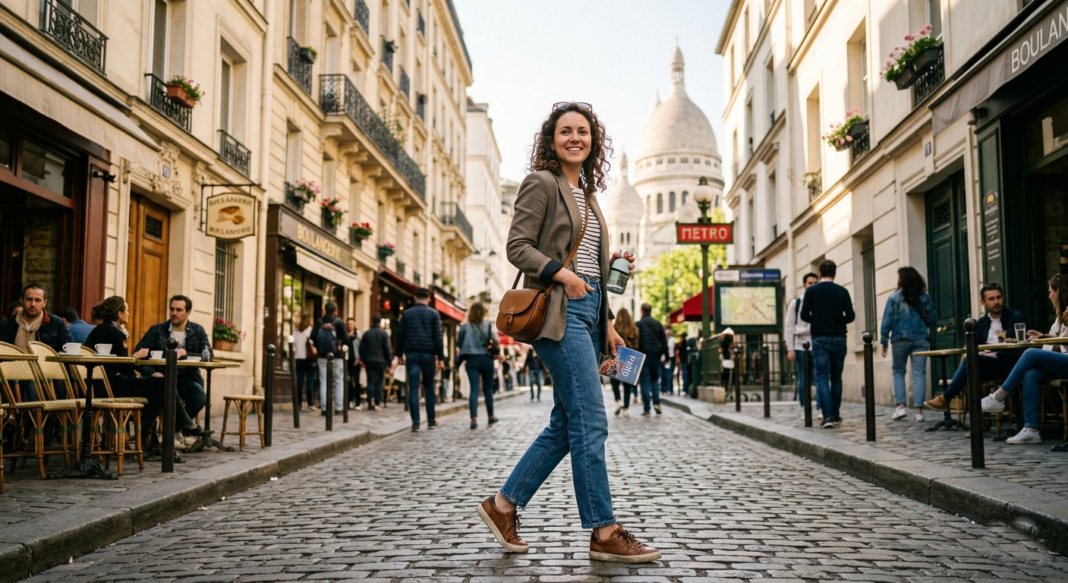
Leave your high heels and new shoes in your suitcase. In Paris, you walk. A lot. Metro stations are full of stairs, and thecobblestone streets—with all their romantic charm—will quickly ruin your nice shoes and leave your feet in agony. During my first month in Paris, I tried to look fancy in heeled ankle boots in the Montmartre neighborhood; I regretted it within the first hour. Opt for a good pair of stylish sneakers: it’s the perfect combo for staying on-trend and logging 20,000 steps a day.
4. Planning: Save Time and Avoid Scams 🎟️
Booking tickets in advance saves you hours ⏱️
If there’s one golden rule to remember, it’s this: improvisation is the traveler’s worst enemy in Paris. Especially for the Louvre, the Eiffel Tower, and the Palace of Versailles, buying skip-the-line tickets in advance is a must if you don’t want to waste four hours of your day standing in line in the rain or the sun.
The secret trick to skipping the lines at the Louvre 🏛️
Everyone lines up under the famous glass Pyramid. However, there are some well-kept secrets. Skip the line at the Pyramid and use the entrances at the Carrousel du Louvre (accessible by metro or at 99 Rue de Rivoli) or the Porte des Lions (when it’s open) instead. You’ll get through security in a quarter of the time.
Be on the lookout for tourist scams ⚠️
Like all major world capitals, Paris has its pickpockets and con artists. Tourist scams are common near monuments. Refuse to sign fake petitions (often held up by minors to distract you while someone else picks your pocket), refuse the “friendship bracelets” that people try to force onto your wrist in Montmartre, and ignore unsolicited “help” at metro ticket machines. Stay polite but firm, and always keep an eye on your bag.
5. Immersion: Parisian Psychology and Local Secrets 🎭
It’s simply a matter of “Bonjour” and “Merci” 🗣️
People often say that Parisians are rude. It’s a persistent cliché, but in reality, it’s all a matter of social etiquette. In France, “Bonjour” is a magic key. If you walk into a store or call out to a server and immediately state your order, you’ll be seen as extremely rude. On the other hand, using simple French phrases and being polite will instantly improve the service you receive. A smile, a “Bonjour Monsieur, ” followed by “Merci, au revoir” will completely change the other person’s attitude.
Paris is so much more than just the highlights 🗺️
The Eiffel Tower and the Arc de Triomphe are must-sees, of course. However, the soul of Paris lies elsewhere. To fall in love with the city, you have to experience it like a local.
Spend an afternoon strolling through the hidden courtyards of the Marais district, watch Parisians picnicking along the Canal Saint-Martin by the locks, or lose yourself in the steep side streets of Montmartre, far from the Place du Tertre. To learn more about planning your itinerary off the beaten path, feel free to check out our guide to experiencing Paris differently.
SEO FAQ: Everything You Need to Know Before Traveling to Paris ❓
What’s the best month to visit Paris?
May, June, and September are generally the best months to visit Paris. The weather is mild, the days are long, and you’ll avoid the summer closures of many small local shops in August.
What’s the most economical way to get around Paris?
The metro remains the most economical and efficient way to get around. You can opt for a Navigo Easy pass and load it with individual tickets, or purchase a “Paris Visite” day pass if you plan to get around a lot.
Is Paris a safe city for solo travelers?
Yes, Paris is generally very safe for solo travelers. You just need to follow basic common-sense precautions, especially on public transportation at night and in highly touristic areas to avoid pickpockets.
Why do Parisian waitstaff seem rushed or distant?
In France, table service is meant to be unobtrusive. A server won’t come up to you every five minutes to ask if everything is okay—this is to respect your privacy. If you need something, simply make discreet eye contact and politely raise your hand.