







🚗 Renting a Car in Paris: A Good or Bad Idea for Your Trip? The Complete Guide 🚗
You’re planning your next trip to the City of Light, and one key question keeps running through your mind: Should you rent a car in Paris? Torn between the desire for independence to explore France and the fear of getting stuck on the ring road, travelers are often torn. Paris welcomes tens of millions of tourists every year. Many of them wonder whether it’s worth renting a car as soon as they arrive at the airport or if it’s better to rely on public transportation.
So, is it true freedom or a budget trap? To help you plan your vacation as effectively as possible, we’re taking a close look at the idea of having a car in Paris. Prices, regulations, alternatives, and expert advice: here’s our comprehensive analysis.
🚦 Driving a Car in Downtown Paris: A False Good Idea for Tourists 🚦
At first glance, the idea of cruising down the Champs-Élysées behind the wheel of a sleek rental convertible sounds like a dream. However, the reality of city traffic in the French capital quickly catches up with even the most optimistic travelers.
1. The War on Cars Within the City Limits
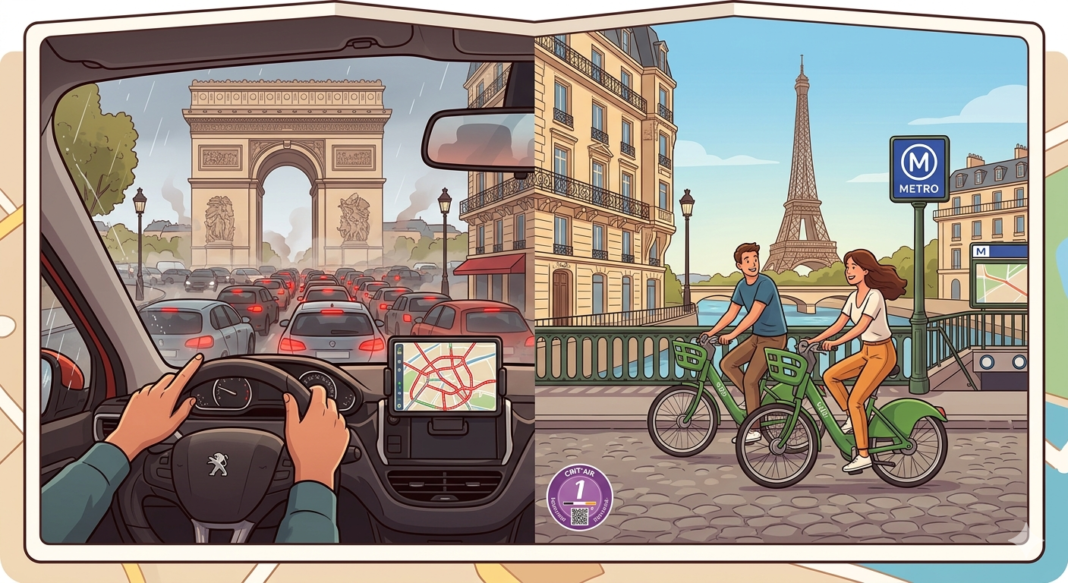
For several years now, the Paris city government has been implementing a policy to drastically reduce the role of cars. Overall car traffic within Paris has dropped by nearly 60% over the past twenty years. The riverside paths along the Seine are now reserved for pedestrians, and major thoroughfares like Rue de Rivoli are off-limits to private cars. As a result, getting around the city center often feels like an obstacle course.
2. Traffic Jams and Average Speed
If you think you’ll save time by renting a car, keep in mind that the average speed on the streets of the historic center during rush hour (7:30–9:30 a.m. and 5:00–7:30 p.m.) drops well below 15 km/h. You’ll therefore spend a large part of your precious vacation time at a standstill, watching for right-of-way and the endless waves of scooters. (Live traffic updates from the Paris Ring Road )
3. The Financial Nightmare of Parking
This is the deal-breaker that finally turns tourists off. Finding a free parking spot in Paris is impossible. On-street parking rates range from €4 to €6 per hour depending on the zone, and parking time is strictly limited to 6 consecutive hours. In addition, the “Forfait Post-Stationnement” (parking fine) ranges from €50 to €75.
To park your car safely, you’ll need to look for private underground parking garages. The average cost of a spot there now ranges from €35 to €60 per 24-hour period. In short, three days of parking can cost more than renting the car itself.
4. The Low-Emission Zone (ZFE) and the Crit’Air sticker
Paris enforces strict environmental restrictions. To be allowed to drive in the Greater Paris area, every vehicle must display a sticker called a Crit’Air on its windshield, which classifies cars based on their pollution levels. Older vehicles are completely banned from driving during the day on weekdays. Even though professional rental companies generally provide newer, compliant vehicles, this is an additional regulatory requirement that you should check carefully before hitting the road.
🗺️ When is renting a car in Paris a great idea? 🗺️
It’s not all bad news. In certain specific travel situations, having your own vehicle becomes an undeniable strategic advantage for a tourist.
A road trip starting from the capital
If Paris is just the first stop on your vacation in France, then renting a car makes perfect sense. The city is the country’s central highway hub. Renting a car will allow you to easily reach beautiful regions that are sometimes poorly served by high-speed trains:
- Normandy (Honfleur, Étretat, Mont-Saint-Michel): Just a 2.5-hour drive away.
- The Loire Valley Castles (Chambord, Chenonceau): Ideal for a two-day getaway at your own pace.
- Champagne (Reims, Épernay): To visit the great traditional champagne houses and explore the vineyards.
Traveling with Family or in a Group
If you’re traveling with young children, elderly people, or carrying a lot of luggage, navigating the Paris metro can be a challenge. The historic network features hundreds of passageways and staircases, and the vast majority of stations do not have elevators. In this specific case, the comfort of a family car justifies the expense, provided you’ve booked accommodations with private parking.
🙋♂️ My personal experience: My encounter with the Place de l’Étoile 🙋♂️
“On my very first vacation to Paris, I wanted to act like an American and rented a compact sedan as soon as I arrived at Roissy-CDG Airport. My plan? To have complete freedom of movement. What a monumental mistake! I’ll remember for the rest of my life pulling onto the Arc de Triomphe roundabout (the famous Place de l’Étoile) on a Friday evening at 6:30 p.m.
For an inexperienced driver, this place is a real-time simulation of chaos. There are no road markings, twelve different avenues converge at the same point, and the absolute “right-of-way” rule applies at every internal intersection. I spent ten minutes terrified, surrounded by tour buses and delivery riders on scooters who would suddenly appear out of nowhere, coming within a millimeter of me.
After working up a serious sweat, I finally found my hotel, which, of course, didn’t have a parking garage. I drove around for forty minutes looking for an available underground parking spot. The result: I paid €140 in parking fees for the weekend, and the car didn’t move a centimeter because I did all my sightseeing by metro. Ever since that experience, my golden rule has been simple: in Paris, I walk, and the car waits until I leave the city!
🚇 Alternatives: How to get around like a true Parisian? 🚇
For tourists visiting central Paris, giving up the idea of a gas-powered car is often a relief. The capital offers an extensive and extremely dense network of public transportation and sustainable mobility options:
- The Metro and the RER: With 16 lines and over 300 stations, you’re always within 400 meters of a metro entrance, no matter where you are in Paris.
- Bikes (Vélib’ Métropole): Paris has become a major cycling capital. It’s the ideal way to get from Notre-Dame to the Eiffel Tower while enjoying the scenery in the open air for just a few euros.
- Taxis and Ride-Hailing Services: If you’re coming home late from a cabaret or a fine-dining restaurant, Parisian taxis (which can be expensive) and ride-hailing apps will get you back to your hotel safely, without you having to worry about local traffic laws.
💡 Our tips for tourists who absolutely must rent a car 💡
Have you weighed the pros and cons and still decided to rent a car? To save money and avoid stress, follow these recommendations carefully:
- Avoid downtown rental agencies: Never pick up your car at an agency located near a major downtown train station (Gare de Lyon, Gare du Nord) or in a central neighborhood (Châtelet). You’ll be immediately thrown into heavy traffic. Opt for the rental counters at Roissy-Charles de Gaulle or Orly airports. These offer direct and immediate access to major highways without having to go through the city center.
- Go for the smallest size possible: Forget about large SUVs or long sedans. Opt for a small, compact city car. Parking spaces in Paris and the access ramps to underground parking garages are extremely narrow.
- Plan your stops in advance using apps: Never search for a spot at random on the streets. Use dedicated mobile apps to compare underground parking rates and reserve your spot in advance with tourist discounts.
- Purchase full deductible waiver insurance: In Paris, driving is fast-paced, and parking is often done “bumper-to-bumper.” Minor scratches and scrapes on the fenders are commonplace. To avoid losing your security deposit when you return the keys, the “zero deductible” insurance option is highly recommended for your peace of mind.
🌐 Essential websites and apps for your trip 🌐
To get around stress-free, here’s the essential digital toolkit to keep on your smartphone:
- To plan your public transit trips: Visit the official RATP website or download the Île-de-France Mobilités app. It’s the essential tool for checking real-time schedules and routes for the metro, buses, and RER.
- To reserve discounted parking: Use the Indigo Neo or Onepark platforms. They let you reserve a spot in a secure underground parking garage in advance, often with significant discounts.
- To rent a bike from a bike-sharing service: Visit the official Vélib’ Métropole website to understand the rates and find available bike stations near you.
- To check environmental regulations: If you’re driving your own vehicle, be sure to order your Crit’Air sticker on the official Crit’Air website to avoid fines in low-emission zones.
❓ SEO FAQ: Everything travelers want to know about driving in Paris ❓
🧐 Is it worth renting a car if I’m staying in Paris for 3 days?
No, it’s definitely not worth it. In 3 days, you’ll focus on the main sights in the city center (Musée d’Orsay, Montmartre, Arc de Triomphe). Taking the metro or walking will save you time and money.
🧐 What’s the average price for renting a car in Paris?
Rates vary greatly depending on the season, but for an economical city car, you can generally expect to pay between €35 and €75 per day. On top of that, you’ll need to factor in the cost of parking and gas.
🧐 Where can you park for free in Paris?
Parking is paid everywhere from Monday through Saturday, 9 a.m. to 8 p.m. It’s generally free on Sundays and holidays on certain streets (indicated by the absence of the “Payant” sign or by a specific logo on the parking meter). However, spots are extremely rare and snapped up by residents.
🧐 How do you get to Disneyland Paris or Versailles without a car?
Both of these major tourist attractions are well-served by public transit. To get to Versailles, take the RER C (about 45 minutes from the city center). For Disneyland Paris, the RER A takes you directly to the gates of the theme parks (Marne-la-Vallée Chessy station) in 40 minutes.
🧐 Is an international driver’s license required to rent a car in France?
If your driver’s license was issued by a European Union member country, it is sufficient on its own. However, for travelers from Canada, the United States, or other countries outside Europe, rental agencies very often require an international driver’s license in addition to your original national license.
🏆 The Final Verdict: Good Idea or Bad Idea? 🏆
In conclusion, the answer depends entirely on the nature of your travel itinerary:
- Renting a car in Paris is a bad idea if your goal is to do traditional sightseeing in the historic center, visit the national museums, and stay in the heart of the city. The financial cost and traffic-related stress far outweigh the benefits.
- Renting a car in Paris is an excellent idea if the capital is just the starting point for a family adventure through the French provinces, or if your accommodations are located in the outer suburbs far from public transportation routes.
It’s up to you to choose the mode of transportation that best fits your vacation plans so you can enjoy your stay in France with peace of mind!