




To plan a memorable stay in the City of Light without any unpleasant surprises, choosing your base is an absolutely crucial step. Paris captivates the whole world with its Haussmann-era boulevards, lively café terraces, and historic monuments. However, like all major global cities, the French capital features striking contrasts from one street to the next. While the vast majority of the city remains perfectly safe both day and night, certain areas have higher crime rates or a nighttime atmosphere that can be intimidating for unsuspecting travelers. That’s why identifying in advance the neighborhoods and districts to avoid in Paris ensures a smooth, stress-free, and completely safe experience.
1. Northeast Paris: Areas Requiring Extra Caution 🗺️
First and foremost, it’s important to consider the northeast of the capital, an area that has historically faced significant economic and social challenges. The affected arrondissements—primarily the 18th and 19th—contain specific areas where street crime and social instability are highly visible. For example, the area connecting the Stalingrad, Jaurès, and Louis Blanc metro stations is infamous for its recurring issues related to public drug use. If you walk through this area during the day, the vibe is simply that of a working-class, cosmopolitan neighborhood, but the atmosphere changes radically after 9 p.m. Groups gathering on the sidewalks and frequent altercations among drug users make the area unpredictable and unsettling for a tourist on their own.
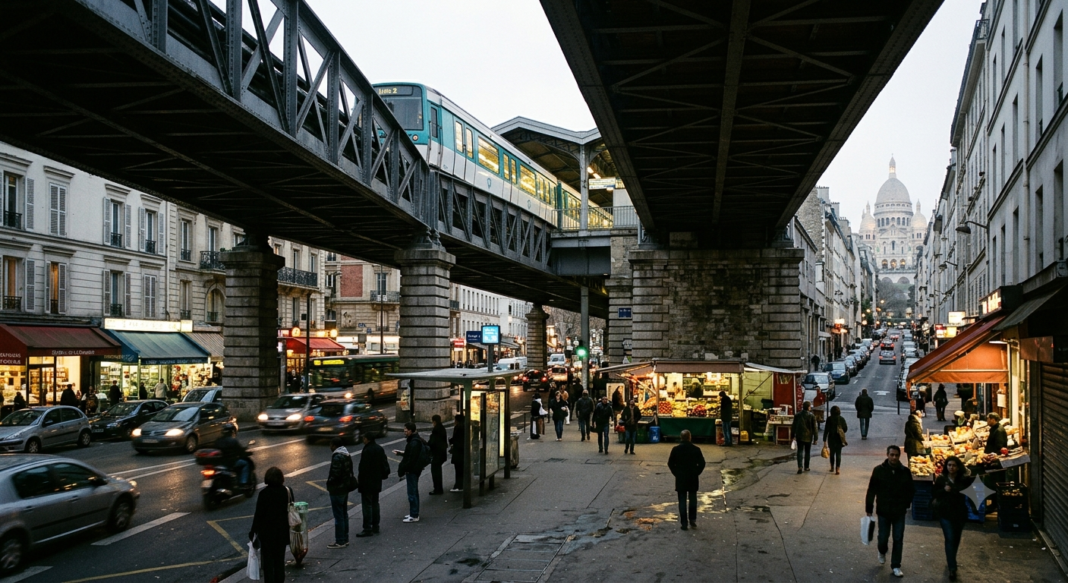
Moreover, the Montmartre hill has two distinct sides that you must learn to distinguish from one another to have a successful trip. While the southern slope (toward Abbesses and Sacré-Cœur) embodies the romantic, postcard-perfect Paris, the northern slope, which slopes down toward Château Rouge and La Goutte d’Or, presents a much rougher side. After dark, the narrow alleys of La Goutte d’Or can quickly become oppressive due to poor visibility and a police presence that is sometimes sporadic. Informal street vending and pickpocketing are commonplace there, so be sure to keep your valuables secure and avoid lingering on the platforms of metro stations. To stay in a much more peaceful setting while remaining close to major transit lines, you can book your accommodation through this booking platform to find a safe hotel in Paris.
2. The “Portes de Paris” and the outer ring road 🚗
In addition, areas located on the very outskirts of the city, commonly known as the “Portes de Paris,” require extra caution in the late evening. The Porte de la Chapelle (18th arrondissement) and the Porte de la Villette (19th arrondissement) are areas undergoing rapid urban transformation, particularly thanks to recent infrastructure developments such as the Adidas Arena, but they remain marked by high levels of social instability. Underpasses, highway interchanges, and pedestrian crossings along the ring road are dark, secluded spots that lend themselves to snatch thefts. The layout of these areas makes it easy for pickpockets to escape, making distracted pedestrians ideal targets.
Furthermore, the eastern gateways to Paris, such as the Porte de Montreuil and the Porte de Bagnolet in the 20th arrondissement, share similar characteristics. Although these neighborhoods are very lively on weekends thanks to their traditional flea markets, they quickly empty out once the metal shutters come down. The lack of regular human activity after stores close reduces the natural sense of security provided by a bustling street. If your route requires you to pass through these outlying areas in the middle of the night, always opt for ride-hailing apps or night bus lines (Noctilien) rather than walking alone along poorly lit outer boulevards.
3. The city center and transit hubs: a pickpocket’s paradise 🎒
At the same time, it would be completely wrong to think that Paris’s safety issues are limited solely to outlying or working-class neighborhoods. Paradoxically, the Châtelet-Les Halles neighborhood (1st arrondissement), located in the geographical heart of the capital, has one of the highest rates of theft reports in the city. This situation can be explained by an absolutely massive influx of people: tourists, commuters, and locals all converge there every day in what is Europe’s largest underground transit hub. Here, the danger isn’t violent assault, but pickpocketing through distraction. Pickpocket rings here are highly organized and take advantage of the crowds on escalators or in packed subway cars to snatch smartphones and wallets in a fraction of a second.
Similarly, the immediate vicinity of major train stations requires constant vigilance on the part of travelers carrying luggage. The Gare du Nord and Gare de l’Est, located in the 10th arrondissement, see millions of international travelers pass through, making them prime hunting grounds for con artists of all kinds. During rush hour, firmly refuse any unsolicited offers of help from non-official personnel to carry your luggage or purchase tickets from vending machines. To avoid unpleasant surprises as soon as you arrive by train, be sure to choose a hotel located on a well-lit, bustling commercial street by checking hotel availability in central Paris.
4. Essential Criteria for a Safe Hotel in Paris 🏨
Finally, choosing your hotel wisely is your best line of defense for enjoying completely peaceful nights in the heart of the capital. To avoid any disappointment, it’s strongly recommended to prioritize hotels with a 24-hour front desk, secure magnetic-card access, and located on main thoroughfares or well-lit residential streets in the central and western districts (such as the 5th, 6th, 7th, or 15th). To make your search easier and select accommodations that meet the strictest security standards, you can use this search engine to find the safest hotels in Paris and book your room with confidence.
5. My personal experience: a night full of lessons 🚶
As an example, I remember a mishap that occurred during my second year living in Paris, just when I thought I had a good handle on the ins and outs of the local nightlife. It was a Friday night in November, around midnight, and I was heading home from dinner with friends in the very trendy Canal Saint-Martin neighborhood. Instead of taking a taxi or staying on the well-lit main streets of Boulevard de Magenta, I had the bad idea of taking a shortcut on foot through the dark alleys just behind Gare de l’Est to get to my metro station.
Suddenly, the atmosphere of the street changed dramatically: the lit storefronts gave way to shuttered facades, and the streetlights had been partially vandalized. Two men began following me at a distance, quickening their pace whenever I sped up. Sensing the tension rising, I immediately put my phone in my inside pocket and turned toward a brasserie that was still open on a major boulevard. This experience taught me a golden rule that I now follow scrupulously: in Paris, safety depends less on the general district than on the specific choice of your route as soon as the sun goes down.
6. Comparative Risk Table by Sector in 2026 📊
To summarize the situation clearly and factually, here is a summary table of the areas in Paris that require special vigilance, based on the latest field observations and urban safety data.
| Area / Neighborhood | District | Main Type of Risk | Period of Maximum Vigilance |
|---|---|---|---|
| Stalingrad / La Chapelle | 10th, 18th, 19th | Street crime, disorderly conduct, drug abuse | Evenings and nights (after 9 p.m.) |
| Goutte d’Or / Château Rouge | 18th | Snatch thefts, pickpocketing, street harassment | All day, particularly in the evening |
| Châtelet-Les Halles | 1st | Distraction thefts, pickpocketing in crowds | Rush hours and weekends |
| Gare du Nord / Gare de l’Est | 10th | Counterfeit money scams, luggage theft | Train arrivals and late at night |
| Portes de la Villette and Portes de la Chapelle | 18th, 19th | Pickpocketing, isolated areas | After offices and shopping centers close |
7. Safety Tips for a Trouble-Free Stay 🛡️
Finally, adopting a few simple behavioral habits is usually enough to deter the vast majority of opportunistic criminals who operate in tourist areas. First of all, never leave your cell phone in plain sight on a table at a café or restaurant terrace, as the so-called “map” or “newspaper” trick allows thieves to snatch it in the blink of an eye. Also, refuse to participate in street games like three-card monte (finding a card or a ball under a cup) that are common on tourist bridges near the Eiffel Tower; these are outright scams run by organized gangs designed to distract you while an accomplice picks your pockets. To learn more about safety rules in urban areas and discover the fascinating history of how Parisian neighborhoods have evolved, feel free to check out our comprehensive guide via this internal Paris safety guide.
SEO FAQ: Everything You Need to Know About Safety in Paris ❓
Which arrondissement in Paris is the safest place to stay?
Generally speaking, the arrondissements west and south of the Seine—such as the 7th (Eiffel Tower, Les Invalides), the 15th (Vaugirard), and the 16th—have the lowest street crime rates in the capital. These are predominantly residential, middle-class, and quiet areas, ideal for families or solo travelers. However, real estate and hotel prices are understandably higher there.
Is the Paris metro dangerous at night?
Overall, the Paris transit network managed by the RATP is safe and heavily monitored, including by cameras and dedicated security patrols. The main risks remain pickpockets on heavily touristed lines (such as Line 1, Line 4, or the RER A). It’s simply advisable to keep an eye on your personal belongings at major transfer stations after 11 p.m.
What are the most common street scams in Paris?
Tourists arefrequently targeted by the fake petition scam (often carried out by minors pretending to be deaf to extort money from you after you sign) or the braided cord bracelet scam in Montmartre, where street vendors forcibly tie a cord around your wrist before demanding an exorbitant amount of money. Stand your ground, ignore them, and keep walking without stopping.
Is Paris a good city for women traveling alone?
Absolutely—Paris remains a very welcoming and safe destination for women traveling solo. As in any major European capital, street harassment can unfortunately occur in certain working-class or nightlife districts (such as Pigalle or the lower part of Belleville) late at night. By following basic safety precautions and sticking to major shopping streets, your stay will go smoothly.
Official Safety Notice: For real-time information on security alerts, authorized gathering areas, or to complete emergency administrative procedures in the event of lost documents, you can visit the website of the Paris Police Prefecture, the official public agency responsible for protecting citizens and visitors in the capital.