
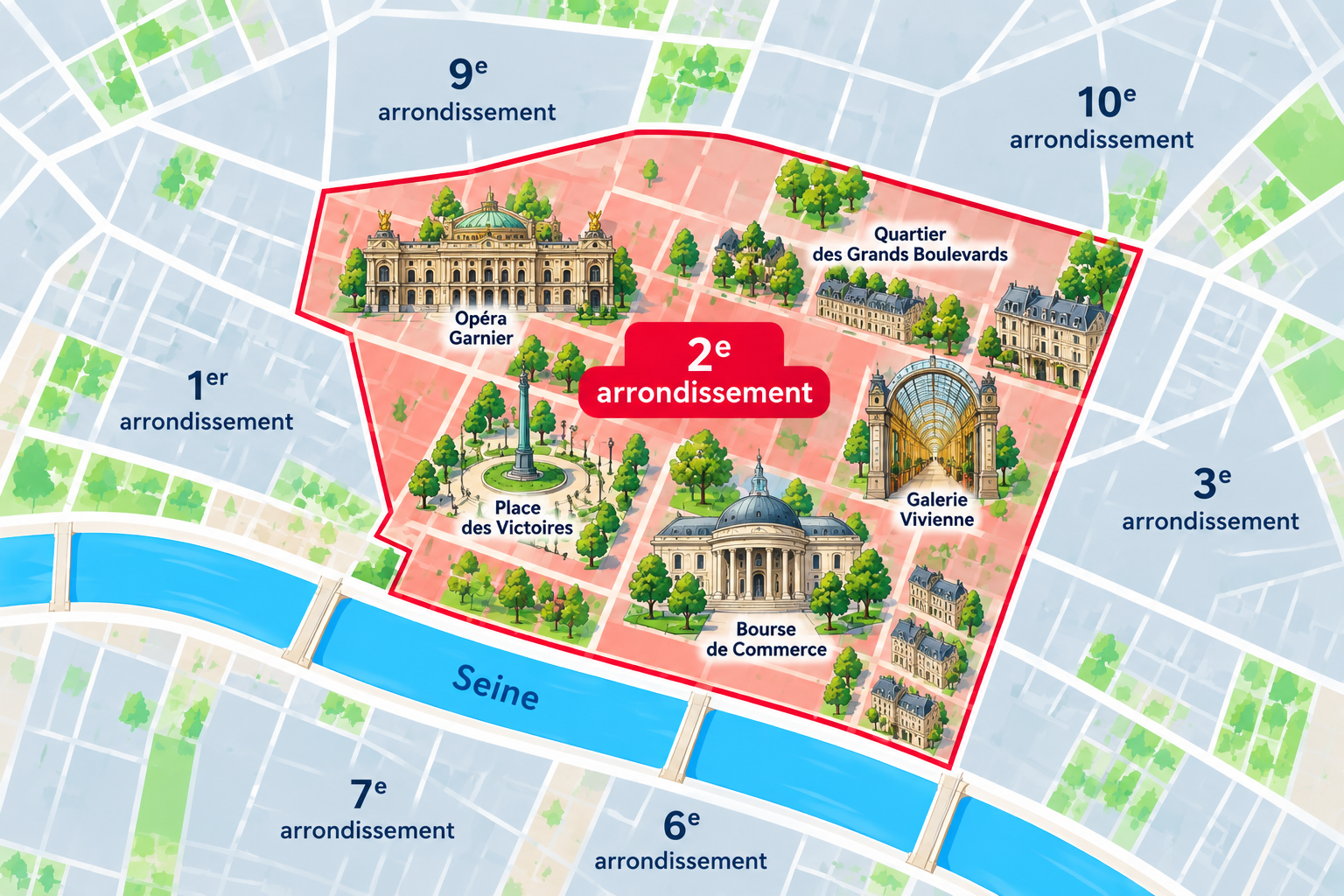
2nd arrondissement
🏛️ Visiting Paris’s 2nd Arrondissement: Covered Passages, Landmarks and Itinerary
The 2nd arrondissement of Paris is the smallest in the capital by area, but one of the most endearing. Between the Palais Brongniart, the 19th-century covered passages, Place des Victoires, Rue Montorgueil and the Grands Boulevards, it packs the commercial and cultural history of Paris into just a few streets. There is no single giant monument that overshadows the rest: the charm comes from glass-roofed galleries, Haussmann-style façades, lively café terraces and tempting food spots. Thanks to its central location, you can explore it entirely on foot and easily combine it with the neighbouring 1st arrondissement. Here is our complete guide to discovering the 2nd arrondissement, planning your visits, choosing the right metro stations and finding a well-located hotel.
📍 Paris’s 2nd Arrondissement at a Glance
- ⏱️ Recommended time: half a day to one day
- 🏛️ Must-sees: covered passages, Palais Brongniart, Place des Victoires, Rue Montorgueil and the Grand Rex
- 🚇 Transport: metro lines 3, 4, 8 and 9, with several stations only minutes from one another
- 🚶 On foot: the arrondissement is easy to explore in a single stroll
- 💶 Budget: free walks and passages, with paid entry for some cultural venues
- 🏨 Where to stay: hotels around the Bourse, Montorgueil and the Grands Boulevards
🏛️ Why Visit Paris’s 2nd Arrondissement?
The 2nd arrondissement is one of the most authentic districts of central Paris. Historically linked to commerce, the press and finance, it has kept a very lively atmosphere. In the morning, the shopkeepers of Rue Montorgueil set out their stalls; during the day, the covered passages offer an elegant shelter from the rain; in the evening, the Grands Boulevards and the surrounding streets come alive around theatres, cinemas and restaurants.
Its small size is an advantage: you can string together several visits without taking lots of journeys. Plan half a day for a focused stroll, or a full day if you want to visit the Bibliothèque nationale de France – Richelieu site, browse the shops and take time for lunch. Before you leave, check the opening hours of the places you want to visit: some close one day a week, and hours may vary by season.
🛍️ The Covered Passages: The Soul of the 2nd Arrondissement
The covered passages are the district’s finest curiosity. Built in the early 19th century, they let Parisians shop sheltered from rain and the mud of the streets. Their glass roofs, mosaic floors and old-fashioned shops create a unique atmosphere.
The Passage des Panoramas, opened in 1799, is one of the oldest in Paris. It is home to restaurants, stamp-collecting shops and local favourites. The Galerie Vivienne, inaugurated in 1823, is often considered the most elegant: its rotunda, mosaics and glass roof make it a very photogenic spot. Right next door, the Galerie Colbert, now part of the Institut national d’histoire de l’art, is also worth a detour for its rotunda.
Take your time wandering from one passage to the next: they are free to visit during opening hours and are perfect for a coffee break or a browse in a bookshop. The passages are closed at night and their hours may vary, so check them before you go.
📈 The Palais Brongniart and Place de la Bourse
The Palais Brongniart, built between 1808 and 1826 to plans by Alexandre-Théodore Brongniart, long housed the Paris Stock Exchange. Its neoclassical architecture, with a Corinthian colonnade, recalls an ancient temple and dominates Place de la Bourse.
Today the building hosts events and visits. Even without going inside, it is worth a detour for its façade and for the atmosphere of the surrounding district, with its cafés and shops. From the square, you can easily reach Rue Vivienne, the covered passages and the Bibliothèque nationale.
📚 The Bibliothèque nationale de France – Richelieu Site
Housed in the former mansion of Cardinal Mazarin, the Bibliothèque nationale de France – Richelieu site reopened to the public in 2022 after major renovation. The place combines heritage and modernity and includes a museum and a large reading room. The Labrouste Room, with its slender cast-iron columns and domes, is one of the most remarkable interiors in the district.
This venue is a good fit for lovers of architecture and books. Check opening hours, the areas open to the public and visiting conditions in advance before you go.
🏙️ Place des Victoires and the Sentier District
Place des Victoires is a circular 17th-century square, dominated by the equestrian statue of Louis XIV. Its harmonious façades, designer boutiques and cafés make it a pleasant stop between the Palais-Royal and the Bourse. Nearby, the Basilica of Notre-Dame-des-Victoires, often quieter than the great monuments of the centre, is worth a short visit.
The Sentier district, historically focused on the textile industry, has undergone a profound transformation. Today it attracts creative and tech companies, as well as many restaurants. Strolling around Rue d’Aboukir and Rue Réaumur, you will discover handsome Haussmann-style buildings and a very Parisian atmosphere.
🥖 Rue Montorgueil: The District’s Food Street
Rue Montorgueil is one of the liveliest streets in Paris. Pedestrianised along much of its length, it brings together bakeries, cheese shops, greengrocers, fishmongers and café terraces. It keeps the atmosphere of an old market street, inherited from its neighbourhood with the former Les Halles market.
Stop at Stohrer, a pastry shop founded in 1730 by the pastry chef of Marie Leszczynska, Queen of France, often presented as one of the oldest in Paris. You can also put together a picnic of bread, cheese and fruit before heading to the Palais-Royal garden or the Tuileries. At weekends and in the evening, the terraces are very busy: choose quieter hours if you prefer calm.
🎬 The Grands Boulevards, the Grand Rex and the Opéra-Comique
In the north of the arrondissement, the Grands Boulevards evoke the Paris of theatres, cinemas and cafés. The Grand Rex, opened in 1932, is one of the largest cinemas in Europe. Its starry-sky ceiling and Art Deco façade make it a landmark in its own right; guided behind-the-scenes tours are available.
To the west, the Opéra-Comique, housed in the Salle Favart, stages operas, shows and concerts in an elegant setting. Fans of live performance will find plenty of places in this area to extend the evening. Remember to book tickets in advance for the most popular performances.
🚇 How to Get Around the 2nd Arrondissement
The 2nd arrondissement is very well served. Line 3 serves Bourse, Sentier and Quatre-Septembre, at the heart of the district. Line 4 stops at Étienne Marcel and Réaumur–Sébastopol, while lines 8 and 9 serve Grands Boulevards, Bonne Nouvelle and Strasbourg–Saint-Denis. Pyramides station, on lines 7 and 14, lies on the edge of the 1st arrondissement.
To plan your journeys between the passages, landmarks and your hotel, use our Paris metro route planner. However, walking remains the best way to discover the arrondissement: the main sights are only minutes apart, and the 1st arrondissement, with the Louvre and the Palais-Royal, is right next door.
-15%BOOKING.COMExclusive offer15% off Paris hotels with Booking.com- No conditions at all
- Hotels and stays
- Booking in a few clicks
🏨 Where to Stay in Paris’s 2nd Arrondissement
Staying in the 2nd arrondissement offers an excellent compromise: you are in the centre of Paris, a few minutes’ walk from the Louvre, the Palais-Royal and Les Halles, in a district that is lively by day and by night. It suits travellers who like going out, having lunch on busy streets and getting around on foot.
The hotel offer mixes small boutique hotels and mid-range establishments. Prices depend on the season, events in Paris and proximity to Rue Montorgueil or the Bourse. Compare several hotels and check their exact location before booking, as the atmosphere can change from one street to the next.
🏛️ Hôtel Vivienne: Near the Covered Passages
The Hôtel Vivienne is located close to the Bourse and the covered passages. This hotel suits travellers who want to stay in a quiet, elegant area while remaining close to the Palais-Royal and the Grands Boulevards.
🌆 Hôtel Victoires Opéra: Between Place des Victoires and the Palais-Royal
The Hôtel Victoires Opéra is in a central area, close to Place des Victoires and the Bourse. Its location makes it easy to walk to the Louvre and the Grands Boulevards.
🥐 Hôtel Tiquetonne: The Montorgueil Atmosphere
The Hôtel Tiquetonne appeals to travellers looking for a simple address near Rue Montorgueil. Its neighbourhood has many bakeries and restaurants right on the doorstep.
🔎 Compare Accommodation Before Booking
Prices vary by season, dates and room type. Before choosing, compare recent reviews, facilities, cancellation policies and the distance to the places you want to visit. See our selection of hotels in Paris to find accommodation that suits your budget and travel dates.
Very lively streets, especially around Montorgueil and the Grands Boulevards, can be noisy in the evening: if you are a light sleeper, ask for a courtyard-facing room or one on a higher floor. For a summer stay, also check whether the hotel has air conditioning.
🍽️ Where to Eat in the 2nd Arrondissement
The 2nd arrondissement is an excellent playground for food lovers. Rue Montorgueil and its neighbouring streets are packed with terraces, bistros and restaurants, from traditional addresses to more modern tables. The covered passages also house tearooms and restaurants in an original setting.
For a quick lunch, buy a baguette, cheese and fruit from the Montorgueil shopkeepers, then settle in the Palais-Royal garden or the Tuileries. For a sweet break, the Stohrer pastry shop is a safe bet. In the evening, restaurants around Rue Tiquetonne and Rue Étienne Marcel attract a Parisian crowd. Prices vary from street to street: explore the side streets if you are looking for gentler prices.
⚠️ Practical Tips for a Successful Visit
The 2nd arrondissement is a lively, busy district, especially in the evening and at weekends. In shopping streets, on the metro and on café terraces, keep your valuables safe and your bag closed. Avoid leaving your phone unattended on a terrace table.
Check the opening hours of the passages, shops and cultural venues before you go, as they can vary by day and season. Shops are often closed on Sundays. For shows and guided tours, book in advance through official sites.
Also remember to check the weather forecast for Paris before you set out. In case of rain, the covered passages are an excellent plan B: you can wander under cover among shops, bookshops and tearooms. On sunny days, bring comfortable shoes and enjoy the terraces.
🗓️ Suggested Itinerary for One Day in the 2nd Arrondissement
Start your morning on Rue Montorgueil, when the shops open and the atmosphere is at its best. Have a coffee or a pastry, then head up towards the Sentier to reach Place des Victoires. Continue to the Galerie Vivienne and the Passage des Panoramas, which you can visit at your own pace.
Have lunch around the Bourse or Montorgueil, then admire the Palais Brongniart and visit the Bibliothèque nationale – Richelieu site if you have booked. In the late afternoon, head to the Grands Boulevards to discover the Grand Rex or see a show at the Opéra-Comique. End with dinner at one of the district’s restaurants.
This itinerary involves roughly two to three kilometres of walking. If you have more time, extend it into the 1st arrondissement by continuing to the Palais-Royal and the Louvre, only a few minutes away.
💶 What Budget Should You Plan for the 2nd Arrondissement?
The arrondissement lends itself well to a budget-friendly visit, as most of its charm is found on the street. Here are the main expenses to consider.
- 🌆 Walks: the covered passages, Place des Victoires and the façades of the Bourse can be enjoyed for free.
- 📚 Cultural venues: plan a budget for the Bibliothèque nationale (depending on the areas), the Grand Rex or the Opéra-Comique.
- 🥐 Meals: a quick lunch on Montorgueil costs little, while a restaurant with a terrace requires a bigger budget.
- 🚇 Transport: the visit is done on foot, but plan a transport ticket if you go on to other districts.
- 🏨 Hotel: compare hotels and the rates for your dates.
- 🚢 Activities: a Seine cruise is an additional expense depending on the option you choose.
💡 Our tip: make the most of the covered passages and free walks, then book your tickets in advance for paid venues. Always check official prices before you leave.
🚢 Discover Paris on a Seine Cruise
The 2nd arrondissement is not on the Seine, but it is only a few minutes from the riverbanks. After a day of walking through the passages and shopping streets, a cruise lets you see Paris from a different angle and admire several iconic landmarks from the river, from the historic façades of the centre to the surroundings of the Eiffel Tower.
To organise this experience, see this selection of Seine cruises with views of the Eiffel Tower. Check the duration, departure point, what is included and availability for your stay before booking.
❓ FAQ: Visiting Paris’s 2nd Arrondissement
📍 What are the must-see places in Paris’s 2nd arrondissement?
The 2nd arrondissement is home to the covered passages (Galerie Vivienne, Passage des Panoramas), the Palais Brongniart, Place des Victoires, Rue Montorgueil, the Grand Rex and the Bibliothèque nationale de France – Richelieu site.
⏱️ How long does it take to visit the 2nd arrondissement?
Half a day is enough for a focused stroll. Allow a full day if you want to visit the Bibliothèque nationale, see a show or take time over lunch.
🚇 Which metro station should I choose to visit the 2nd arrondissement?
Bourse, Sentier, Étienne Marcel and Grands Boulevards are good starting points. Choose according to the place you want to see first.
💶 Is visiting Paris’s 2nd arrondissement free?
Walking the streets, the covered passages and seeing monuments from the outside are free. However, some cultural venues, shows and guided tours are paid. Check prices on the official websites.
🌧️ What can you do in the 2nd arrondissement when it rains?
The covered passages are one of the best options: you can wander under cover among shops, bookshops and tearooms. The Bibliothèque nationale and the Grand Rex are other indoor ideas.
🏨 Where should I stay in Paris’s 2nd arrondissement?
The area around the Bourse is quieter, while the Montorgueil area is livelier. Compare prices, recent reviews, facilities and cancellation policies before booking.
🚶 Can you visit the 2nd arrondissement on foot?
Yes, it is the best way: the arrondissement is small and its main places are only minutes apart. You can easily extend your walk into the 1st arrondissement.
📅 What is the best time to visit Paris’s 2nd arrondissement?
Spring and early autumn offer pleasant conditions for strolling. Thanks to the covered passages, the district can also be visited all year round, even in the rain. Check the weather forecast and opening hours before you leave.
📍 Plan Your Stay in the 2nd Arrondissement
The 2nd arrondissement is an ideal base for anyone who likes to wander, taste and go out, without leaving the heart of Paris. By planning your visits and choosing a well-located hotel, you can fully enjoy its unique atmosphere.
Whether you are coming for a weekend or several days, take time to discover the passages, the small streets and the terraces that give the district its character. See our selection of hotels in Paris to plan your accommodation, and book your activities in advance to get the most out of your visit.