




🌈 I visited the Sainte-Chapelle in Paris: breathtaking stained-glass windows
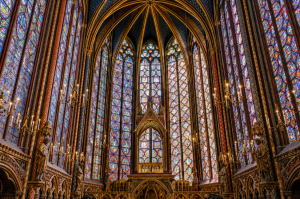
During my stay in Paris, I decided to spend part of my day exploring the Sainte-Chapelle, located in the heart of the Île de la Cité. I was, of course, familiar with the monument’s reputation—especially for its immense stained-glass windows—but I didn’t expect to feel such a stark contrast between the rather unassuming exterior and the particularly spectacular interior. As soon as I arrived in the Boulevard du Palais area, I was struck by the unique atmosphere of Paris’s historic center, with the Seine just a few steps away and several major landmarks within walking distance. I chose a guided tour to better understand the chapel’s history, its role during the reign of Louis IX, and the significance of its many decorative elements. This decision allowed me to see the monument in a new light, as every architectural detail and every scene depicted in the stained-glass windows has a story behind it. If you’re visiting Paris for the first time, I think the Sainte-Chapelle is definitely worth including in your itinerary.
🏰 The Sainte-Chapelle, a royal monument in the heart of Paris
The Sainte-Chapelle is located at 10 Boulevard du Palais, on the Île de la Cité, in Paris’s 1st arrondissement. The monument was once part of the former medieval royal palace, which occupied a large portion of this island in the middle of the Seine. When I arrived, I found it fascinating to think that this very spot was once the center of French royal power. Today, visitors discover a bustling neighborhood, but it only takes a few steps to find traces of that history. The proximity to Notre-Dame, the Conciergerie, and the Pont Neuf also makes it very easy to include the Sainte-Chapelle in a day of exploring the historic center. I particularly appreciated this location, as I could continue my walk without having to take public transportation right away.
Louis IX, better known as Saint Louis, had the Sainte-Chapelle built in the 13th century. The king wanted to create an exceptional sanctuary intended, in particular, to house relics of the Passion of Christ. The building was also meant to demonstrate the power of the French monarchy and its religious significance in medieval Europe. As I explored the chapel with the guide’s explanations, I gained a better understanding of why the architecture seems so ambitious for its time. The monument seeks to impress not only through its size, but above all through its light, colors, and the richness of its decorations. This combination explains why the Sainte-Chapelle remains one of the most remarkable Gothic monuments in Paris today.
🌈 The Upper Chapel and its stained-glass windows: the most impressive moment
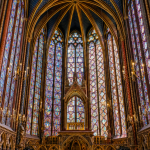
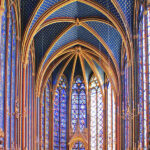
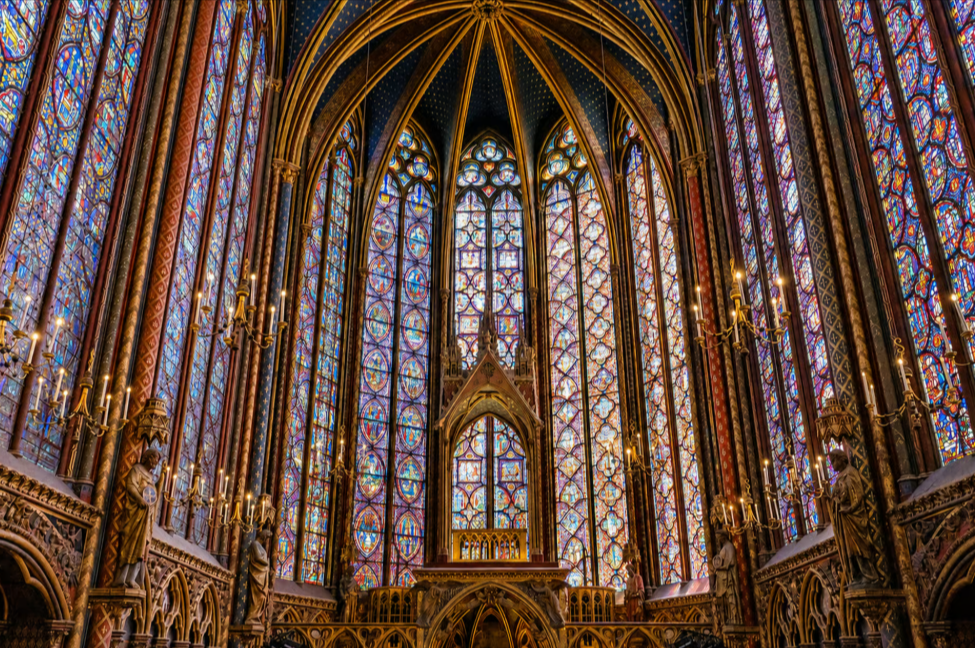
The real visual impact comes when you discover the upper chapel. After passing through the lower chapel, I climbed the few steps leading to this much brighter space. The walls seem to almost disappear behind the immense windows, creating an astonishing sense of lightness. The stained-glass windows take up a significant amount of space and depict numerous biblical scenes arranged as a single, sweeping narrative. I spent several minutes simply taking in the whole scene before I started taking pictures. In hindsight, that’s probably the best advice I can give: first, take the time to look at the chapel without immediately trying to capture everything on camera.
The colors of the stained-glass windows change depending on the natural light streaming through them. Certain details become more visible when you get closer to the panels, while the full scope of the scene is best appreciated when you stand in the center of the chapel. The guide helped me understand how medieval artists arranged the various scenes and why certain depictions hold a special place. Without these explanations, I probably would have admired the colors without really understanding what I was looking at. I also found it interesting to discover that the stained-glass windows are a valuable source of information on how people in the Middle Ages portrayed their history and religion. This perspective completely transforms the visit and makes you want to spend more time in front of each window.
📖 Why choose a guided tour of the Sainte-Chapelle?
A self-guided tour obviously allows you to admire the monument’s beauty, but I preferred to take a guided tour to understand its history. The guide explained, in particular, the role of Louis IX, the layout of the royal palace, and the specific function of the chapel’s two levels. This information gives much more meaning to the elements you observe along the way. I also came to understand why the chapel has such a light-filled architecture and why the stained-glass windows depict so many different scenes. The tour then becomes much more than just a succession of beautiful images. It helps you understand how architecture, religion, and royal power were all brought together within a single building.
The Sainte-Chapelle also offers guided tours at certain times, notably at 11 a.m. and 3 p.m., subject to guide availability. The site also offers an audio guide available in several languages for visitors who wish to explore at their own pace. Personally, I enjoyed the interactive aspect of a guided tour, as I could focus on the explanations while taking in the monument’s details. For visitors who prefer a more comprehensive experience, some tours combine a visit to the Sainte-Chapelle with a tour of the Conciergerie and a walk around the Île de la Cité. This option provides a better understanding of the shared history of several monuments located just a few minutes apart.
Discover the guided tour of the Sainte-Chapelle and the Conciergerie
⛪ The Lower Chapel: A Completely Different Atmosphere
Before reaching the upper chapel, I explored the lower chapel, which offers a completely different atmosphere. The space feels darker and much more intimate, especially when compared to the spectacular upper chapel. This first section, however, helps you understand the monument’s unique layout and the separation between the different groups that frequented the royal palace. The decorations, columns, and sculptures are also of great interest, even though the stained-glass windows in the upper section naturally draw more attention. So I took the time to examine the details before heading up to the upper level. This step helped me better understand the deliberate contrast between the two spaces.
The lower chapel, in particular, was intended for palace staff and those who did not have access to the upper chapel. The upper section had a character much more directly linked to the sovereign and the relics preserved in the sanctuary. This layout reflected the very strict hierarchy of medieval society. The guide explained how the architecture itself served to convey this social and political organization. I found this explanation particularly interesting, as it shows that each space served a specific function. The Sainte-Chapelle thus emerges as a building meticulously designed down to the smallest detail.
👑 Louis IX and the Relics of the Passion
The history of the Sainte-Chapelle remains inextricably linked to Louis IX. The king wished to preserve, in a particularly prestigious location, several relics associated with the Passion of Christ. This desire partly explains the importance placed on light and religious imagery. The chapel was intended to serve as a setting capable of showcasing these objects, which were considered extremely precious in the Middle Ages. As I listened to the guide’s explanations, I came to better understand that the monument thus possessed a dual religious and political dimension. The Sainte-Chapelle represented the king’s faith while asserting his prestige among other European powers.
The construction of the monument also attests to the extraordinary advances in Gothic architecture during the 13th century. The architects sought to visually minimize the presence of the walls in order to leave more space for the large windows. This design choice explains why the upper chapel seems almost entirely made of light and glass. When standing in the center of the building, it becomes difficult to immediately distinguish the boundaries between the architecture and the stained-glass windows. I found this effect particularly striking, even after having seen numerous photographs of the Sainte-Chapelle before my visit. The monument possesses a dimension that photographs do not always fully capture.
🚶 An ideal itinerary with Notre-Dame and the Conciergerie
The Sainte-Chapelle’s location makes it very easy to plan a tour focused on the historic monuments of Île de la Cité. After my visit, I headed to the Conciergerie, which is right nearby. I then continued on foot toward the banks of the Seine before reaching the area around Notre-Dame. This walk allows you to explore several major sites without having to take multiple metro or bus rides. I particularly enjoyed this way of visiting Paris, because the journey between two monuments becomes part of the experience itself. The streets and riverbanks also offer plenty of opportunities to take a break or snap a few photos.
For a half-day itinerary, I recommend starting with the Sainte-Chapelle, then continuing on to the Conciergerie. You can then walk to Notre-Dame and continue on to the Latin Quarter. If you have a full day, you can extend the route to Saint-Germain-des-Prés or the Louvre. The Sainte-Chapelle’s central location really makes this kind of itinerary easy. You can also have lunch around Saint-Michel before continuing your walk. This itinerary lets you discover a significant part of Paris’s heritage without spending most of the day on public transportation.
🎟️ Prices, Hours, and Reservations in 2026
The Sainte-Chapelle’s hours vary depending on the time of year. From April 1 to September 30, the monument welcomes visitors from 9 a.m. to 7 p.m., while from October 1 to March 31, it’s open from 9 a.m. to 5 p.m. Last admission is generally 30 minutes before closing. The Sainte-Chapelle is closed on January 1, May 1, and December 25. In 2026, the individual admission price for citizens or legal residents (staying for more than four months) of a country in the European Economic Area is €16, while the full admission price is €22. A combined ticket with the Conciergerie costs €23 or €30, depending on the applicable category.
I always recommend checking the details before your visit, as hours may change on certain special days or depending on visitor capacity. If you choose a guided tour with an outside provider, be sure to carefully note the meeting time and location. Some tours require you to arrive several minutes before the tour begins. Personally, I prefer to arrive early rather than start a historical tour in a rush. This precaution becomes even more important when you’re planning to visit several monuments in a single day.
📍 How do you get to the Sainte-Chapelle?
The Sainte-Chapelle is located in a particularly central area and is easy to reach from several neighborhoods in Paris. The Cité station, served by Metro Line 4, is one of the most convenient options. You can also reach the area from Saint-Michel and then continue on foot to Boulevard du Palais. Several bus lines also serve the immediate vicinity of the Île de la Cité. The RER B and RER C lines also provide easy access to the area from various parts of Paris. I’ve prioritized public transportation followed by walking, since the final leg on foot allows you to soak up the atmosphere of the historic center.
Once on the Île de la Cité, I recommend not rushing straight to the entrance. Take a few minutes to look at the surrounding buildings and the banks of the Seine. The Pont Neuf is also nearby and makes for an excellent stop to continue your walk. You can then cross over to the Latin Quarter or head to Saint-Michel for lunch. This location makes the Sainte-Chapelle particularly convenient for visitors who want to plan an itinerary entirely on foot. In just a few hours, you can explore several iconic monuments in the historic heart of Paris.
🏨 Where to stay near the Sainte-Chapelle?
If you’d like to visit the Sainte-Chapelle at your own pace, staying in the Île de la Cité, Saint-Michel, or Latin Quarter areas is a convenient option. This way, you can walk to the monument and enjoy the atmosphere of central Paris in the evening. Several hotels are located just a few minutes from the monument and also offer easy access to Notre-Dame, the Conciergerie, and the banks of the Seine. Rates obviously depend on your travel dates, the season, and availability at the time of your reservation. I therefore recommend comparing prices that match your exact travel dates before choosing your hotel. Here are a few options you can check out directly:
- Les Rives de Notre-Dame Paris —a hotel located in the Saint-Michel area, right next to Île de la Cité.
- Hôtel du Mont Blanc Paris – a very central location, convenient for exploring the Latin Quarter and nearby landmarks.
- Hotel Le Notre Dame Saint Michel Paris – a hotel particularly well-located for walking to the Seine and the Sainte-Chapelle.
- Hôtel Albe Saint Michel Paris – a hotel in the Saint-Michel neighborhood, ideal for enjoying the restaurants and streets of downtown Paris.
- Relais Hôtel du Vieux Paris – a hotel located in the historic Saint-Germain and Saint-Michel area.
- Hôtel le Clos de Notre Dame Paris – another option for staying near the Île de la Cité.
I particularly like the idea of staying in this area when planning a short trip to Paris. After a day of sightseeing, it’s very pleasant to be able to walk back to your hotel rather than take the metro. The neighborhood also stays lively in the evening thanks to the many restaurants, cafés, and shops around Saint-Michel and the Latin Quarter. So you can easily grab dinner nearby before walking back to your hotel. The next morning, you can head straight to another landmark without wasting time on public transportation.
📸 My tips for making the most of your visit
My first tip is to take the time to look at the upper chapel before you start taking photos. The stained-glass windows create such a spectacular effect that it’s best to spend a few minutes taking in the whole scene. Then, gradually move closer to the windows to examine the different scenes depicted. Some details are hard to spot from the entrance but become much more visible as you get closer. A guided tour can point out the key elements to look for. This way, you’ll get much more out of the monument than if you just quickly snap photos of the stained-glass windows.
I also recommend wearing comfortable shoes if you plan to combine a visit to the Sainte-Chapelle with a walk on the Île de la Cité. The distances between the different monuments are short, but a full day in Paris can quickly add up to several kilometers of walking. If you’re traveling with children, you can introduce them to some of the characters or stories depicted in the stained-glass windows before you arrive. This makes the visit much more fun and helps them understand what they’re seeing. The Sainte-Chapelle is sure to appeal to architecture enthusiasts, families, and history buffs alike.
🗺️ My recommended half-day itinerary
To plan my visit, I’d start by arriving on the Île de la Cité about thirty minutes before my scheduled time. I’d use that time to walk around the Boulevard du Palais and explore the area before going inside. I’d then spend enough time at the Sainte-Chapelle to ensure I don’t rush through the stained-glass windows. After the visit, I’d continue on to the Conciergerie, then to the banks of the Seine. I’d wrap up this first part of the day near Notre-Dame before heading over to the Latin Quarter for lunch.
A guided tour combining the Sainte-Chapelle and the Conciergerie can also simplify planning. Some tour packages allow you to explore several historic sites along the same route, with admission included as part of the tour. I find this option appealing for first-time visitors to Paris who want to quickly grasp the history of Île de la Cité. You just need to check the tour’s language, duration, meeting place, and which monuments are actually included when you book. Checking these details helps avoid unpleasant surprises and lets you plan the rest of your day around your chosen schedule.
Book a guided tour of the Sainte-Chapelle and the Conciergerie
💡 Why the Sainte-Chapelle deserves a spot on your Paris itinerary
What stood out most to me after my visit was the contrast between the monument’s relatively unassuming exterior and the extraordinary splendor of its interior. The upper chapel has a very special atmosphere that photographs don’t always capture accurately. The stained-glass windows are obviously the highlight of the tour, but I also appreciated the historical explanations about Louis IX, the relics, and the former royal palace. The guided tour helped me better understand why the monument has such distinctive architecture. It transforms what might otherwise be a simple visual exploration into a true immersion in Paris’s medieval history.
The location is also a major advantage. After the Sainte-Chapelle, you can reach the Conciergerie, Notre-Dame, the Pont Neuf, and the banks of the Seine in just a few minutes. You can then continue on to Saint-Michel or the Latin Quarter without needing to take public transportation right away. This concentration of monuments allows you to plan a very fulfilling day within a relatively compact area. For a first visit to Paris, I find this itinerary particularly effective. The Sainte-Chapelle thus becomes a central stop on a true historical tour through the heart of the capital.
📌 Practical Information to Keep in Mind
The Sainte-Chapelle is located at 10 Boulevard du Palais, in Paris’s 1st arrondissement. From October 1 to March 31, the monument is open from 9 a.m. to 5 p.m., while from April 1 to September 30, it’s open from 9 a.m. to 7 p.m. Last admission is 30 minutes before closing. The monument is closed on January 1, May 1, and December 25. Prices and admission conditions may vary depending on the visitor’s profile and the option chosen, particularly for guided tours or combination tickets. It is therefore best to check the official information before visiting.
Address: 10 Boulevard du Palais, 75001 Paris
Metro: Cité, Line 4
Hours from October 1 to March 31: 9:00 a.m. to 5:00 p.m.
Hours from April 1 to September 30: 9:00 a.m. to 7:00 p.m.
Last admission: 30 minutes before closing time
Guided tours: notably at 11:00 a.m. and 3:00 p.m., subject to availability
Nearby: Notre-Dame, Conciergerie, Pont Neuf, the Seine, Saint-Michel, and the Latin Quarter
✨ Other sights to explore around the Sainte-Chapelle
After exploring the Sainte-Chapelle, I recommend continuing your stroll around the Île de la Cité. Notre-Dame is just a few minutes away and is a natural stop to continue your exploration of Parisian religious architecture. The Conciergerie, meanwhile, offers a glimpse into another part of the former royal palace and introduces you to a different period in the site’s history. You can then walk along the Seine, cross the Pont Neuf, and gradually make your way to Saint-Michel or the Latin Quarter. This walk lets you explore Paris without having to make multiple trips and offers numerous views of the historic center.
Finally, the Sainte-Chapelle remains one of those monuments that you understand much better once you’re inside. Its exterior doesn’t necessarily give you a sense of the splendor of the upper chapel and its stained-glass windows. The guided tour adds real value by placing the building in its historical and religious context. Personally, I particularly enjoyed the blend of architecture, history, and a stroll through one of Paris’s oldest neighborhoods. If you’re planning your trip, I recommend setting aside enough time to explore the Sainte-Chapelle and then enjoy the Île de la Cité on foot.