



💳 How to Pay in Paris: The Complete Guide to Cards, Cash, and Financial Pitfalls
You’re planning a trip to the French capital. Paris captivates travelers from around the world with its historic landmarks, legendary cuisine, and vibrant culture. However, the success of your trip also depends on thorough practical preparation. One question that frequently comes up among visitors is: how can you pay for your expenses while there with complete peace of mind?
Between international credit cards, the massive rise of contactless payments, mobile apps, and managing cash, local customs can sometimes be disorienting. Payment rules in France differ from those in North America or other European countries.
This comprehensive guide covers all payment methods in Paris. You’ll learn how to optimize your spending, avoid excessive bank fees, and navigate the city without ever running into any issues when booking a table or validating your ticket.
💳 Credit Cards in Paris: Acceptance of Visa, Mastercard, and American Express 🏨
Your choice of credit card directly impacts your daily life in Paris. In France, the banking network is extremely modern and centralized, but not all international cards are accepted to the same extent by local merchants.
💳 Visa and Mastercard: The Undisputed Kings of French Retail 🛍️
In France, the Visa and Mastercard networks reign supreme. Virtually all Parisian establishments accept these cards without exception. You can pay for your purchases with these cards on the metro, at the supermarket, in a department store, at the bakery, or in a small neighborhood taxi.
These cards operate on the national “Carte Bancaire” (CB) network. If you have a Visa or Mastercard issued by a foreign bank, the payment terminal will recognize it instantly. You’ll have nothing to worry about during your trip if your wallet contains one of these two cards.
💳 Why is American Express acceptance still so limited? ⚠️
If you have an American Express (Amex) card, you should be aware of certain restrictions. Amex acceptance remains low in Paris once you venture beyond high-end tourist areas and major retail chains.
The reason for this refusal is simply due to the structure of interchange fees. The commissions charged by American Express to merchants are significantly higher than those charged by Visa or Mastercard. To protect their already slim profit margins, small retailers, neighborhood restaurants, artisanal brasseries, and bakeries categorically refuse to accept this card.
You can, however, use your Amex card at several specific types of establishments:
- Major luxury hotels and large international hotel chains
- Parisian department stores such as Galeries Lafayette, Printemps, and Le Bon Marché
- Luxury brands located on Place Vendôme, Rue du Faubourg Saint-Honoré, or Avenue Montaigne
- Airlines, car rental agencies, and major train stations
- Certain supermarkets belonging to major national chains, such as Monoprix
For your stays in Paris, you can confidently book a suitable hotel such asthe Pullman Paris Tour Eiffel orthe Novotel Paris Les Halles. These hotels readily accept American Express and guarantee impeccable service in the heart of the capital.
However, keep one essential rule in mind: never travel around Paris with an American Express card as your only payment option. Always carry a backup Visa or Mastercard to avoid any potential awkward situations.
📲 Contactless Payment, Chip & PIN, and Payment Terminals in Paris 🏧
France has been a pioneer in the digitization of financial transactions. Payment habits in Paris have evolved significantly in recent years toward almost complete digitization.
📲 The “Chip & PIN” system and the end of magnetic stripe cards 🔒
In France, the “Chip & PIN” standard (smart card with a PIN) has been the norm since the early 1990s. Transactions involving simply swiping a magnetic stripe and signing a paper receipt no longer exist at all.
When you insert your card into an electronic payment terminal (TPE) in Paris, the machine will always ask you to enter your 4-digit PIN. Be sure to memorize this PIN before setting off on your trip. If your foreign card does not have a chip, it will be virtually impossible to use it at self-service machines such as metro ticket kiosks.
📲 Apple Pay, Google Wallet, and Modern Contactless Payment 📱
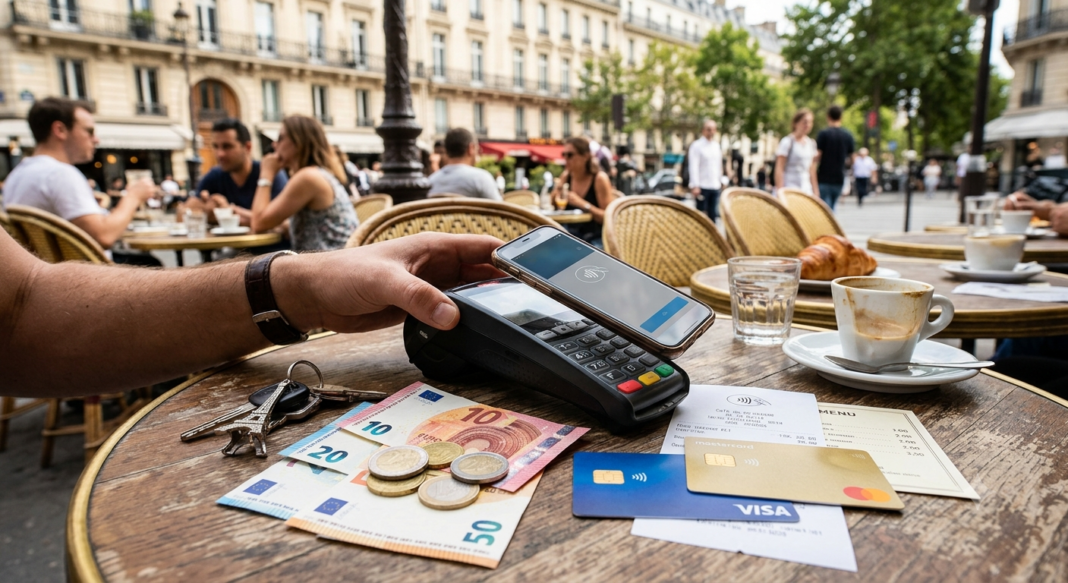
Contactless payment has become the go-to daily payment method for all Parisians. You can pay for your purchases with a simple tap by holding your physical card or smartphone near the payment terminal.
Apps like Apple Pay, Google Wallet, and Samsung Pay are universally accepted at merchants equipped with modern terminals—which is 99% of the time in Paris.
- Contactless payment with a physical card: The legal limit is set at €50 per transaction in France. Above this amount, the terminal will ask you to insert your card and enter your PIN.
- Payment via smartphone (Apple Pay / Google Wallet): This €50 limit is generally waived! Thanks to biometric authentication (Face ID, Touch ID, or fingerprint), you can pay much higher amounts with a single gesture, without even taking your bank card out of your bag.
🏧 The dangerous trap of ATMs: dynamic currency conversion 💸
If your primary bank account is held in a currency other than the euro (U.S. dollars, Canadian dollars, Swiss francs, British pounds), be very careful when withdrawing cash from ATMs.
During your withdrawal, the machine’s screen will ask you a question phrased in a very enticing way: “Would you like to be charged in your local currency with a guaranteed exchange rate?”
This financial mechanism is called DCC (Dynamic Currency Conversion).
Golden rule: ALWAYS decline this offer! Always choose to be charged in the local currency, that is, in EUROS (€).
If you accept conversion into your own currency, the bank that owns the ATM sets the exchange rate. That bank then applies an extremely unfavorable rate with a hidden markup ranging from 8% to 15% above the market rate. If you choose to be charged in euros, your own bank will process the transaction at a standard interchange rate that is much more favorable.
Always use ATMs operated by major French national banks:
- BNP Paribas
- Crédit Agricole
- Société Générale
- LCL (Le Crédit Lyonnais)
- La Banque Postale
Avoid at all costs independent ATMs with generic brands located inside 24-hour convenience stores or near popular tourist attractions.
💶 Cash: How much cash should you carry on a daily basis? 🪙
Paris is now a city where you can get by almost without ever handling a single bill. However, walking around without any physical cash still carries a few minor risks.
💶 Why keep some cash on hand? 🥖
Although regulations require merchants to display their payment terms, some establishments still set a minimum amount for credit card transactions. This minimum amount generally ranges from €1 to €10.
Here are some real-life situations where your euro coins and small bills will come in very handy:
- Buying a baguette or a croissant for €1.30 at a traditional bakery
- Grabbing a quick espresso at the counter of a brasserie (about €2.00)
- Leaving a spontaneous tip for a tour guide, a server, or a baggage handler
- Using certain pay-to-use public restrooms at major train stations or in some parks (often between €0.50 and €1.00)
- Buying fresh fruit or handmade souvenirs at neighborhood open-air markets
💶 How much cash should you keep in your wallet each day? 👛
Between €20 and €50 in cash per person per day is more than enough to cover your small, unexpected expenses. Don’t withdraw huge amounts of cash at the start of your trip.
Opt for smaller denominations when withdrawing cash from an ATM or making purchases. Ask for €5, €10, and €20 bills. Avoid using €100, €200, or €500 bills at all costs.
In France, a merchant has the legal right to refuse a cash payment if you present a bill whose value is disproportionate to the cost of the item purchased. Additionally, large bills are very often refused to prevent counterfeit currency and due to limited cash-handling capacity.
If you want to optimize your overall spending during your stay, read our full article on the best tips for saving money while visiting Paris.
🏛️ Hidden Fees and Financial Security During Your Stay in Paris 🛡️
To travel to Paris with peace of mind, you need to fully understand your bank’s fee policies before boarding your flight.
🏛️ Foreign transaction fees and bank commissions 💳
Before you leave, contact your bank advisor to check the following:
- Fees on card purchases outside the Eurozone: Does your bank charge a fixed percentage (e.g., 2.5%) on every transaction made in Paris?
- Fees for withdrawals at foreign ATMs: Does your bank charge a fixed fee (e.g., €3 to €5 per withdrawal) in addition to the foreign exchange fee?
- Spending limits: Are your daily and weekly withdrawal and payment limits sufficient to cover your lodging, dining, and shopping expenses?
If your bank charges high currency conversion fees, consider opening a travel account with no international banking fees at a modern neobank. This will save you tens of euros over the course of your entire trip.
🏛️ Theft Prevention and Payment Security 🔐
Paris is a very safe city when it comes to violent crime. However, like all major global tourist capitals, the city faces a recurring problem with pickpockets, particularly on public transportation and near major landmarks.
To protect your finances, follow these common-sense recommendations:
- Never put your wallet or phone in the back pockets of your pants.
- On the metro (especially on busy lines like Line 1, Line 9, or the RER B), keep your backpack zipped and in front of you.
- Never leave your phone on the corner of a table at an outdoor café while you’re talking.
- Keep your payment methods separate. Leave a spare card and some of your cash in the safe in your hotel room.
ℹ️ Practical information, schedules, and average prices for your expenses in Paris 📍
To help you create an accurate budget for your days in the capital, here’s a summary table of average prices in the city:
ℹ️ Summary of everyday living costs in Paris 📊
| Expense Category | Estimated Average Price | Practical Notes |
|---|---|---|
| Metro ticket (single ride) | €2.15 | Valid for a one-way trip in central Paris. |
| Navigo Day Pass (Zones 1–2) | €8.50 | Unlimited travel throughout the entire urban transit network. |
| Espresso (at the counter) | €1.80 to €2.50 | More expensive if you sit on the patio (€3 to €4.50). |
| Traditional baguette | €1.20 to €1.40 | Prices are regulated by market competition; cash payment is recommended. |
| Lunch Special (Brasserie) | €16.00 to €22.00 | Typically includes a starter + a main course or a main course + a dessert. |
| Taxi from CDG Airport to Paris City Center | €56.00 to €65.00 | Mandatory flat rate based on the destination. |
ℹ️ Store Hours and Operations ⏰
- Parisian supermarkets: They are generally open Monday through Saturday from 8:00 a.m. to 9:00 p.m. or 10:00 p.m. Many now remain open on Sunday mornings until 1:00 p.m.
- Department stores: They are open continuously from 10:00 a.m. to 8:00 p.m., including Sundays.
- Banks: Parisian bank branches are open Tuesday through Saturday from 9:00 AM to 5:15 PM. Please note that many close between 12:30 PM and 2:00 PM.
To save time during your cultural explorations and avoid lines at the ticket counters, be sure to plan ahead. You can easily book a time-stamped admission ticket for the Louvre Museum directly online to guarantee your visit slot.
🌟 My personal experience: an enlightening evening in the heart of the Marais 🍷
On a pleasant spring evening in Paris, I decided to have dinner with friends at a charming little traditional bistro tucked away on a side street in the historic Marais district. The decor was typical of the area, the atmosphere was warm, and the plates of duck confit served with a homemade Tarte Tatin were simply unforgettable.
When it came time to ask for the check, which came to €58, I automatically handed my American Express card to the young waiter. He immediately smiled kindly at me before shaking his head from side to side. The card reader displayed an unequivocal decline: the restaurant didn’t accept that network due to excessively high transaction fees.
Seeing that I didn’t have enough cash in my wallet that evening, the server reminded me that contactless payment was available. I took out my smartphone, opened my digital wallet linked to my international Visa card, and placed the phone on the terminal. The transaction was authorized in a fraction of a second via facial recognition.
I rounded out the meal by placing a 2€ coin on the saucer next to the bill. This small gesture of appreciation delighted the server. That evening perfectly illustrated the Parisian contrast: a city that loves its bistro traditions but is fully embracing modern technology for its everyday transactions!
❓ FAQ: All your questions about managing your money in Paris ❓
❓ Can you pay with U.S. dollars or other currencies in Paris? 💵
No. The only official currency that is legal tender in France is the euro (€). Retailers, taxis, and restaurants do not accept U.S. dollars, Canadian dollars, or British pounds under any circumstances. All payments must be made in euros, whether by credit card or cash.
❓ Do Parisian taxis always accept credit cards? 🚕
Yes, absolutely. Under French law, all official Parisian taxis are strictly required to be equipped with a fully functional electronic payment terminal (TPE). This terminal must accept payments regardless of the fare amount. If a driver claims that his machine is out of order before you get in, it’s often just an excuse. Let him know that you’ll only pay by card before you set off.
❓ How much should you tip in Paris? 🍽️
In France, service is always included in the prices listed on restaurant and café menus (marked “Service Included”). Tipping is therefore not mandatory at all, unlike in North America. However, if the service was particularly attentive, it’s customary to leave between €1 and €3 on the table for a simple meal, or about 5% to 10% of the total bill at a fine-dining restaurant.
❓ Are traveler’s checks still accepted in France? ✈️
No. Traveler’s checks are completely obsolete in Paris. Stores, hotels, and the vast majority of banks categorically refuse to process them or exchange them for cash. Leave this form of payment at home and opt instead for credit cards and cash withdrawals from ATMs.
❓ What should you do immediately if you lose your bank card in Paris? 📞
If you lose your card or it’s stolen, immediately open your bank’s mobile app to temporarily or permanently block the lost card. Then contact your bank’s emergency card cancellation hotline. This is why it’s always strongly recommended to travel with at least two separate debit or credit cards, kept in two different places.
🎯 Conclusion: Prepare your payment methods to travel with peace of mind 🧳
Managing your budget and paying for purchases in Paris is extremely straightforward as long as you follow a few simple basic principles. Opt for a Visa or Mastercard with contactless payment or set up on your smartphone via Apple Pay or Google Wallet. Keep a small amount of cash on hand—between €20 and €50—for pastries or your morning coffee.
Finally, be especially careful when withdrawing cash from ATMs by opting out of dynamic currency conversion. By following these precautions and practical tips, you’ll avoid any financial setbacks and can fully immerse yourself in the cultural, architectural, and culinary wonders of the City of Light!