



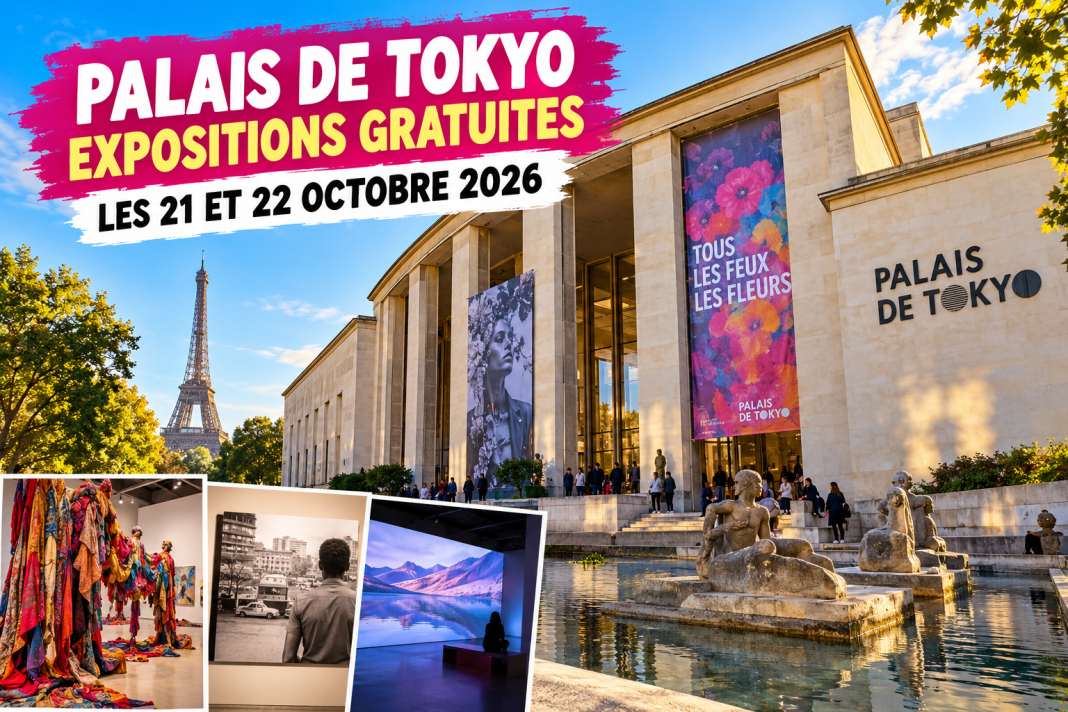

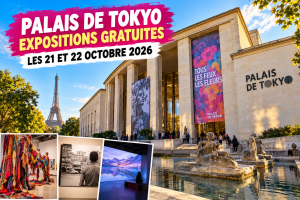
Looking for a free cultural outing in Paris this October? On Wednesday, October 21, and Thursday, October 22, 2026, the Palais de Tokyo is offering two days of free admission to explore the new exhibitions of its fall season. Located in the 16th arrondissement, near the Trocadéro and the Eiffel Tower, this contemporary art center showcases artists with very diverse artistic worlds. The “Tous les feux, les fleurs” program explores, among other themes, territories, collective memories, cultural identities, and representations of the world. This initiative offers a wonderful opportunity to discover contemporary art without paying an admission fee during the announced time slots.
📅 Two days to explore the Palais de Tokyo for free
On Wednesday, October 21, you can visit the exhibitions for free from 12 p.m. to 10 p.m. On Thursday, October 22, free admission is available from 12 p.m. to 5 p.m. These extended hours allow you to tailor your visit to your schedule, whether you’re available in the afternoon or after work. According to official information, no advance reservation is required to take advantage of these two time slots. Before you go, however, check the venue’s program to review any guidelines and plan your itinerary.
The Wednesday evening opening is a great option for those who want to explore the exhibitions after work. You can arrive in the early evening and take your time exploring the different galleries at your own pace. Thursday is better suited for visitors who have part of the day to plan their cultural outing. To enjoy several exhibitions, plan on spending about two hours—or even longer if certain works particularly catch your eye. It’s better to prioritize a pleasant, thoughtful visit rather than trying to rush through all the galleries too quickly.
🔥 “Tous les feux, les fleurs”: An Art Season Exploring Territories
The “Tous les feux, les fleurs” season explores the concept of territory in its geographical, social, cultural, and symbolic dimensions. A territory is not merely a border or a landscape—it also carries stories, memories, and identities. The artists gathered at the Palais de Tokyo explore these questions through various artistic practices, ranging from photography and sculpture to film and installations. Their works address the relationships between individuals, their environment, and the legacies that shape societies. This diversity lends coherence to the exhibition while allowing each artist the freedom to develop their own visual language.
Contemporary art does not always seek to tell a story in a linear manner or to present immediately recognizable images. Rather, some works invite you to observe the materials, forms, and associations of ideas to construct your own interpretation. This approach may come as a surprise on a first visit, but it also allows you to discover unexpected perspectives. Take the time to read the explanatory texts and look at the works before trying to assign them a specific meaning. This way, you’ll be able to enjoy this season’s exhibition even if you don’t have any specific knowledge of art history.
🧵 Sonia Gomes: Textiles Transformed into Works of Art
The exhibition “Cœur sauvage” showcases the work of Sonia Gomes, a Brazilian artist who transforms fabrics, ropes, and salvaged materials into sculptures and installations. The materials she uses sometimes bear traces of their past lives, giving them a sense of memory. Through assemblages, twists, stitches, and volumes, the artist creates forms that seem to evolve within the space. Her work engages with Afro-Brazilian heritage and explores cultural transmission, personal histories, and collective experiences. This exhibition offers a glimpse into how ordinary materials can become the medium for a unique form of artistic expression.
As you tour the exhibition, observe the textures, colors, and the various ways in which the materials come together. Some works emphasize volume, while others draw attention through their details and combinations of materials. You’ll also notice how fabrics and repurposed objects take on a new presence when their function changes. This transformation is one of the most fascinating aspects of Sonia Gomes’s artistic approach. Let your curiosity guide you, and take the time to view the works from multiple angles.
🌍 Valérie John: Memory, Identity, and Cultural Heritage
Valérie John presents “I Telman nwè ki i blé (So Black It Turns Blue),” an exhibition that explores identities and cultural legacies. Her artistic world draws particularly on connections to Martinique and Senegal. This exhibition fits into the season’s overarching theme by exploring the relationships between creativity, history, and place. It invites the public to view cultural references as living elements, capable of evolving and transforming over generations. The exhibition thus adds both a personal and collective dimension to the Palais de Tokyo’s programming.
To explore this approach, pay attention to the artistic choices and references you notice in the works. Some meanings may depend on historical or cultural contexts that aren’t necessarily apparent at first glance. The exhibition texts help contextualize the artist’s approach and enrich your visit. You don’t have to understand everything right away to appreciate an exhibition. Observation, questions, and personal impressions are also part of the cultural experience.
📷 Paul Kodjo: Photography Attuned to Daily Life
The program also includes “Photoromance,” dedicated to photographer Paul Kodjo. This exhibition offers a glimpse of Abidjan and scenes of daily life in Côte d’Ivoire, particularly during the 1970s. Here, photography serves as a way to preserve visual records of an era, its places, and its people. The images allow viewers to focus as much on the people in the photos as on the details of their surroundings. This exhibition will particularly appeal to lovers of photography, urban history, and cultural heritage.
To fully appreciate the photographs, take the time to observe the framing, the expressions, and the elements in the background. Clothing, settings, and everyday situations can provide valuable clues about the era depicted. The images also bridge the gap between individual memory and collective history. By taking the time to compare several photographs, you’ll gain a better understanding of the diversity of scenes and perspectives. This approach transforms the tour into a visual exploration of society and its evolution.
🎬 Rose Lowder: Seeing Landscapes Differently
With “The Source of the Loire and Other Films,” Rose Lowder brings a cinematic dimension to the season. The artist has developed a practice of experimental film that pays particular attention to landscapes, colors, and the movements of living things. Through editing and the possibilities of film, she offers a different way of perceiving moving images. This approach moves away from films that rely primarily on plot and dialogue. Instead, she invites viewers to observe, feel, and discover the visual transformations as the film unfolds.
Experimental film sometimes requires viewers to adjust their viewing habits. Images may unfold at a unique pace, without following a traditional narrative. All you need to do is take the time to observe the movements, colors, and changes in framing. People who appreciate photography, landscapes, or unique visual experiences may find this particularly engaging. Check the on-site information for screening details and to plan your visit.
🏛️ Ali Cherri: The Impact of War on Individuals
Ali Cherri presents “TODAY IS OK,” an exhibition that expands upon his film “La Sentinelle” in a setting featuring sets, sculptures, and installations. The Franco-Lebanese artist explores the effects of war on individuals and their imagination. The film depicts a soldier grappling with the weight of his military role, in a world that blurs the boundaries between reality and dreams. The installation allows cinema to extend beyond the screen and physically occupy the exhibition space. This project invites viewers to reflect on representations of conflict, military symbols, and human vulnerability.
The exhibition also prompts visitors to question the narratives that shape our perception of heroism and authority. The sculptures and scenographic elements contribute to this reflection by subverting certain visual codes typically associated with power. Visitors can thus observe how a work blends multiple disciplines to convey an idea. This approach makes the exhibition particularly interesting for those who wish to explore the connections between cinema and the visual arts. Take the time to explore the various installations rather than limiting yourself to just the film.
🗿 Céleste Richard-Zimmermann: Questioning Architectural Symbols
The exhibition “Not All Columns Have a Heart of Stone” showcases the work of Céleste Richard-Zimmermann. Her artistic universe invites us to examine architectural forms and symbols that traditionally represent authority or stability. Columns, in particular, evoke monuments, institutions, and collective memory. The artist draws on these references to give them new meanings and invite the public to view familiar forms in a different light. This exhibition complements the program by exploring the relationships between objects, representations, and structures of power.
You can approach this exhibition by first observing the forms, materials, and their arrangement in space. Then reflect on the ideas these elements evoke for you and the symbols to which they might refer. Contemporary art often plays on the disconnect between a work’s appearance and the questions it raises. This freedom of interpretation allows everyone to form their own perspective. It makes the visit particularly interesting for those who appreciate sculptural works and reflections on architecture.
ℹ️ Hours, admission prices, and practical information
- Event: Two days of free exhibitions.
- Dates: Wednesday, October 21, and Thursday, October 22, 2026.
- Wednesday: 12 p.m. to 10 p.m.
- Thursday: 12:00 PM to 5:00 PM.
- Admission: Free during the announced hours.
- Reservations: No advance reservations required.
- Address: 13 Avenue du Président-Wilson, 75116 Paris.
- Phone: 01 81 97 35 88.
- Official website: information on the two free days.
Please note: this free admission applies only to the specific time slots announced for these two days. For visits on other dates, please check the standard admission fees and conditions applicable to the various exhibitions. The Palais de Tokyo is also organizing separate events, including the season’s public opening reception scheduled for Thursday, October 22, at 9:00 p.m., with free admission announced. This evening event has its own terms and conditions and does not replace the free admission period for the exhibitions, which ends at 5:00 p.m. Check the official website for the latest information before visiting.
📍 Where Is the Palais de Tokyo? Map and Directions
The Palais de Tokyo is located in Paris’s 16th arrondissement, close to the Eiffel Tower, the Trocadéro and the Seine. Its central location makes it an excellent stop for anyone exploring Paris’s contemporary art scene. Use the map to find the museum and plan your journey from your hotel or another location in the city.
By metro: Take Line 9 and get off at Iéna or Alma-Marceau. You can also use the RER C and get off at Pont de l’Alma, then walk to the museum. Several bus routes serve the surrounding area.
Address: 13 Avenue du Président-Wilson, 75116 Paris, France.
For opening hours, accessibility information and visitor updates, visit the official Palais de Tokyo website.
The Palais de Tokyo is located between the Eiffel Tower and the Champs-Élysées, in Paris’s 16th arrondissement. The map shown here helps you pinpoint the exact location of this contemporary art center and plan your route. You can open the map in Google Maps to find directions from your home or place of stay. The neighborhood also makes it easy to extend your visit with a stroll to the Trocadéro or the banks of the Seine. This location makes it easy to include the museum in a day spent exploring Paris.
By metro: Take Line 9 and get off at the Iéna or Alma-Marceau stations. You can also take the RER C to the Pont de l’Alma station, then walk to the venue. Several bus lines also serve the area, including lines 32, 42, 63, 72, 80, 82, and 92. Parking lots are available nearby for those arriving by car, but be sure to check the rates before you leave. Find all the information on the Palais de Tokyo’s official “Hours and Access” page.
🚶 What to do around the Palais de Tokyo?
You can easily extend your visit with a stroll through western Paris. The banks of the Seine offer beautiful views of the city’s landmarks and let you explore the capital on foot. The Trocadéro is also a great spot to enjoy views of the Eiffel Tower. Weather permitting, plan to spend some time outdoors after the exhibitions to round out your outing without spending any extra money. You can also stop at a local café, keeping in mind that prices can be high in this tourist area.
If you’d like to plan other outings, check out our ideas for cultural activities in Paris. There, you can search for exhibitions, walks, and activities suited to different budgets. Ideally, choose a few attractions that are close to one another to minimize travel time. Also, be sure to check the opening hours and admission requirements for each venue. Planning ahead this way will let you enjoy your day without spending more than necessary.
🚢 A cruise on the Seine to round out the day
After your visit to the Palais de Tokyo, you can add a sightseeing activity to discover Paris from a different perspective. A cruise on the Seine lets you admire several landmarks from the river without having to walk between each site. Some tours depart from the base of the Eiffel Tower and last about an hour. Depending on the package you choose, you’ll have access to an audio guide or live commentary to better understand the history of the sites you pass. This activity is a great way to round out a cultural day, especially if it’s your first visit to the capital.
GetYourGuide offers this one-hour cruise on the Seine departing from the Eiffel Tower. The route allows you to see iconic landmarks such as the Louvre Museum and Notre-Dame Cathedral from the boat. Check the activity details for availability, languages offered, pricing, and booking conditions. This excursion requires a fee and is optional: you can fully enjoy the free exhibitions without booking any additional activities. Simply check the schedule and boarding location if you’d like to combine both visits.
✅ Why take advantage of this free admission?
On October 21 and 22, 2026, the Palais de Tokyo offers a wonderful opportunity to explore its new season without paying admission during the announced hours. The program brings together a wide range of artistic approaches, from photography to textile sculptures, experimental film, and contemporary installations. Each exhibition offers a unique perspective on territories, identities, memories, and representations of the world. This diversity allows visitors to discover artists they haven’t encountered yet and to gain a fresh perspective on contemporary art. The Wednesday evening time slot is particularly convenient for planning an outing after work.
To plan your visit, be sure to note the exact hours and check the official website before heading out. The map included in this article will help you locate the Palais de Tokyo and plan your route by public transportation or on foot. You can then round out the day with a stroll through the neighborhood or a cruise on the Seine, if your budget allows. For more ideas on things to do and great deals, visit City-Paris. All that’s left is to choose your time slot and enjoy this artistic escape in the heart of the capital.