
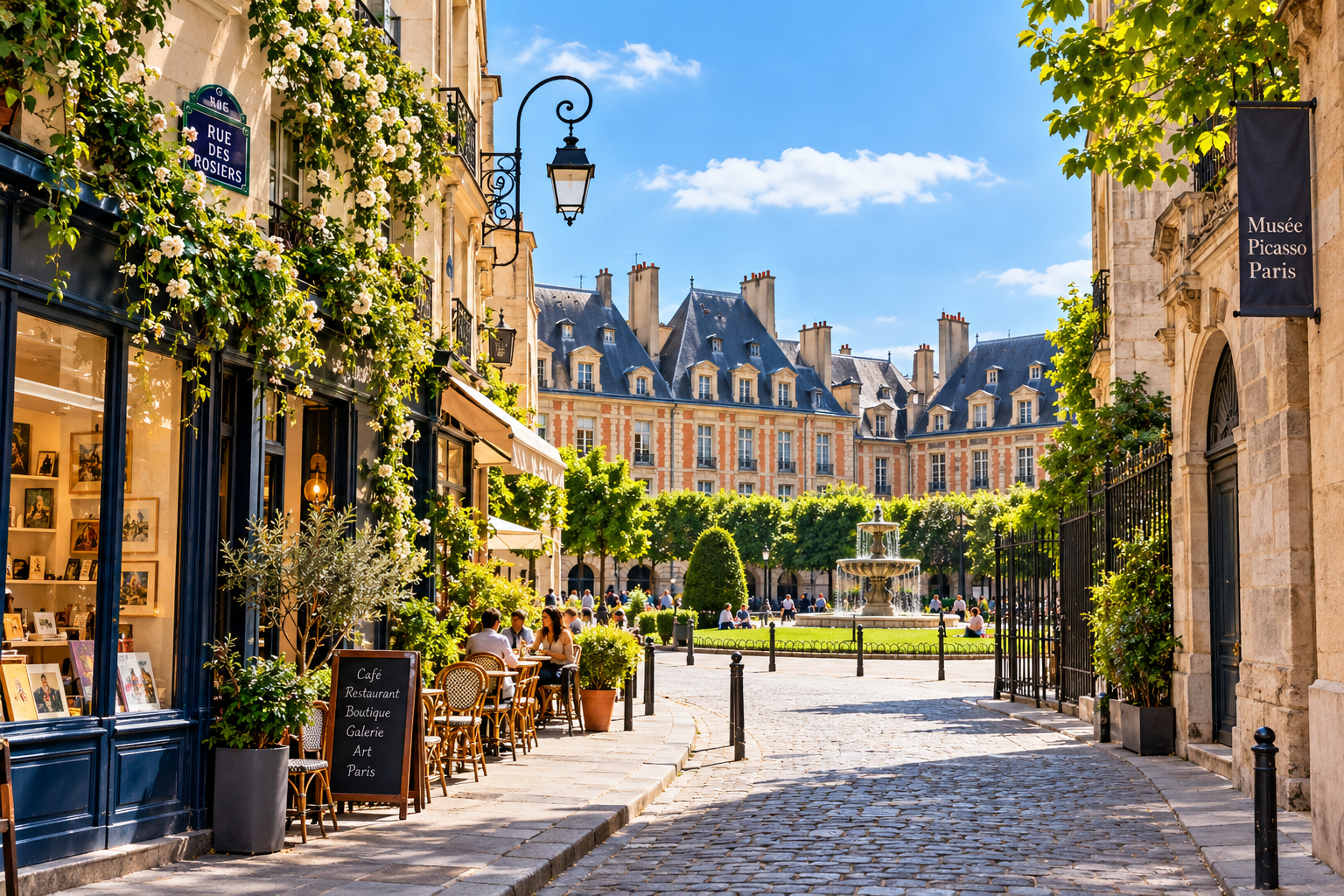
🏘️ Visiting the Marais in Paris: What to See and Do on the Weekend?
An iconic neighborhood on the Right Bank, the Marais is one of the capital’s most popular destinations, beloved by Parisians and visitors alike. Located primarily in the 3rd and 4th arrondissements, it offers a rare concentration of historical landmarks, cultural institutions, independent shops, and gourmet spots—all within an area that’s easy to explore on foot. Its cobblestone streets, 17th-century mansions, art galleries, and the constant bustle of its streets create a unique atmosphere, where the Paris of yesterday is in constant dialogue with the Paris of today.
This density is one of the neighborhood’s main attractions: in just a few minutes’ walk, you can go from a royal square to an internationally renowned museum, then from a designer boutique to a café terrace. On weekends, the Marais draws particularly large crowds, including strollers, shoppers, history buffs, and visitors eager to soak up its vibrant energy. This guide introduces you to the neighborhood’s history, its must-see spots, and an itinerary designed to help you make the most of a day’s visit.
📜 The Marais: A Neighborhood Steeped in History
As its name suggests, the Marais developed on former marshlands that were gradually drained and cultivated during the Middle Ages. This land attracted religious communities, who founded convents and priories there, as well as artisans and merchants who gradually contributed to the area’s urbanization. However, it was in the 17th century that the neighborhood experienced its golden age: having become the preferred residence of the aristocracy and the upper middle class, it was dotted with mansions featuring refined facades, arranged around courtyards and gardens. Many of these exceptional residences have survived to this day and now house some of Paris’s most renowned museums.
The gradual relocation of the royal court to Versailles marked the beginning of a slow decline. Abandoned by the nobility, the mansions were converted into workshops, warehouses, or housing, while artisans and merchants took up permanent residence in the neighborhood’s streets. It wasn’t until the 20th century—and in particular, the major preservation and restoration efforts—that this exceptional architectural heritage was preserved and showcased. The contemporary Marais is the result of this layered history: today, it combines culture, gastronomy, creativity, and nightlife, while preserving an important Jewish heritage centered around Rue des Rosiers and playing a central role in Parisian LGBTQIA+ life.
🏛️ What to see in the Marais? Must-see spots
🌳 Place des Vosges
Inaugurated in 1612 under the name Place Royale, the Place des Vosges is unanimously considered one of the most beautiful architectural ensembles in Paris. Its perfectly symmetrical layout, its red-brick and light-stone pavilions topped with high slate roofs, and its continuous arcades create a setting of remarkable harmony. The central square, shaded and bordered by railings, offers a welcome respite for strollers, while the covered galleries—home to art galleries, cafés, and restaurants—invite visitors to walk around the square to appreciate every detail.
At number 6, Victor Hugo’s house occupies the apartment where the writer lived from 1832 to 1848. The tour allows visitors to explore his living environment, his creative world, and numerous artifacts related to his work and his activism. It is recommended that you check the opening days and hours before visiting.
🎨 The Picasso Museum
The Musée National Picasso-Paris is housed in the Hôtel Salé, one of the most spectacular mansions in the Marais, built in the 17th century. It houses one of the world’s most significant collections dedicated to Pablo Picasso, bringing together paintings, sculptures, drawings, prints, and ceramics that trace his entire career and showcase the diversity of his artistic explorations. The building itself is worth the visit: its grand staircase, spacious interiors, and garden provide a remarkable setting for the works on display. Be sure to allow enough time to fully enjoy the collections, and check the schedule of temporary exhibitions in advance, as they regularly offer fresh perspectives on the artist.
🕰️ The Carnavalet Museum
Dedicated to the history of Paris, the Carnavalet Museum traces the capital’s evolution from its origins to the present day. It occupies two interconnected historic mansions and houses a rich and varied collection: paintings, furniture, reconstructed interior settings, historic signs, everyday objects, and mementos of major events that have shaped the city, foremost among them the French Revolution. This visit offers an excellent introduction to exploring the neighborhood, as it helps put the streets and facades of the Marais into their historical context. Since opening hours and accessible areas may vary, we recommend checking the museum’s official information before your visit.
⛪ Saint-Paul-Saint-Louis Church
Located on Rue Saint-Antoine, the Saint-Paul-Saint-Louis Church is one of the finest examples of 17th-century Parisian religious architecture. Inspired by Italian Baroque models, it stands out for its monumental façade, its slender dome, and the quality of the works of art that adorn its interior. It’s worth stopping by during your walk, provided you respect the services and the worshippers’ quiet contemplation. If the church is open during your visit, take the time to admire its architecture and decorative details, which reflect the artistic splendor of the era.
🖼️ The Pompidou Center and the Stravinsky Fountain
On the edge of the Marais, the Centre Pompidou stands out as one of the symbols of contemporary architecture in Paris, with its metal structures and colorful technical systems deliberately left exposed on the facade. Its surroundings also feature the Stravinsky Fountain, whose colorful, moving sculptures—designed by Jean Tinguely and Niki de Saint Phalle—rank among the most photographed public artworks in the capital. It should be noted, however, that access to the Centre Pompidou may change due to renovation work and scheduled closures: be sure to check official information before planning an indoor visit.
-15%BOOKING.COMExclusive offer15% off Paris hotels with Booking.com- No conditions at all
- Hotels and stays
- Booking in a few clicks
🥙 Rue des Rosiers and the Jewish Heritage of the Marais
Rue des Rosiers is one of the neighborhood’s most iconic streets. As the historic heart of the “Pletzl,” it retains an identity closely tied to the history of Paris’s Jewish community, evident in its shops, restaurants, bakeries, and storefront signs. A stroll down this street and through the neighboring passageways reveals a diverse array of culinary delights, where falafels, hearty sandwiches, and Jewish-inspired pastries from Central and Eastern Europe are among the specialties most appreciated by visitors.
The area is particularly busy on weekends, especially around lunchtime. To enjoy the most popular spots without hassle, it’s best to expect a wait or visit during off-peak hours. This is also a residential neighborhood: please be mindful of the residents’ peace and quiet and respect access to the buildings.
🛍️ Shopping in the Marais
The Marais is one of the most pleasant neighborhoods in Paris for shopping on foot. Its streets are home to a particularly diverse range of shops, featuring designers, independent boutiques, concept stores, home decor shops, bookstores, and thrift stores. Rue des Francs-Bourgeois, Rue Vieille-du-Temple, and the streets radiating out from Rue de Bretagne in the Haut-Marais are home to many of these shops, offering visitors the chance to discover unique collections that often stand apart from what you’ll find at traditional big-box retailers.
Near City Hall, the BHV Marais rounds out this experience with a more general selection. The best advice, however, is to wander without sticking to a strict itinerary: it’s often around a corner or in an inner courtyard that you’ll make the most delightful discoveries.
🍴 The Enfants Rouges Market
Located on Rue de Bretagne, the Enfants Rouges Market is a must-visit spot for lunch in the Haut-Marais. Founded in the 17th century, it’s generally considered the oldest covered market in Paris still in operation. Its stalls offer fresh produce as well as a wide variety of international cuisines, making it an ideal option for a casual meal: everyone can choose their favorite specialty before finding a seat—depending on availability—at the communal tables. Very busy at lunchtime, especially on weekends, the market has specific opening days and hours, so it’s a good idea to check them before heading out.
🎭 What to do in the Marais on the weekend?
On the weekend, the Marais is perfect for a day of exploration on foot, punctuated by a mix of cultural visits, culinary breaks, and leisurely strolls. You can start the morning with coffee on a sidewalk terrace, follow up with a museum visit, have lunch at one of the neighborhood’s restaurants, and then spend the afternoon exploring boutiques and art galleries. In the evening, bars, cafés, and nightlife spots take over, contributing to the lively atmosphere for which the neighborhood is renowned. The Marais also plays a major role in Paris’s LGBTQIA+ scene, particularly along several streets in the 3rd and 4th arrondissements.
To fine-tune your itinerary, check the museums’ schedules, temporary exhibitions, and events taking place during your stay. Since the hours of shops and cultural venues can vary from day to day, checking in advance will help you plan your day without any unpleasant surprises.
🚶 A one-day itinerary for exploring the Marais
☕ Morning: History and Culture
Start your day at Place des Vosges, which you’ll appreciate all the more since it’s still relatively quiet early in the morning, then continue on to Victor Hugo’s house if it’s open. Next, head to the Carnavalet Museum or the Picasso Museum, both located just a few minutes’ walk away. To ensure you have enough time for the rest of your itinerary, it’s best to visit only one major museum per day.
🥙 Lunch: a gourmet break
For lunch, head to Rue des Rosiers and its iconic spots, or walk up toward the Haut-Marais to enjoy the diverse offerings at the Marché des Enfants Rouges. Both of these options have the advantage of fitting naturally into your itinerary and allow you to continue your stroll without having to cross the city.
🛍️ Afternoon: Shopping and Strolling
Spend the afternoon exploring Rue des Francs-Bourgeois, Rue Vieille-du-Temple, and the surrounding alleyways. Look up to admire the facades of the mansions, step inside any shops that catch your eye, and don’t hesitate to peek into the inner courtyards when they’re accessible. You can wrap up your day near City Hall or continue your stroll to the banks of the Seine, which are especially pleasant in the late afternoon.
📍 Practical Information for Visiting the Marais
How much time should you allow? Half a day is enough to explore the neighborhood’s main streets and discover the Place des Vosges. To comfortably combine a museum visit, lunch, and some shopping, it’s best to set aside a full day.
How to get there? The neighborhood is served by numerous metro stations, including Saint-Paul, Hôtel de Ville, Chemin Vert, Rambuteau, and Arts et Métiers. Which station you choose will depend primarily on the first place you’d like to visit.
When to visit? The Marais is worth visiting any time of year. Mornings are generally quieter, while weekend afternoons tend to be the busiest. Since walking is the best way to explore the neighborhood, comfortable shoes are highly recommended.
Should you make a reservation? For museums and certain temporary exhibitions, it’s advisable to check admission requirements and book a time slot when recommended. A reservation may also be helpful for the most popular restaurants, especially on weekends.
🗓️ Plan your weekend in Paris with City-Paris
While the Marais alone offers enough to fill a busy day, your stay can also be an opportunity to check out an exhibition, see a show, or take part in an activity in another neighborhood of the capital. Check out our guide for ideas on things to do for your next weekend in Paris.
❤️ Why visit the Marais during your stay?
The Marais embodies much of what makes Paris so charming: exceptional architectural heritage, world-class museums, streets perfect for strolling, and a vibrant commercial scene that keeps the neighborhood alive. Whether you have a few hours to discover the must-see sights or a whole day to alternate between culture, shopping, and culinary breaks, the neighborhood is sure to satisfy your desires. Take the time to admire the facades, inner courtyards, and architectural details—each of which, in its own way, tells the story of several centuries of Parisian history.
The Marais certainly deserves a prominent place on your itinerary: just stroll down a few streets to go from the elegance of the Grand Siècle to one of the liveliest and most creative facets of contemporary Paris.