



🗼 Eiffel Tower: 25 Secrets Tourists Don’t Know
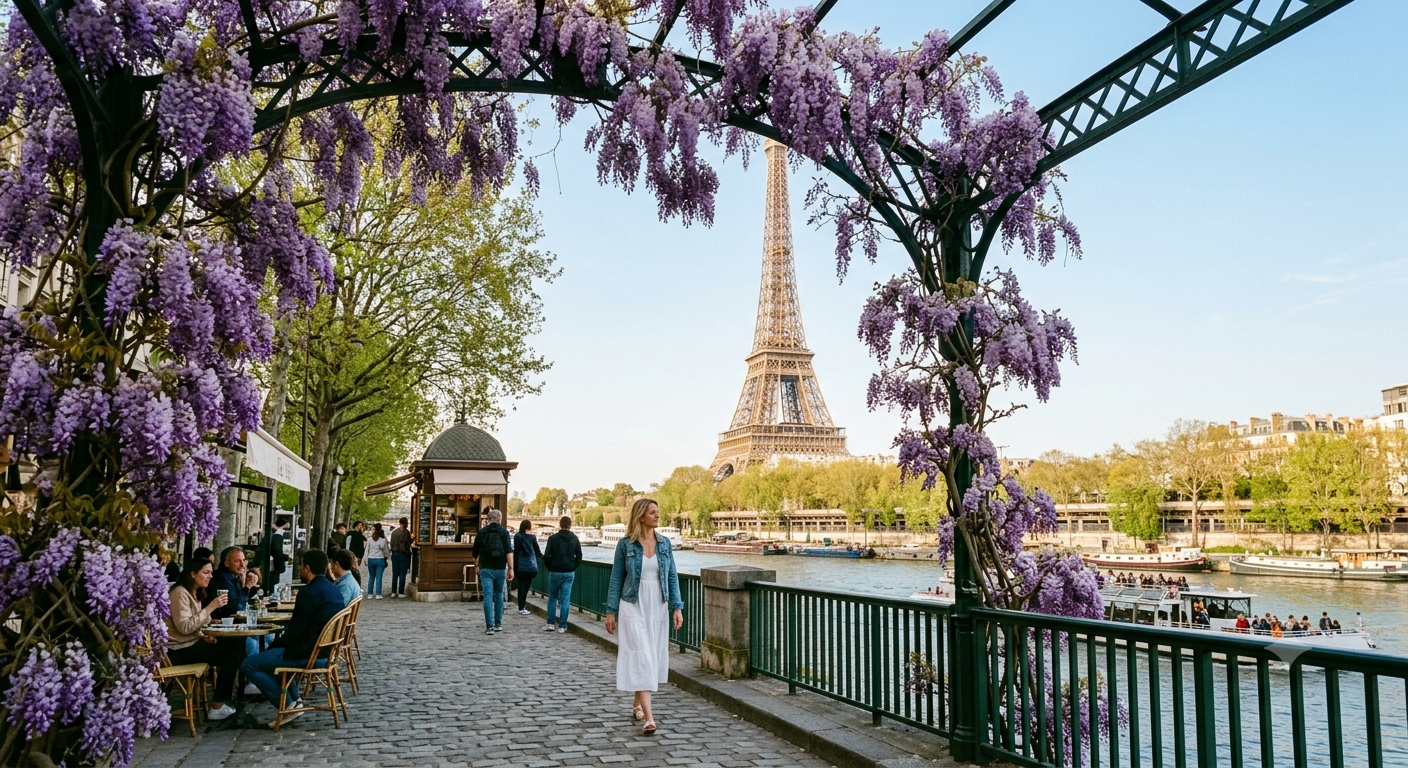
You’ve probably seen the Eiffel Tower in photos hundreds of times. But will you really know how to appreciate it when you’re standing right in front of it?
Most visitors arrive at the Champ-de-Mars, look up, take a few photos, and start their tour. Yet the Eiffel Tower hides a multitude of details that are easy to miss: names engraved in the metal, a former private space belonging to Gustave Eiffel, hidden technical areas, surprising stories, and vantage points that completely change your perception of the monument.
So this guide isn’t just a simple historical overview. It’s a real treasure hunt to go on during your visit.
Save this page on your phone and follow the different steps. Several times, we’ll ask you to stop, look behind you, or simply look up.
🕵️ Secret #1: Don’t look at the Eiffel Tower right away
When you arrive at the Champ-de-Mars, resist the urge to immediately pull out your phone for a few seconds.
Start by looking at the ground.
Try to imagine a huge square with sides about 125 meters long. The four legs of the Eiffel Tower each occupy one corner of this gigantic geometric figure.
The challenge: Stand roughly in the center of the Tower and slowly look up.
You’ll see the four pillars extend in four directions before gradually converging at the top.
You’re no longer just looking at a monument—you’re looking at a gigantic structure designed to distribute forces.
🔩 Secret #2: Get closer to discover another Eiffel Tower
From a distance, the Eiffel Tower appears almost smooth.
Get closer to its base.
You’ll then discover a multitude of beams, cross-braces, and rivets.
The Tower has approximately 18,038 metal parts and 2.5 million rivets.
Here’s a tip: take a photo of a metal assembly from just a few meters away. Then take the same photo from several dozen meters away.
You’ll see just how much perspective completely transforms the monument.
🚪 Secret #3: Look for the spots that visitors never see
The Eiffel Tower contains numerous technical areas that are off-limits to the public.
Service staircases, technical installations, maintenance rooms, and staff-only areas form a veritable network hidden behind the parts accessible to visitors.
So, is there a mysterious “secret hatch” leading to a forgotten room?
The reality is less romantic but much more interesting: the Tower does indeed have areas that ordinary visitors cannot access.
However, these technical areas should not be confused with the many legends circulating on the Internet.
🏠 Secret #4: Look for Gustave Eiffel’s retreat at the top
At the top is one of the monument’s most famous and mysterious spaces: Gustave Eiffel’s private office.
Eiffel had set aside a space where he could work, receive guests, and conduct certain experiments.
The space does not resemble a luxurious apartment. It was, above all, a workspace and reception area.
Where to look? When you reach the top, look for the glass panels through which you can view the reconstruction of the office.
In particular, you’ll be able to see the wax figures depicting Gustave Eiffel and some of his visitors.
🎩 Secret #5: The visitor who met Eiffel at the top
Take a close look at the scene set up in the office.
You’ll recognize Thomas Edison, among others.
The American inventor did indeed meet Gustave Eiffel in Paris in 1889.
Edison then presented Eiffel with a phonograph.
Imagine the scene: two major figures of the Industrial Revolution gathered at the top of the most spectacular structure of the era.
Remember: when you look at this reenactment, you’re standing in a place associated with a real historical encounter.
🔬 Secret #6: Gustave Eiffel wanted to save his Tower through science
The Eiffel Tower was originally intended to be temporary.
Gustave Eiffel therefore quickly sought to demonstrate its usefulness.
He gradually transformed the monument into a gigantic scientific laboratory.
The Tower’s height made it possible to conduct meteorological observations and experiments in various scientific fields.
The Tower also became an important site for early experiments in wireless communications.
The secret: science wasn’t just a hobby for Gustave Eiffel. It helped secure the monument’s future.
🧑🔬 Secret #7: The scientists are right before your eyes
On the first floor, look for the long frieze that wraps around the Tower.
There you’ll find the names of 72 scientists and engineers.
Ampère, Lavoisier, Laplace, Cauchy, Fourier, Gay-Lussac, and Fresnel are among them.
Your mission: Choose a name you recognize and look for it on the frieze.
This simple search turns a stroll into a real game of observation.
👩🔬 Secret #8: Look at the frieze with a modern eye
The original list of scientists also tells part of the social history of the19th century.
The 72 original names are all male.
Today, initiatives are working to better represent women scientists in the monument’s legacy.
When you look at the frieze, don’t just see names. See, too, a reflection of the era in which the Eiffel Tower was built.
⚰️ Secret #9: A Tragic Story Tied to the Tower
The construction of the Eiffel Tower took place under conditions that were remarkable for the time.
The main structure was assembled without any fatalities among the workers directly involved in the assembly.
However, a fatal accident occurred after the inauguration while work on the elevators was still underway.
This historical detail is important: the Tower’s inauguration did not mean that all work had been completed.
🌬️ Secret #10: The Eiffel Tower actually moves
When you’re at the top, you might get the impression that everything is perfectly still.
That’s not the case.
The wind causes slight movements in the structure. Temperature changes also cause the metal to expand.
Try this experiment: when the wind blows, observe the elements around you and imagine the forces acting on the thousands of metric tons of metal.
The structure was specifically designed to withstand these stresses.
📡 Secret #11: Look for the antennas that changed its fate
The Eiffel Tower now stands at approximately 330 meters.
This height far exceeds that of the original monument.
The antennas installed at the top have gradually transformed the Tower’s silhouette.
Above all, they have enhanced its importance for communications.
At the top: look up. Part of what you see today belongs to a history much more recent than that of Gustave Eiffel.
💰 Secret #12: The Eiffel Tower Was “Sold”
One of the most famous scams in Parisian history directly involves the Eiffel Tower.
In the 1920s, Victor Lustig convinced several scrap metal dealers that the monument was going to be dismantled and sold.
He staged a fake auction and managed to convince André Poisson to pay him a large sum of money.
Lustig then disappeared.
Why is this story so incredible? Because one man managed to turn the real questions surrounding the Tower’s future into a particularly credible scam.
📰 Secret #13: Le Figaro had a newsroom in the Tower
Imagine taking the elevator up to the second floor and discovering a newspaper newsroom.
Yet that is exactly what happened during the 1889 World’s Fair.
Le Figaro had set up a small newsroom in the Tower.
There was even a printing press that allowed the newspaper to be produced right on site.
The Eiffel Tower was thus at once a monument, an attraction, a laboratory, and a workplace.
🥖 Secret #14: A man climbed the tower on stilts
A few months after the Tower opened, the first feats began.
Sylvain Dornon, a baker from the Landes region, climbed the stairs to the first floor on stilts.
He climbed the 347 steps leading to the first floor in this rather unusual way.
The Tower quickly became a favorite setting for the most surprising feats.
🚲 Secret #15: Someone rode a bike down the Tower
The feats didn’t stop there.
In 1923, Pierre Labrie rode his bike down from the first floor.
Over the decades, others would go on to achieve even more spectacular feats around the monument.
Warning: These historic feats are obviously not permitted activities for visitors.
👀 Secret #16: The best view isn’t always at the top
Here’s a common mistake visitors make.
They assume the best view is necessarily at the highest point.
However, the second floor offers a particularly interesting perspective.
Paris’s landmarks remain close enough to be easily recognizable.
At the top, the panorama becomes much wider, and the city seems almost miniature.
Tip: Take at least one photo from each accessible level.
🧭 Secret #17: Turn the summit into a giant map
Once you reach the top, don’t start your photo session right away.
Look for the orientation signs.
They’ll help you identify different directions and distances.
Family game: Choose a city listed on the sign and try to guess how far away it is before checking the answer.
You’ll discover Paris from a completely different perspective.
🌆 Secret #18: Look Behind You
When you’re at a famous viewpoint, your gaze naturally turns toward the monument that everyone is photographing.
At the Eiffel Tower, do exactly the opposite.
Turn around.
Look at the lesser-known neighborhoods, the rooftops, the streets, and the Seine.
You’ll sometimes discover a much more authentic view of Paris than the one on postcards.
🎨 Secret #19: The Eiffel Tower has changed color
The Tower hasn’t always been the color you see today.
Over the course of its history, several painting campaigns have altered its appearance.
Its current color is part of a long evolution.
Tip: Look at the Tower at sunset. The light further transforms the various metal surfaces.
🏗️ Secret #20: Look at the beams like an engineer
Get up close to a metal section and look for the diagonal members.
You’ll see that the Tower doesn’t look like a huge wall of metal.
Its structure functions like a gigantic truss.
This design reduces wind resistance while maintaining exceptional strength.
It’s one of the reasons the Tower seems so light despite its weight.
🌙 Secret #21: Come back to see the Tower after dark
The Eiffel Tower takes on a completely different atmosphere once the sun goes down.
Its lighting and twinkling lights make it one of the most recognizable sights in Paris.
Tip: If your schedule allows, plan to visit the monument twice: once during the day and once after dark.
📐 Secret #22: The four pillars aren’t just decorative
From the Champ-de-Mars, take a close look at the base of the Tower.
Their curved shape isn’t just meant to create an elegant silhouette.
It directly addresses the mechanical stresses imposed by weight and wind.
Gustave Eiffel and his engineers designed every part of the structure to gradually transfer forces down to the foundations.
Look at the curve of the pillars: you’re observing an architectural solution to an engineering problem.
🗼 Secret #23: The Eiffel Tower Could Have Disappeared
This may be the most important secret of all.
The Eiffel Tower was not meant to remain in Paris forever.
It was built for the 1889 World’s Fair, and its long-term preservation was not guaranteed.
Its scientific value and its role in communications gradually reinforced its usefulness.
Without this new function, its history might have been very different.
🔎 Secret #24: Look for the details that no one photographs
The Eiffel Tower has an astonishing feature: the closer you get, the more you discover.
Visitors usually photograph the entire silhouette.
But the most interesting details are sometimes just a few meters away from you.
Look closely at the joints, bolts, rivets, inscriptions, beams, and changes in perspective.
Take a close-up photo of a metal component.
You’ll end up with an almost abstract photograph that bears no resemblance to a typical tourist snapshot.
🎯 Secret #25: Go on this secret hunt during your visit
Here’s your final itinerary to save on your phone.
Step 1 — Champ-de-Mars: Imagine the square formed by the four pillars.
Step 2 — Under the Tower: Observe the curves and the metal structure.
Step 3 — First Floor: Look for the 72 scientific names.
Step 4 — First Floor: Observe the rivets and joints.
Step 5 — Second Floor: Look for the best vantage points to view Paris.
Step 6 — Summit: Look for the reconstruction of Gustave Eiffel’s office.
Step 7 — Summit: Take a look at the orientation panels.
Step 8 — Before leaving: look up at the Tower from the ground and try to spot the details you discovered.
🗼 The City-Paris Challenge
How many secrets will you actually have found during your visit? Write down your discoveries and try to find at least five details you’d never noticed before.
❤️ The next time you see the Eiffel Tower, you’ll never look at it the same way again
The Eiffel Tower is probably the Parisian landmark we think we know best.
Yet, all it takes is a different perspective to uncover a completely different story.
You can view it as a work of architecture, as an engineering feat, as a scientific laboratory, or as a witness to over a century of history.
You can also simply set out to discover its little secrets.
So the next time you’re in front of the Eiffel Tower, don’t take your photo right away.
Look up.
Look at the rivets.
Look for the names.
Turn toward Paris.
Look for Gustave Eiffel’s office.
And above all, take a few minutes to observe what other visitors aren’t looking at.
Perhaps the real tour of the Eiffel Tower begins when you stop simply taking pictures of it.
🎟️ Plan Your Visit to the Eiffel Tower
Want to explore the Eiffel Tower and make the most of its different levels? Plan your visit in advance and choose a package that fits your stay in Paris.
🗼 Visit the Eiffel Tower
Book your experience and discover Paris from one of the world’s most famous landmarks.
📚 Continue exploring Paris
The Eiffel Tower is just one of the landmarks that hide amazing stories. Check out our other guides dedicated to the capital’s must-see landmarks, museums, and experiences.
Also check out our other guides
Explore City-Paris articles about the Eiffel Tower and Paris
Official Information