




This incredible photo of the Eiffel Tower seen from space is captivating the Internet
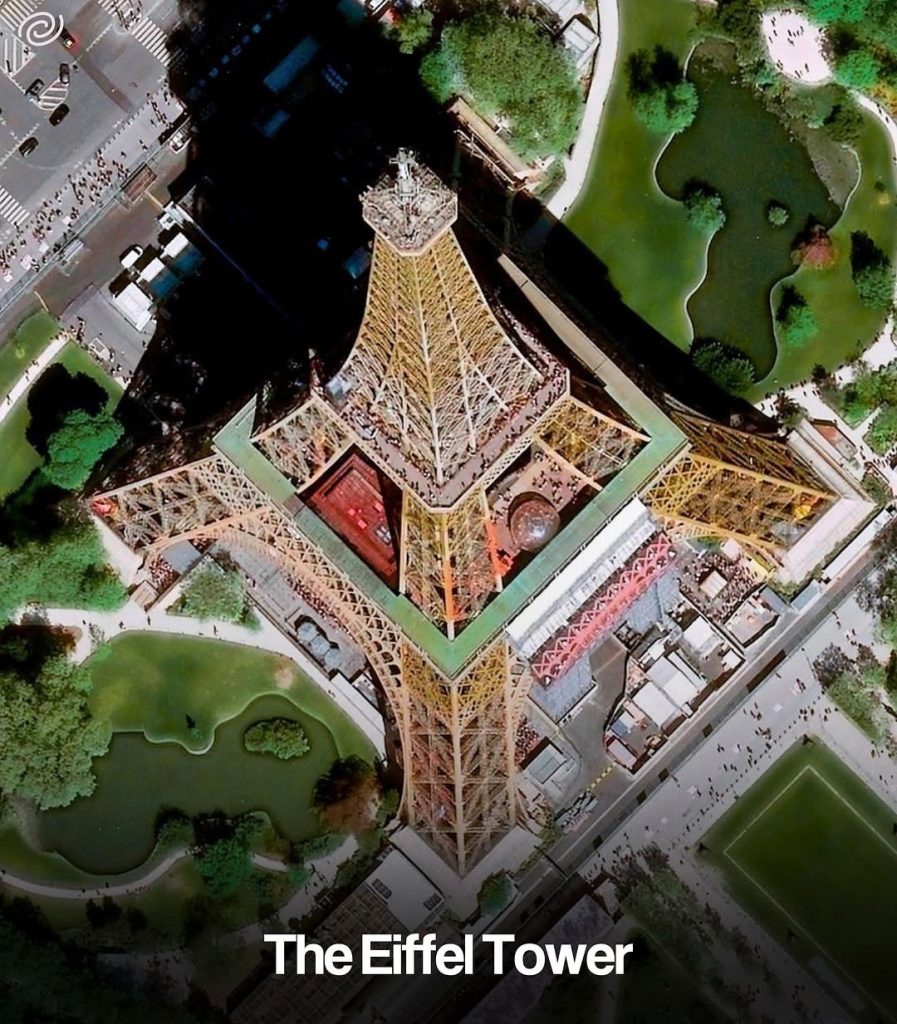
We thought we’d already seen the Eiffel Tower from every angle, but this spectacular image proves otherwise. Photographed perfectly from a vertical perspective, the Iron Lady takes on a completely different appearance from the one visitors see every day from the Champ de Mars or the Trocadéro. Its four immense pillars form an almost perfect geometric figure, and the people at its base appear tiny. The gardens, fountains, avenues, and neighboring buildings almost give the impression of looking at a gigantic model of Paris. This image is all the more impressive because it’s presented online as a view taken from space. It’s sometimes associated with NASA, but its history is actually more complex and offers a glimpse into the incredible advances made in the field of satellite imagery.
🗼 The Eiffel Tower as you’ve probably never seen it
When you stand in front of the Eiffel Tower, it’s obviously its height that immediately impresses you. With its hundreds of meters of steel structure, it towers over much of western Paris and remains visible from many neighborhoods across the capital. This photograph, taken directly above the monument, completely reverses that perception and reveals the structure from an unusual angle. The four pillars appear to be arranged around an almost perfectly symmetrical square, while the tower’s various levels overlap in the center of the image. Visitors become tiny dots, and the cars help convey the monument’s gigantic scale. Even for someone who knows Paris inside and out, it takes a few seconds to realize that you’re indeed looking at one of the world’s most famous monuments.
The tower’s immediate surroundings also become much easier to grasp from this perspective. The Champ de Mars, the gardens, the fountains, and the major thoroughfares appear as the various pieces of a vast urban plan. This view, in particular, helps explain why the Eiffel Tower’s location plays such an important role in the Parisian landscape. The monument isn’t isolated but stands at the center of an architectural and landscape ensemble designed around major thoroughfares. This also explains why the photographs taken from the Trocadéro are so spectacular. From the sky, this layout becomes even clearer.
🛰️ A NASA photo? Not exactly
This image is sometimes shared online with a caption suggesting that it was photographed by NASA. The association seems plausible since the U.S. space agency does indeed have numerous photographs of Paris taken from space. However, we must not confuse the photographs taken by astronauts from the International Space Station with the images produced by modern Earth-observation satellites. The extremely vertical and detailed view accompanying this article is the kind of very high-resolution imagery that commercial satellites—such as those in the Pléiades Neo constellation operated by Airbus—are now capable of producing. These technologies enable a level of precision that would have seemed extraordinary just a few decades ago. It would therefore be incorrect to claim that this precise image was photographed by a NASA astronaut from a porthole on the International Space Station.
The confusion is understandable, however, because NASA has indeed photographed the Eiffel Tower from space on several occasions. A particularly interesting photograph was taken on August 18, 2018, from the International Space Station and remains in the U.S. agency’s official archives. At the time the photo was taken, the ISS was orbiting approximately 396 kilometers above Earth. The camera used had an impressive focal length of 1,600 millimeters, allowing for an extremely detailed image despite this considerable distance. The original photograph has a resolution of 5,568 by 3,712 pixels, and NASA’s description explicitly identifies Paris and the Eiffel Tower. You can view this authentic photograph of Paris directly in NASA’s archives.
🤯 How can an image taken from space be so precise?
The level of detail in some modern satellite images is probably what surprises people the most when they see this type of photograph. Many people still imagine that a satellite must be so far away that it can only distinguish entire cities, mountains, or vast territories. However, some observation satellites operate in low Earth orbit and are equipped with extremely sophisticated optical systems. The Pléiades Neo satellites, in particular, can provide commercial images with a stated native resolution of approximately 30 centimeters. Such precision makes it very easy to identify buildings, roads, vehicles, and many other features of the urban landscape. When a landmark as imposing and recognizable as the Eiffel Tower is photographed, the result can therefore give the impression of a shot taken from an airplane.
It’s also important to understand that the final image we see isn’t necessarily comparable to a conventional photograph taken with a phone. Satellites are equipped with specialized sensors, and the data collected can be processed to produce a particularly clear representation of the Earth’s surface. Modern systems are designed to map cities, monitor infrastructure, and track changes in the landscape with impressive precision. Paris is, of course, a particularly spectacular setting for showcasing the capabilities of these technologies. The density of the buildings, the wide avenues, the Seine, and the many monuments make the French capital instantly recognizable. The Eiffel Tower thus becomes one of the most obvious landmarks in the midst of this vast urban landscape.
🚀 NASA actually photographed Paris from space
Long before the 2018 photograph, Paris had already caught the attention of astronauts. On January 7, 2008, the Expedition 16 crew aboard the International Space Station took a remarkable photograph of the French capital. A digital camera equipped with an 800-millimeter lens was used to photograph the city from Earth’s orbit. In the image released by NASA, the Eiffel Tower can be identified by its distinctive silhouette and its urban surroundings. Light and shadow also help highlight certain landmarks in the heart of the city. This true space photograph is very different from the extremely close-up vertical view circulating today, which clearly illustrates the difference between a photograph taken from the ISS and a very high-resolution satellite image.
Viewing Paris from several hundred kilometers away also offers a completely different perspective on the capital. The Seine becomes one of the most easily identifiable features, and its course draws a distinct line through the metropolitan area. Large green spaces stand out more than when walking at street level, and certain major thoroughfares help illustrate Paris’s overall layout. Monuments that seem gigantic when viewed up close become tiny features in the midst of a vast metropolis. The Eiffel Tower, however, retains one particularly useful distinguishing feature: its shape is unlike that of any other building in Paris. It is this combination of unique architecture and remarkable location that makes it a particularly interesting subject for photographs taken from the sky and from space.
🌍 Can you really see the Eiffel Tower from space?
To say that the Eiffel Tower is visible from space does require some explanation. From the International Space Station, which is generally located at an altitude of about 400 kilometers, astronauts can obviously see Paris when weather and lighting conditions permit. However, this does not mean that an astronaut glancing briefly out a porthole will immediately see the Eiffel Tower the way one might recognize a landmark from an airplane. At that distance, its size appears minuscule compared to the entire Paris metropolitan area. The powerful telephoto lenses used for photography, on the other hand, provide considerable magnification and reveal details that would be much harder to identify with the naked eye. It is therefore largely thanks to the capabilities of cameras and sensors that we can now admire these extraordinary views.
☀️ The Eiffel Tower was even used in an astonishing experiment from space
The connection between space observation and the Eiffel Tower goes beyond beautiful photographs. On July 23, 2000, NASA’s Terra satellite observed Paris using the ASTER instrument, designed to study the Earth’s surface. In the resulting image, the Eiffel Tower—and especially its shadow—could be distinguished. By using the length of this shadow and knowing the Sun’s position, it was possible to estimate the monument’s height using geometry. This experiment perfectly illustrates the wealth of scientific information that an image taken from space can contain. Behind a spectacular photograph, therefore, lies data that allows us to study buildings, landscapes, vegetation, and the evolution of cities.
🎟️ Discover the Eiffel Tower During Your Stay in Paris
After seeing the Eiffel Tower from space, the most spectacular experience is, of course, to climb the monument itself. The tour allows you to explore several levels and view Paris from a completely different perspective than the one you’re used to seeing from the streets of the capital. On a clear day, the view stretches far into the distance, allowing you to spot the Trocadéro, Les Invalides, Montmartre, the Seine, and many other must-see Parisian landmarks. However, during peak times, crowds can be heavy, so it’s best to plan your visit before arriving on site. You can browse the tours and experiences available around the Eiffel Tower on GetYourGuide to compare the different options. A late-afternoon visit can be particularly enjoyable since, depending on the season, it allows you to watch Paris gradually light up.
Another spectacular way to explore the area is to view the Eiffel Tower from the Seine. The monument is located right next to the river, and some river cruises take you past several of the capital’s most famous landmarks in a single trip. This experience is especially enjoyable for first-time visitors because it offers a different perspective on Notre Dame, the Louvre, the historic bridges, and, of course, the Iron Lady. There are frequent departures throughout the year, and some companies also offer tours just as Paris begins to light up. You can browse the various Seine river cruises available on GetYourGuide and choose the one that best fits your itinerary. To continue planning your trip, check out our ideas for things to do in Paris.
🏨 Where to stay near the Eiffel Tower?
Staying near the Eiffel Tower can be an excellent choice for your first trip to Paris, especially if you want to enjoy the monument early in the morning or return to see it when it’s lit up at night. The neighborhood offers a variety of accommodation options and provides easy access to the Seine, the Champ de Mars, Les Invalides, and the Trocadéro. Among the well-known hotels in the area, the Pullman Paris Tour Eiffel is located particularly close to the monument, while the Hôtel La Comtesse offers another option in the 7th arrondissement. The Hôtel Eiffel Trocadéro is also an attractive option for travelers who prefer to stay on the other side of the Seine. Prices can vary greatly depending on the dates, school breaks, and major events taking place in Paris, so it’s a good idea to compare availability before booking. You can view available hotels near the Eiffel Tower on Booking and compare their locations directly on the map.
📸 The Best Spots to Photograph the Eiffel Tower
It’s impossible for a visitor to get exactly the same perspective as a satellite, but fortunately, Paris offers many spots where you can photograph the Eiffel Tower from very different angles. The Trocadéro remains the most famous vantage point thanks to its position perfectly aligned with the monument and the Champ de Mars. The banks of the Seine offer a more quintessentially Parisian atmosphere and allow you to include bridges, boats, and building facades in your shot. Rue de l’Université has also become extremely popular with visitors seeking a more intimate perspective among the Parisian buildings. To gain even more height, several terraces and observation decks also let you take in the tower set against the entire Parisian landscape. Check out our other suggestions by browsing our selection of the most beautiful views of the Eiffel Tower.
❤️ An image that lets us rediscover Paris’s most famous landmark
Millions of photographs of the Eiffel Tower are taken every year, and it seemed almost impossible to find yet another truly surprising angle. Yet this incredible vertical view manages to completely transform the monument by revealing its geometry, its proportions, and the layout of its immediate surroundings. It also shows just how far Earth observation technologies have advanced and how they can now provide images of spectacular precision. It’s important to avoid a common misconception: automatically attributing all impressive images taken from space to NASA. While the U.S. agency does have authentic photographs of Paris taken from the International Space Station, modern commercial satellites are also capable of producing extraordinary views of the capital. More than 130 years after its inauguration, the Eiffel Tower still manages to surprise us and reveal a side of itself that even many Parisians have probably never seen before.