




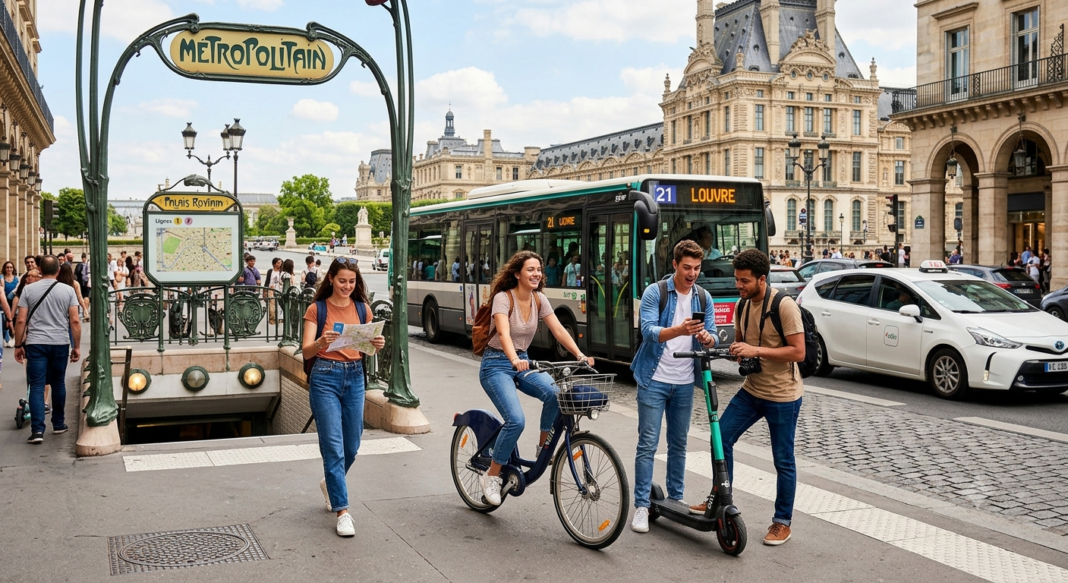

🗺️ How to Get Around Paris? Tips, Fares, and Transportation

Visiting Paris promises an unforgettable adventure. However, navigating a metropolis of several million people can sometimes be daunting for travelers. The City of Light boasts an extremely dense transit network. You’ll find metro stations nearly every 500 meters. However, to avoid stress, you need to know how to get around Paris with ease. This practical guide explains how to choose your route, save money on tickets, and save precious time every day.
🚇 The Paris Metro: Speed, Schedules, and Day-to-Day Operations
The metro remains the fastest way to get around the capital. The network consists of 16 lines numbered 1 through 14, plus the 3bis and 7bis branch lines. It serves more than 300 stations within Paris and its inner suburbs. Trains run daily from 5:30 a.m. to 1:15 a.m. on weekdays. On Friday and Saturday evenings, service runs until 2:15 a.m.
First, locate the direction of your line on the display panels. The direction always corresponds to the line’s terminal station. For example, on Line 1, you can choose the direction toward Château de Vincennes or La Défense. Next, follow the colored signs on the corridor walls to make your transfers without any mistakes.
Also, try to board the middle cars to make it easier to exit at large stations. Automated metro lines such as Lines 1, 4, and 14 run very frequently. You’ll rarely wait more than two minutes on the platform during the day. To read other practical guides on urban transit systems, check out our comprehensive guide to the Navigo pass in Paris.
🚆 RER and Transilien: Traveling to the Suburbs and Airports
The RER (Réseau Express Régional) network consists of five lines designated by the letters A through E. These trains cross Paris faster than the metro because they make fewer stops. As a result, the RER is ideal for long distances from east to west or north to south.
In addition, the RER serves major tourist attractions located outside the city limits of Paris. Take the RER A to reach Disneyland Paris in Marne-la-Vallée. The RER C takes you directly to the Palace of Versailles. Transilien trains (lines H, J, K, L, N, P, R, U) depart from major stations such as Gare du Nord or Gare Saint-Lazare and travel throughout the Île-de-France region.
✈️ How do you get to Roissy-CDG and Orly airports from downtown?
To reach Paris-Charles de Gaulle Airport (CDG), take the RER B from downtown Paris (Gare du Nord, Châtelet-Les Halles, or Saint-Michel Notre-Dame). The trip takes about 35 to 45 minutes and costs €11.85 per adult. Trains run from 4:50 a.m. to 11:50 p.m., with departures every 7 to 15 minutes.
To get to Orly Airport, you can now use the extension of Metro Line 14. This option offers a fast, direct connection from Châtelet or Gare de Lyon in just 25 minutes. The special ticket for Orly Airport costs €10.30. This way, you avoid the risk of getting stuck in traffic during rush hour.
🚌 Buses and Trams: Travel Above Ground with Views of the Capital
If you’d like to admire the sights while you travel, choose the bus network. More than 60 routes crisscross the capital all day long. Buses generally run from 7:00 a.m. to 8:30 p.m., and many routes continue until 12:30 a.m.
In addition, the Noctilien network takes over at night. These night buses run from 12:30 a.m. to 5:30 a.m. They mainly depart from major transit hubs such as Châtelet, Gare de l’Est, or Gare de Lyon. This way, you can get home safely after a night out for the price of a standard ticket at €2.15.
The tram network has more than 10 lines (T1 through T14). Most trams circle the capital along the Boulevards des Maréchaux. This eco-friendly mode of transportation offers optimal comfort for trips around the outskirts.
🎫 Paris transit fares, tickets, and passes: Which pass should you choose?
Your choice of transit pass depends on the length of your stay and how often you’ll be traveling. The Île-de-France region has updated its fare structure to make life easier for passengers. If you’d like to compare your options, read our guide to Paris transit fares.
- The single-ride T+ ticket (€2.15): Valid for a single trip on the metro, RER within Paris (Zone 1), bus, or tram. It allows transfers between metro/metro and bus/tram for 1 hour and 30 minutes after the first validation. It does not allow transfers between the metro and the bus.
- The book of 10 digital tickets (€17.35): Loaded directly onto your Navigo Easy card (purchase the rechargeable card for €2.00 at the ticket window) or onto your Android/iOS smartphone via the IDF Mobilités app.
- The Navigo Day Pass (€12.30): This pass offers unlimited access to Zones 1 through 5 for an entire day (from 12:00 a.m. to 11:59 p.m.). It includes access to the airports via the RER B and Line 14. It pays for itself after your fifth trip of the day.
- The Navigo Week Pass (€32.40): This pass is perfect for a stay of several days. Please note the terms of sale: it is valid strictly from Monday at 12:00 a.m. to Sunday at 11:59 p.m. You must purchase it no later than Thursday for the current week.
- The Paris Visite pass (from €13.95 to €74.30): Available for 1, 2, 3, or 5 consecutive days. The Zones 1–3 version is suitable for the city center, but the Zones 1–5 version is required to access the airports, Versailles, and Disneyland.
📍 Key Metro Lines and Must-See Routes in Paris
To get around like a true Parisian, certain key lines deserve special attention. Metro Line 1 (La Défense – Château de Vincennes) runs driverless from west to east across Paris. It serves the Arc de Triomphe (Charles de Gaulle – Étoile station), the Champs-Élysées, Place de la Concorde, the Louvre Museum (Palais Royal – Musée du Louvre station), and Place de la Bastille. It runs from 5:30 a.m. to 12:45 a.m., with trains every 90 seconds during rush hour.
Line 6 (Charles de Gaulle–Étoile to Nation), meanwhile, offers a breathtaking view of the Eiffel Tower as it crosses the Bir-Hakeim Bridge via an elevated section. To get to the Musée d’Orsay from the Eiffel Tower, take the RER C between the Champ de Mars – Tour Eiffel station and the Musée d’Orsay station for a trip that takes just 7 minutes and costs €2.15.
If you plan to visit Montmartre and the Sacré-Cœur Basilica, head to the Anvers station on Line 2 or the Abbesses station on Line 12. To avoid climbing the 222 steps at Square Louise Michel, take the Montmartre funicular. The ride takes 1 minute and 30 seconds, and standard T+ tickets as well as Navigo passes are accepted at no extra charge.
🏨 Where can you book a hotel in Paris with good public transportation access?
Your choice of accommodations will determine the success of your stay. Opt for a hotel located near a station served by multiple metro lines. The Châtelet, Gare de Lyon, Montparnasse, and Saint-Lazare neighborhoods offer ideal connections to all tourist attractions.
To book a well-located hotel that fits your budget, check out our selection of hotels with great public transit access in Paris. By choosing a central neighborhood, you’ll be able to explore most of the city on foot or by bike.
🚲 Bike Rentals in Paris: Rates and Bike Lanes
Paris has become a global cycling capital thanks to the massive expansion of safe bike paths. The “RER V” network lets you safely cross the city along major thoroughfares. Check out our tips for renting a bike in Paris to fully enjoy the banks of the Seine.
🚲 What are the rates for bike-sharing in Paris?
The Vélib’ Métropole service provides thousands of mechanical (green) and electric (blue) bikes. The V-24h Mechanical Ticket costs €5.00 and allows for an unlimited number of 30-minute trips over a 24-hour period. The V-24h Electric pass costs €10.00 and includes 6 trips of 45 minutes each on an electric bike.
Alternatively, private operators (Lime, Dott, Tier) offer self-service electric bikes and scooters. Unlocking the vehicle generally costs €1.00, and each minute is charged between €0.23 and €0.29. Be sure, however, to park your vehicle in the designated parking zones marked on the ground, or you may be fined €35.00.
To round out your stay with a relaxing break after a day of cycling, you can book a scenic cruise on the Seine. It’s the perfect way to admire the most beautiful bridges without getting tired.
🚘 Why I Avoid Parisian Taxis for My Rideshare Trips
Even though official taxis offer flat rates to the airports (between €56 and €65 to Roissy-CDG, depending on which side of the river you’re on), my own experience has definitively turned me away from this option. On my last trip from Gare de Lyon to Porte Maillot, I had a particularly unpleasant experience. The taxi driver was unfriendly from the moment I got in, grumbling about the capital’s usual traffic jams.
Worse still, the stifling heat inside the cab made the ride unbearable. I had to ask him three times to turn on the air conditioning. Exasperated by my insistence, the driver finally turned the air conditioning up to full blast, creating an absurdly freezing cold atmosphere in the vehicle. Add to that a final fare higher than expected because the meter kept running while we were stuck in traffic, and the experience was a disaster.
Since that incident, I’ve consistently opted for ride-hailing services through mobile apps for my trips around Paris. The fare is set in advance when I book the ride, regardless of how long I’m stuck in traffic. What’s more, the drivers pay much closer attention to passenger comfort (immediate temperature adjustments, politeness, bottled water provided), and the rating system on the app ensures impeccable service.
💡 My personal experience: Tips from a regular user
During my first few trips to Paris, I made the mistake of taking the metro for trips of just two stops. I’d wear out my legs in the underground corridors and stairwells. Nowadays, I prefer to walk or bike for any distance under two kilometers. You discover the true beauty of the capital out in the open air.
Another tip saves me during the morning rush hour: I absolutely avoid Line 13 between 8:00 a.m. and 9:00 a.m. If my route crosses this line, I prefer to take a detour via Line 14, which is automated, much smoother, and better ventilated. Finally, I always keep a power bank in my bag. Your phone now serves as both your transit pass and your map. A dead phone can quickly turn a great day into a logistical nightmare.
❓ Frequently Asked Questions (FAQ) on Mobility and Transportation in Paris
❓ What’s the cheapest way to get to Paris from CDG Airport?
The RER B offers the most direct and economical route at €11.85. It takes you to central Paris in 35 to 45 minutes without the risk of traffic jams. If you’re traveling with a lot of luggage or with your family, booking a private car in advance guarantees a fixed price with no unpleasant surprises due to traffic.
❓ Is public transportation in Paris accessible to people with limited mobility?
Metro Line 14, the tram networks, and all Parisian buses are fully accessible. However, the historic metro network still has many stairs. For a trip without stairs, opt for the bus or tram.
❓ What are the operating hours of the Paris Metro on weekdays and weekends?
The metro runs from Sunday through Thursday until 1:15 a.m. (last train to the terminal). On Friday and Saturday evenings and on the eve of public holidays, service runs until 2:15 a.m. After these hours, the Noctilien bus network takes over all night from 12:30 a.m. to 5:30 a.m.
❓ Do you need to validate your ticket on the bus and tram?
Yes, you must validate your ticket or pass every time you board a bus or tram. If you’re checked and your ticket hasn’t been validated, you’ll be fined a flat rate of €35.00 to €50.00, even if your pass includes a valid subscription.
❓ How can you avoid the crowds on the Paris Metro during rush hour?
Avoid traveling between 8:00 a.m. and 9:30 a.m. in the morning, as well as between 5:00 p.m. and 7:00 p.m. in the evening. Also, opt for the newer automated lines (Lines 1 and 14) and check transit apps like IDF Mobilités or Citymapper for real-time crowd levels.
📌 Conclusion: How to get around Paris stress-free?
Getting around Paris isn’t an insurmountable challenge. By planning your trips in advance and choosing the right transit passes for your pace, you’ll save valuable time. Combine the metro for long distances, biking for outdoor excursions, and walking to soak up the charm of the neighborhoods. To learn more about must-see neighborhoods, check out our walking tours of Paris. Plan your routes on your smartphone, slip on some comfortable sneakers, and set out to explore the City of Light!